

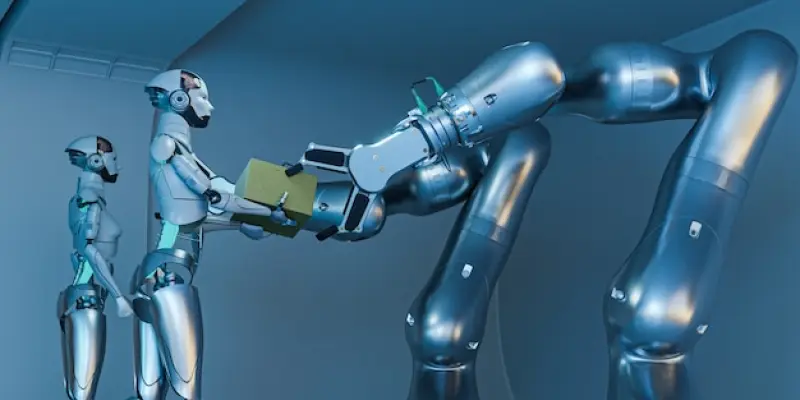
The fast-paced evolution of technology has ushered in a new era of industrial automation, sparking significant interest and discussion about cobots, or collaborative robots. Cobots are transforming industries by offering a flexible, cost-effective, and user-friendly alternative to traditional industrial robotics. Unlike their larger, more imposing predecessors, these sophisticated robotic arms are designed to work seamlessly alongside human operators, broadening the scope of automation to sectors and businesses previously constrained by budget and safety concerns. As organizations seek to maximize efficiency and productivity, cobots have emerged as pivotal players in this progressive shift toward automation. Their ability to collaborate closely with human workers while ensuring safety has placed them at the forefront of technological advancements, positioning them as a cornerstone of modern industrial practices.
The Rise and Functionality of Cobots
Initially developed in the mid-1990s and commercialized around a decade later, cobots have steadily ascended to become essential components of industrial operations worldwide. Their core innovation lies in their design, which prioritizes safety through features like sensors and advanced software that halt the cobot’s movements if any unexpected contact occurs. This approach allows them to operate without the heavy protective barriers that traditional robots require, facilitating harmonious integration into workspaces. Over the years, cobots have proved their versatility in industries ranging from electronics to pharmaceuticals, handling tasks such as assembly, packaging, gluing, and welding with remarkable precision and efficiency. As the market matures, the ability of cobots to switch between various tasks with minimal reprogramming continues to be a driving force behind their widespread appeal, enhancing productivity without necessitating extensive technical resources. Furthermore, cobots have emerged as enablers of democratized automation by lowering both financial and operational entry barriers for small and medium enterprises (SMEs). Their user-friendly interfaces, often featuring intuitive touchscreen controls, allow operators to guide tasks without extensive training or programming expertise. Such accessibility encourages even the smallest enterprises to incorporate cobots into their operations, promoting innovation and increasing competitiveness across diverse markets. As more businesses witness the transformative impact of cobots, the enthusiasm surrounding their application and potential only grows stronger. Consequently, this has catalyzed a surge in cobot adoption rates, helping SMEs bridge the gap to the automated future envisioned by industry experts a decade ago.
Market Trends and Economic Impact
The global penetration of cobots has seen exponential growth, with these collaborative robots accounting for a considerable share of all industrial robots installed. From 2025 onward, this trend is poised to continue, driven by industry demands for cost-efficiency and adaptability. The cobot market, which is already generating billions of dollars annually, is forecasted to expand at remarkable rates, buoyed by technological advancements and increased competition among manufacturers. Established players like Universal Robots and Fanuc lead this charge, but the market’s dynamic nature has also welcomed new entrants eager to capture a slice of the burgeoning industry. This competitive atmosphere fuels continuous innovation and drives down costs, making cobots financially accessible to an even larger pool of potential adopters.
The implications of this expansion extend beyond mere economic growth. By integrating cobots into their processes, businesses are realizing significant enhancements in their operational efficiency and productivity. Cobots take on monotonous, dangerous, or labor-intensive tasks that would otherwise burden human workers, empowering employees to focus on more strategic and value-added functions. This shift not only enhances job satisfaction but also potentially increases employment opportunities through business growth. The challenge of transitioning traditional workforces fully into automated settings remains, prompting companies to strike a balance between leveraging technological advancements and retaining their human touch. It is within this context that cobots serve a crucial role, effectively merging human ingenuity with robotic precision.
Challenges and Future Considerations
Cobots, first conceptualized in the mid-1990s and hitting the market a decade later, have become indispensable in industrial settings worldwide. Their standout feature is their safety-focused design. Equipped with sensors and smart software, they can stop the moment there’s unexpected contact, allowing them to work without the bulky barriers traditional robots require. This design enables seamless integration into various workspaces. Over time, cobots have showcased their adaptability in fields from electronics to pharmaceuticals, handling tasks like assembly, packaging, gluing, and welding with precision. As the market evolves, cobots’ capability to swiftly transition between tasks without extensive reprogramming amplifies their appeal, boosting productivity while minimizing the need for technical resources. Additionally, cobots are democratizing automation for small and medium enterprises (SMEs) by reducing costs and operational hurdles. Their intuitive interfaces, often controlled by touchscreens, let operators manage tasks with minimal training, encouraging even small businesses to innovate. This has led to growing enthusiasm for cobots, increasing adoption rates as SMEs move towards the automated future industry experts predicted.