

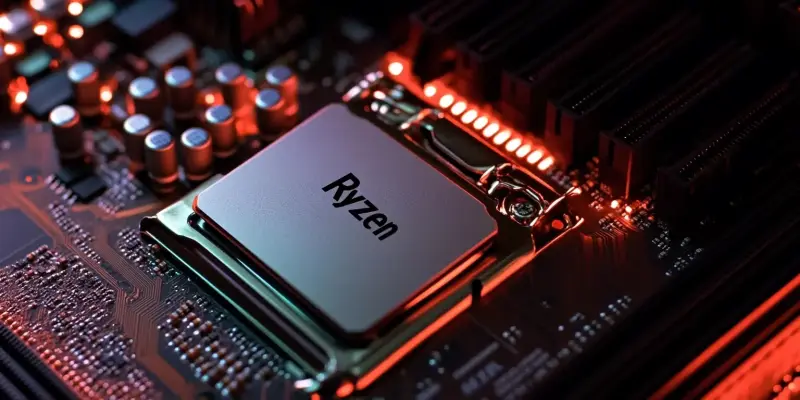
The ever-evolving landscape of gaming hardware continues to captivate enthusiasts, and AMD’s upcoming Ryzen 9950X3D is poised to be a significant contender in the market. With substantial spec upgrades like 16 cores (32 threads), a 5.7GHz boost clock, and 144MB of 3D V-Cache, AMD is setting high expectations for its new CPU. Yet, the question remains: how will this powerhouse compare to the existing Ryzen 9800X3D in terms of gaming performance and value?
Gaming Performance Analysis
Ryzen 9950X3D’s Architectural Advantages
The Ryzen 9950X3D’s imposing specifications are designed to impress. Boasting double the core count and nearly 40% more 3D V-Cache than the 9800X3D, it is clear that the 9950X3D packs a punch in raw computational power. The increase to a 5.7GHz boost clock also suggests a notable improvement in processing speed. However, gaming performance is not solely determined by these metrics. The architecture’s ability to handle the specific demands of gaming, such as multithreading and latency, is critical. In scenarios where games are optimized to utilize multiple cores and threads, the 9950X3D is expected to shine, providing smooth gameplay and reduced frame rendering times.
Despite its technical prowess, the real-world performance gains in gaming might not be as dramatic as the numbers suggest. The Ryzen 9800X3D, with its 8 cores (16 threads) and 104MB of 3D V-Cache, has already proven to be a formidable gaming CPU. The key advantage lies in its 1CCD (Core Complex Die) configuration, which helps avoid latency issues that can arise in multicore setups. Thus, while the 9950X3D might show superior performance in heavily multithreaded applications and games that can leverage its additional cores, there are instances where the 9800X3D’s streamlined architecture could edge out due to lower latency.
Real-World Gaming Scenarios
When diving into specific gaming benchmarks, the Ryzen 9950X3D is expected to offer minor improvements over the 9800X3D in many titles. The distinction between these processors becomes more apparent in games optimized for multithreading. Modern titles that efficiently utilize multiple cores and threads may see a modest boost in frame rates with the 9950X3D, leading to slightly more fluid gameplay. However, the overall difference might be marginal, often within a few frames per second, which may not be noticeable during actual gameplay.
Another factor to consider is the processor’s efficiency at handling background tasks while gaming. The 9950X3D’s additional cores provide a cushion for multitasking, such as streaming or running other applications concurrently without significantly impacting gaming performance. This is a crucial benefit for content creators who game and stream simultaneously. Conversely, the 9800X3D, despite having fewer cores, manages to sustain impressive gaming performance and handles background tasks adeptly, though with potentially higher CPU utilization. This balance of capabilities suggests that for most gamers, especially those on a budget, the 9800X3D remains a compelling option.
Value Proposition
Cost-Effectiveness in Gaming
A significant factor in the decision-making process for many gamers is cost-effectiveness. While the Ryzen 9950X3D promises high performance and superior specifications, it is also expected to come with a steeper price tag. The 9800X3D, on the other hand, offers nearly equivalent gaming performance at a more accessible price point. This distinction becomes vital for gamers focused primarily on value rather than the absolute pinnacle of performance. With gaming frame rates expected to be similar between the two CPUs, the cost savings with the 9800X3D offer a clear advantage for budget-conscious consumers.
The attention AMD is directing towards the 9800X3D’s affordability is no accident. By providing a gaming experience that rivals their top-tier models at a lower cost, AMD strengthens its market position among gamers who seek maximum value. Consequently, the Ryzen 9800X3D’s balance of price and performance allows it to capture a broader audience. For casual gamers or those with mid-range gaming setups, the 9800X3D is an attractive choice, granting near-flagship performance without the premium price.
Comprehensive Performance for Creators
While the primary focus may be gaming, it is worth acknowledging that CPUs serve multifunctional purposes, especially among users who engage in creative tasks. The Ryzen 9950X3D’s expanded capabilities extend beyond gaming, offering notable advantages in applications that demand substantial processing power. These include tasks like video editing, 3D rendering, and software development, where the additional cores and higher clock speeds translate to reduced processing times and improved workflow efficiency.
In contexts where robust multitasking and heavy computation are required, the Ryzen 9 series, exemplified by the 9950X3D and its sibling, the 9900X3D, deliver substantial value. For professional creators and power users, the investment in higher-end models pays dividends through enhanced productivity and performance in demanding applications. However, for gamers whose primary concern is achieving optimal frame rates, the practical gains offered by the 9950X3D may not justify the increased expenditure. Thus, the decision hinges on the balance between gaming needs and broader performance requirements.
Conclusion
The ever-evolving landscape of gaming hardware continues to captivate enthusiasts, and AMD’s upcoming Ryzen 9950X3D is set to be a formidable contender in the market. This new CPU boasts impressive specs, including 16 cores and 32 threads, a 5.7GHz boost clock, and a massive 144MB of 3D V-Cache, promising a significant performance boost over its predecessors. Such enhancements aim to elevate both gaming and overall computing experiences to new heights. With these high expectations, the gaming community is eagerly anticipating its release.
However, an important question remains: how will the Ryzen 9950X3D stack up against the existing Ryzen 9800X3D in terms of gaming performance and value? The Ryzen 9800X3D has already made waves in the market with its impressive capabilities, and many are curious to see whether the new model will deliver enough improvements to warrant an upgrade. AMD’s continued innovation in gaming hardware suggests that the Ryzen 9950X3D could bring about a significant shift, but only time and rigorous testing will reveal its true impact on the gaming community.