

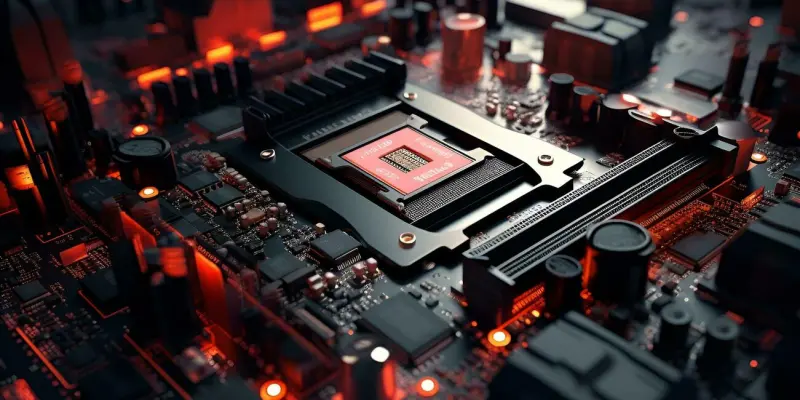
The world of high-end desktop and workstation CPUs is witnessing a transformative leap as AMD introduces the Ryzen Threadripper 9000 series, a formidable lineup designed on the Zen 5 architecture and aiming to tackle the soaring demands of artificial intelligence and high-performance computing sectors. This launch signifies a major shift in processing power and efficiency, potentially redefining industry norms. The series caters to both professional and broader markets, structured with clarity into PRO and Non-PRO categories, each tailored to specific user requirements. With notable enhancements in core count and memory support, AMD’s new offerings promise unmatched computational capabilities, designed to meet the needs of both creators and engineers.
Focusing on unparalleled performance, the Ryzen Threadripper PRO 9000 series introduces six new SKUs, led by the impressive 9995WX model. Setting new standards in CPU design, this chip extends its prowess with a staggering 96 cores and 192 threads, enabling unmatched multitasking and computing power. Codifying its superiority, the 9995WX features a boost clock speed reaching 5.45 GHz, up from a respectable 2.5 GHz base, alongside an expansive 384 MB of L3 cache. This arsenal is supported by a significant 128 PCIe Gen5 lanes, coupled with robust 8-channel DDR5-6400 memory compatibility, configuring ECC for strengthened data integrity and reliability, all sustained by a manageable 350W TDP.
Enhanced Processing Potential with PRO Models
The new Threadripper PRO series stands out, particularly for high-performance workstations requiring reliability and scalability. With a continued focus on artificial intelligence and high-performance computing, these processors are built to handle intensive tasks efficiently. The architecture’s advanced design promotes seamless execution of complex computations, simulations, and other memory-heavy applications, which are critical for sectors demanding precision and reliability. The considerable 384 MB of L3 cache ensures quick access to frequently used data, further maximizing processing efficiency in high-demand environments. As industries turn more to automation and AI, the Threadripper PRO series is positioned as an essential tool, empowering users to push the boundaries of innovation.
The series’s inclusion of a high number of PCIe Gen5 lanes facilitates enhanced connectivity and expansion, crucial for users integrating multiple graphics cards or high-speed storage devices. Eight-channel DDR5 memory ensures robust support for diverse workloads, providing users the flexibility needed to adapt to evolving technological demands. The inclusion of error-correcting code (ECC) memory highlights AMD’s focus on ensuring data integrity, reducing the risk of data corruption, which is critical in enterprise and scientific applications. Overall, the PRO lineup emphasizes not only raw power but a commitment to a seamless and secure computing experience.
Catering to Diverse Needs with Non-PRO Models
For those requiring a balance of high performance and accessibility, the standard Ryzen Threadripper 9000 series offers a compelling option. With three distinct SKUs, this category is headlined by the 64-core 9980X CPU. While this model parallels the PRO series in certain capabilities, such as achieving a boost clock speed of 5.4 GHz, it maintains a streamlined approach with a 256 MB L3 cache and supports 4-channel DDR5-6400 memory. Retaining the 350W TDP, these processors deliver substantial power without compromising efficiency for a broader spectrum of uses. Designed with the versatility needed for enthusiasts and smaller enterprises, these CPUs serve as a bridge between professional-grade and mainstream computing power.
As the Threadripper 9000 series incorporates AVX-512 instruction sets, users can experience more efficient data processing, a feature that enhances user engagement with heavy computational tasks, from video editing to 3D rendering. This compatibility caters to do-it-yourself platforms, bringing powerful processing abilities to a wider audience. The Non-PRO lineup’s strategic features make it an attractive choice for professionals and tech-savvy individuals seeking high-performance options, offering them enhanced capability without demanding the investment typically required for enterprise-level solutions.
A Strategic Leap Forward
AMD’s Ryzen Threadripper 9000 series is part of a broader strategy to capture and address the evolving needs of industries pushing for digital transformation. With initial availability beginning mid-year, AMD is ensuring these advanced offerings reach users eager to integrate cutting-edge capabilities into their operations. By providing varied packaging options, including boxed variants, AMD signals a commitment to wide accessibility, making sure these processors are available across different platforms. Although specific pricing details remain under wraps, anticipation around AMD’s strategy hints at competitive positioning within the market.
Engagement with the tech community highlights AMD’s mission to deliver hardware that not only meets but surpasses existing expectations. By segmenting between PRO and Non-PRO units, the brand delineates options to suit varied user needs, balancing performance and cost. This strategy not only broadens AMD’s appeal but also strengthens its presence in a fiercely competitive market landscape. As industry demand grows for higher core counts and processing power, AMD is equipped to lead innovations, delivering performance powerhouses primed for future challenges.
Redefining Industry Standards
The world of high-end desktop and workstation CPUs is experiencing a revolutionary change with AMD’s launch of the Ryzen Threadripper 9000 series, built on the Zen 5 architecture. This new lineup targets the increasing demands of artificial intelligence and high-performance computing, possibly transforming industry standards in processing power and efficiency. Catering to diverse users, the series divides into PRO and Non-PRO categories, tailored to specific needs. Enhanced core counts and memory support promise superior computational power, ideal for both creators and engineers.
Emphasizing extraordinary performance, the Ryzen Threadripper PRO 9000 series introduces six remarkable SKUs, headlined by the 9995WX model. This model sets unprecedented standards with its impressive 96 cores and 192 threads, providing unparalleled multitasking capabilities. Highlighting its strength, the 9995WX boasts a boost clock speed of 5.45 GHz, up from a 2.5 GHz base, and a substantial 384 MB L3 cache. Supported by 128 PCIe Gen5 lanes and robust 8-channel DDR5-6400 memory compatibility with ECC for data integrity, it operates efficiently at a 350W TDP.