

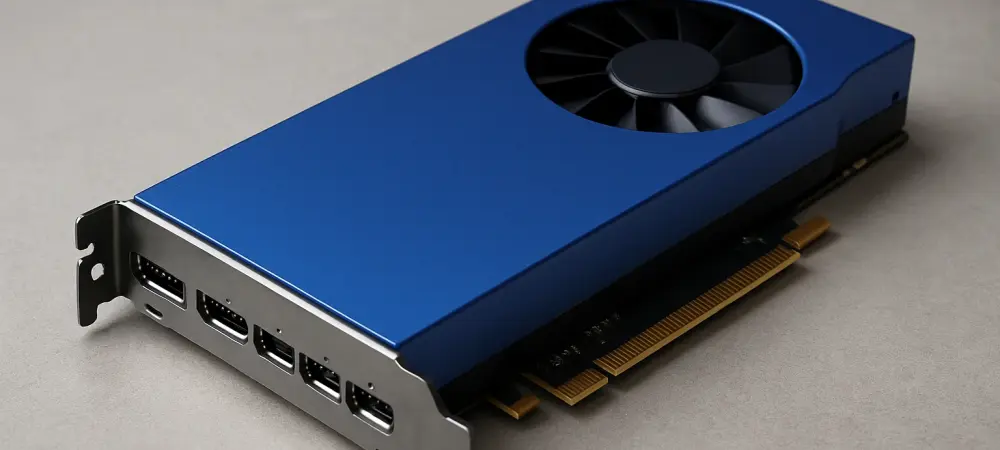
In an era where professional workloads are increasingly diverse, finding affordable yet capable hardware for entry-level workstations can be a significant challenge for many businesses and individual creators. AMD has stepped into this gap with a subtle yet strategic release of a new GPU designed specifically for budget-conscious professionals and compact system builds. This latest addition to their lineup targets a niche but critical segment of the market, offering a balance between cost, efficiency, and performance. Aimed at those who need reliable hardware without the hefty price tag or power demands of high-end models, this release signals AMD’s commitment to broadening access to professional-grade technology. As workstation needs evolve, particularly in smaller or resource-constrained environments, such a solution could prove to be a game-changer for many users seeking value without sacrificing essential functionality.
Power Efficiency and Compact Design
One of the most striking aspects of this new GPU is its remarkable focus on power efficiency, tailored for environments where energy consumption and physical space are critical considerations. With a thermal design power (TDP) of just 55W, it stands out as a highly efficient option, drawing all necessary power directly from the PCIe x16 slot without requiring an external connector. This low power draw not only reduces operational costs but also minimizes heat output, making it ideal for tight server chassis or small form factor workstations. Additionally, its single-slot design and compact length of 6.6 inches enhance compatibility with constrained setups, ensuring it fits seamlessly into environments where larger cards would be impractical. Supporting a PCIe 4.0 interface with 8 lanes, it maintains modern connectivity standards while keeping its footprint minimal. This emphasis on efficiency and size makes it a practical choice for professionals prioritizing sustainability and space optimization in their hardware selections.
Performance and Feature Set for Entry-Level Needs
While not positioned as a powerhouse, this GPU still delivers a competent feature set that meets the demands of entry-level workstation tasks with a focus on essential functionality. Built on the RDNA 3 architecture, it offers 28 Compute Units, 28 Ray Accelerators, and 56 AI Accelerators, aligning closely with higher-tier models in core specifications. However, its memory bandwidth of 172.8 GB/s, driven by a slower 10.8 Gbps GDDR6 memory speed, marks a clear distinction from more robust siblings, though it retains a solid 8GB of GDDR6 memory. Performance metrics reveal 7.9 TFLOPS of FP32 and 15.8 TFLOPS of Peak Single and Half Precision, positioning it as the least powerful in its family but sufficient for lighter workloads. Notably, support for modern video formats like AV1 encoding and decoding adds value for multimedia tasks in low-powered systems. Although pricing and availability details remain undisclosed, the blend of features and efficiency carves a niche for this GPU among budget-focused professionals seeking reliable tools for basic yet critical applications.