

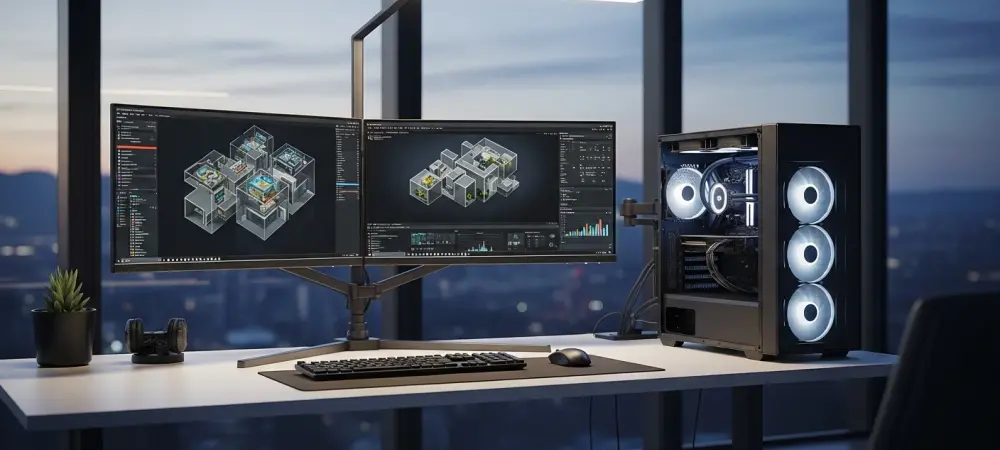
The strategic expansion of high-density vertical cache into enterprise-grade silicon signals a profound transformation in how modern workstations manage complex data pipelines. The AMD Ryzen 9 Pro 9965X3D represents a significant advancement in the professional desktop processor sector. This hardware bridges the gap between consumer hardware and high-end workstations by offering high-performance solutions for specialized environments.
Evolution of the Ryzen Pro Series and 3D V-Cache Integration
AMD shifted focus toward providing professional users with gaming-grade cache technology to benefit creative workloads. The integration of 3D V-Cache allows for massive data throughput without requiring the power draw of larger server chips. This evolution reflects a broader trend where efficiency and low latency are prioritized over simple clock speed increases.
Technical Specifications and Architectural Innovations
The 16-Core Architecture and High-Density Multiprocessing
A 16-core configuration provides a balance of parallel processing power and energy conservation. This architecture allows the system to handle multiple heavy threads simultaneously, which is essential for modern software development environments. It differs from competitors by offering this density on a standard platform rather than requiring a dedicated workstation socket.
128MB L3 Cache and the Role of 3D V-Cache Technology
The massive 128MB L3 cache serves as a high-speed buffer that significantly reduces the time cores spend waiting for data. By stacking memory vertically, AMD bypasses the physical space limitations of traditional chip designs. This implementation is particularly effective for large-scale simulations where frequent memory access often creates performance bottlenecks.
Thermal Efficiency and the 65W TDP Design
Operating at a lower thermal design power ensures that the processor remains stable during extended periods of heavy use. While enthusiast chips chase peak performance, the Pro series emphasizes longevity and reduced cooling requirements. This makes the hardware ideal for compact office setups where noise and heat management are critical considerations.
Benchmarking Performance and Industry Trends
Recent benchmarks show this chip delivers impressive single-threaded results while trailing enthusiast models by a slim margin. This slight performance delta is a deliberate trade-off for the enhanced security and stability features required by corporate environments. The industry is currently moving toward such optimized silicon that balances raw power with reliable uptime.
Practical Implementation in Professional Environments
Game designers and architectural engineers benefit most from this specific cache architecture. The technology allows for real-time rendering of complex environments that previously required much more expensive hardware. Deployment in these sectors demonstrates that massive cache integration is no longer just a luxury for gamers but a tool for productivity.
Addressing Adoption Barriers and Technical Limitations
Technical hurdles remain, such as the sensitivity of stacked cache to extreme temperatures. Furthermore, not every professional application is currently optimized to utilize such a large L3 buffer, which can limit the perceived value for some users. Ongoing development focuses on improving software scheduling to better allocate tasks to cache-heavy cores.
The Future of Workstation-Grade Computing
Looking ahead, the convergence of specialized memory and professional-grade security will likely become the standard for all enterprise computing. Potential breakthroughs in vertical stacking could lead to even larger cache pools or integrated AI accelerators. This trajectory suggests a future where hardware is increasingly tailored to specific algorithmic needs rather than general-purpose tasks.
Final Assessment of the Ryzen 9 Pro 9965X3D
The 9965X3D offered a compelling case for the integration of specialized gaming technology into the professional sphere. It demonstrated that stability and high performance could coexist within a modest power envelope. The industry moved closer to a model where efficiency defined the value of workstation hardware.