

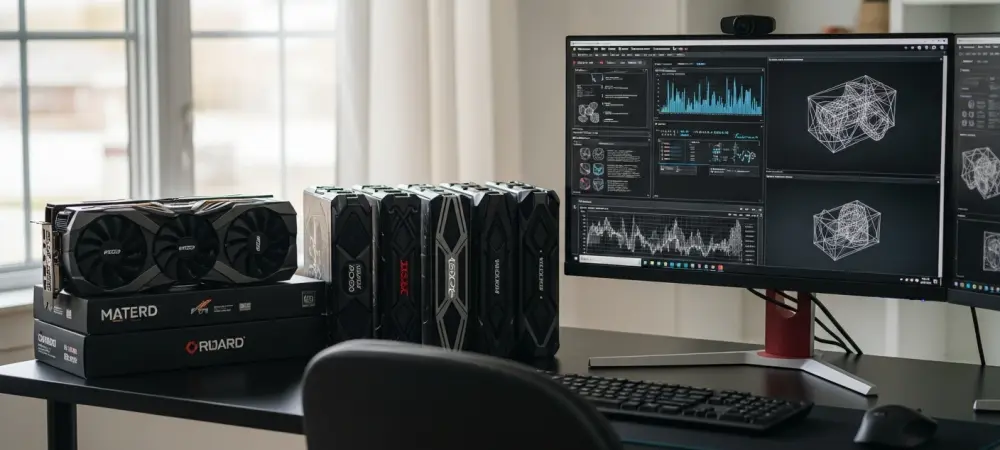
Finding a brand-new graphics card that matches the exact performance of a model released years ago is usually the hallmark of a stagnant market or a desperate inventory clearance. Approximately twelve months after its initial debut as a region-locked exclusive for the Chinese market, the AMD Radeon RX 9070 “Golden Rabbit Edition” has finally transitioned to global retail shelves, yet its arrival carries the heavy scent of a product that should have stayed in the past. Enthusiasts and hardware analysts are currently observing a launch that feels remarkably disconnected from the technological trajectory of the current year. Instead of a fresh architectural triumph, the market is being presented with a repurposed mid-range contender that struggles to justify its own existence against a predecessor that was already well-established. The “9070” nomenclature suggests a level of performance that consumers expect from modern silicon, but the reality of the hardware tells a far less inspiring story of stagnation and brand inflation.
The naming of the “Golden Rabbit Edition” serves as the first clue that this is a product out of time, as it celebrates a Chinese zodiac year that has long since passed. In a global landscape that moves at the speed of light, releasing a card with such a specific and outdated cultural tie-in suggests that AMD is primarily focused on clearing out aging inventory rather than pushing the boundaries of what gaming hardware can achieve. The $550 price tag places it in a highly competitive bracket, directly clashing with more capable offerings and even internal competition from AMD’s own superior models. This card enters the fray not as a champion of value, but as a confusing mid-range entry that seems to exist solely to bridge a price gap that was never truly a problem for informed builders. By the time this card reached international distributors, the narrative of a “new” launch had already been overshadowed by its lackluster specifications and the superior alternatives already populating the ecosystem.
For the modern gamer looking to upgrade, the RX 9070 GRE represents a frustrating detour in an otherwise promising generation of hardware releases. It asks the consumer to overlook significant compromises in memory bandwidth and raw compute power in exchange for a name that sounds more current than it actually is. The industry is currently grappling with the concept of the “sidegrade,” where a new product offers a horizontal shift in performance rather than the vertical leap expected from a generational successor. This specific release highlights a growing trend where manufacturers attempt to revitalize “worst-binned” silicon by rebranding it for a wider audience, hoping that the prestige of a higher series number will mask the technical regressions underneath. It is a product without a clear home, caught between the affordability of the entry-level and the genuine power of the high-end, failing to master either domain.
The Global Arrival of a Repurposed Mid-Range Contender
The transition of the Radeon RX 9070 GRE from a localized curiosity to a global retail product marks a peculiar moment in the current graphics card cycle. Initially designed as a specialized response to the unique market conditions in China, the “Golden Rabbit Edition” was a way for AMD to utilize specific batches of Navi silicon that didn’t meet the rigorous standards for flagship products. Bringing this card to the international stage a full year later feels less like a strategic expansion and more like a tactical inventory dump. Global retailers are now stocked with a card that was fundamentally shaped by the economic and supply chain constraints of a different era, leading to a mismatch between consumer expectations and the reality of what is being sold. This is a card that has arrived late to its own party, dressed in the finery of a “9070” label but carrying the internal scars of its cut-down architecture.
The confusion surrounding this launch is exacerbated by the sheer density of the modern GPU market, where the distinction between “good” and “good enough” is increasingly blurred. By introducing the GRE variant globally, AMD has effectively muddied its own product stack, forcing the RX 9070 GRE to compete with the very cards it was meant to supplement. For many, the choice between a year-old architecture that consistently performs and a new “sidegrade” that occasionally stutters is no choice at all. The global arrival has sparked intense debate among technical reviewers who find it difficult to recommend a card that offers no tangible benefits over existing hardware that is often found at a discount. It represents a shift in strategy toward maximizing the yield of every silicon wafer produced, even if it means saturating the market with confusingly positioned products that do little to advance the state of the art.
Furthermore, the cultural branding of the Golden Rabbit remains a strange vestige of its origins, feeling entirely out of place in a Western market that prioritizes technical specs over zodiac symbolism. While the card itself is physically competent—often featuring high-quality cooling solutions from partners like Sapphire and Gigabyte—the soul of the product remains anchored in a specific time and place. This global release highlights a lack of regional tailoring, suggesting that the primary goal was not to satisfy a specific consumer need in the global market, but to find a destination for chips that were no longer selling in their original territory. As a result, the RX 9070 GRE stands as a monument to the globalized nature of tech manufacturing, where products can be shuffled across borders to balance ledgers, regardless of whether they truly belong on the shelves of a modern PC builder.
Deciphering the Strategy Behind Recycled Silicon
At the heart of the RX 9070 GRE lies a strategic decision regarding silicon “binning,” a process where manufacturers categorize chips based on their stable operating frequencies and core counts. This card is famously built using the Navi 48 silicon, but specifically utilizing the chips that represent the lower end of the quality spectrum. These are the components that were unable to maintain the high clock speeds or full compute unit counts required to become a standard RX 9070 or the more formidable 9070 XT. Instead of discarding these less-than-perfect chips, AMD has opted to “chop them down” further, disabling parts of the silicon to ensure stability at lower performance tiers. While this is a standard industry practice to minimize waste and maximize profit, the decision to brand this specific bin as a “9070” series card pushes the boundaries of consumer transparency, as it implies a level of architectural parity with its superior siblings that simply does not exist.
This strategy of “sidegrading” allows a manufacturer to fill every conceivable price point, ensuring that no matter how much a consumer has to spend, there is a card waiting for them. By offering the GRE at $550, AMD is attempting to lure buyers who are strictly capped at that budget, even though the standard RX 9070 provides a disproportionately larger performance boost for a negligible price increase. The strategy relies heavily on the hope that average consumers will see the “9070” name and assume they are getting a nearly top-tier experience, unaware that the memory bus and compute units have been significantly hampered. It is a game of branding where the numbers on the box are used to elevate a product that technical data shows is more akin to a previous-generation mid-range card.
The move also reflects a broader industry trend where the mid-range market has become a dumping ground for older or lower-quality silicon iterations. In a market where high-end enthusiasts are willing to pay thousands for flagship power, the $500 to $600 bracket has become a battlefield of repurposed chips and clever rebranding. This strategy may help a company’s bottom line by turning what would be “e-waste” into a marketable product, but it risks eroding the trust of the core gaming audience. When a “new” card is launched that actually performs worse in specific modern titles than its predecessor, the logic of the release begins to unravel. The GRE strategy is a testament to the efficiency of modern silicon manufacturing, but it also serves as a warning that in the current hardware climate, a higher model number is no longer a guarantee of a generational leap in performance.
Architecture and Performance: A Statistical Regression
When one examines the technical specifications of the RX 9070 GRE, the architectural reductions are both stark and impactful. The card features a notable cut to 48 Compute Units, which represents a 25% deficit compared to the 64 units found in the XT variant. This reduction in core count is immediately felt in compute-heavy tasks and modern gaming engines that rely on parallel processing. Perhaps even more damaging is the move from a robust 256-bit memory bus to a restrictive 192-bit interface. This decision fundamentally limits how quickly data can move between the GPU and its memory, creating a bottleneck that becomes increasingly apparent at higher resolutions. By slashing the VRAM capacity from 16GB to 12GB, AMD has also reduced the card’s longevity, as modern AAA titles are increasingly demanding larger buffers for high-resolution textures and complex geometric data.
The performance data collected across a comprehensive 15-game testing suite reveals the harsh reality of these architectural compromises. In a direct comparison, the RX 9070 GRE averaged exactly 84 frames per second at 1440p—the identical average produced by the previous-generation RX 7900 GRE. This lack of progress is virtually unheard of for a “new” product release that is supposed to represent a step forward. Even more alarming are the specific regressions observed in modern, high-fidelity titles. In games like Crimson Desert and Starfield, the newer card actually performed 10% to 11% worse than the older model it was intended to supplement or replace. These regressions are a direct result of the reduced memory bandwidth and the smaller 48MB Infinity Cache, which struggle to keep pace with the massive data requirements of current gaming engines, leading to a “new” card that feels decidedly old.
Ray tracing performance, which has become a benchmark for modern GPU quality, provides the most significant evidence of the GRE’s limitations. In titles like Spider-Man 2, the card is up to 19% slower than its predecessor when high-end lighting effects are enabled. This “ray tracing collapse” occurs because lighting calculations are incredibly memory-intensive; once the 12GB buffer is saturated and the 192-bit bus is pushed to its limit, the frame rates plummet. While the card can still deliver a playable experience in many scenarios, it fails the fundamental test of a generational successor. It is a card that seems to be fighting against its own hardware, held back by the very cuts made to bring it to market. The statistical reality is that the RX 9070 GRE is a regression disguised as a release, offering less bandwidth, less VRAM, and lower average performance in demanding workloads than the hardware that came before it.
Expert Analysis and Technical Hurdles in the Field
Technical experts and hardware reviewers have not been kind to the RX 9070 GRE, with many characterizing the product as a “waste of time” at its current $550 MSRP. The consensus in the field is that the card occupies a no-man’s-land of value; the standard RX 9070 offers a roughly 20% performance increase for only a 9% increase in price. This creates a situation where the “GRE” suffix essentially acts as a penalty for the consumer, charging them nearly the same amount for a significantly inferior experience. Analysts have pointed out that for a product like this to be viable, it would need to be priced significantly lower—likely closer to $450—to compensate for the massive reduction in memory bandwidth and compute power. As it stands, the card is cannibalized by its own siblings, making it an illogical choice for anyone who performs even a basic cost-per-frame calculation before their purchase.
Beyond the raw numbers, the launch of the RX 9070 GRE was plagued by a variety of software instabilities and technical hurdles that made testing a nightmare for many professionals. Firsthand reports indicated that AMD’s ReLive recording software completely failed to function on standard AM5 test benches when the GRE was installed, a bug that persisted despite fresh operating system installations. Moreover, early adopters and reviewers found that the card’s core clocks were often locked, preventing traditional overclocking and limiting the ability of enthusiasts to squeeze more performance out of the Navi 48 silicon. There were also specific game-related bugs, such as Indiana Jones and the Great Circle failing to expose path-tracing settings to the card, suggesting that the hardware was not fully integrated into the existing driver ecosystem at the time of its global arrival.
Thermal and acoustic performance also varied wildly between partner models, adding another layer of complexity for the consumer. While the Sapphire Pulse variant was praised for its near-silent operation, it achieved this by running at lower clock speeds, further widening the performance gap between it and the standard RX 9070. Conversely, the Gigabyte Gaming OC model pushed the silicon harder but resulted in much higher hotspot temperatures, reaching up to 75°C under load. These discrepancies indicate a chip that is being pushed to its absolute limits just to remain competitive, leaving very little thermal or electrical headroom for the end user. The overarching expert opinion is that the RX 9070 GRE is a product born of necessity for the manufacturer rather than a desire to innovate, resulting in a hardware experience that feels unpolished and technically compromised compared to the high standards of the current generation.
A Framework for Evaluating Your Next GPU Purchase
The evaluation of the RX 9070 GRE proved to be a cautionary tale for those who ignored the fundamental mathematics of hardware value. When the market shifted toward these repurposed chips, the most successful buyers were those who performed a rigorous value-per-frame calculation instead of following brand marketing. It became clear that the $50 difference between the GRE and the standard RX 9070 represented the worst kind of false economy, as the slightly higher price of the standard model yielded a disproportionately larger return in both raw frame rates and long-term stability. The community eventually recognized that the “Golden Rabbit” was less of a prize and more of a lesson in the importance of looking past a model number to the actual architectural bones of the silicon.
Market participants who prioritized visual fidelity also found that the 12GB VRAM limit on the GRE served as a significant liability as the year progressed. As textures became more complex and resolutions higher, the bandwidth stuttering seen in the 192-bit bus variants became an unavoidable hurdle for a smooth gaming experience. Those who looked toward the remaining stock of the previous generation or invested in 16GB alternatives found themselves much better equipped for the demands of modern software. The technical regressions in ray tracing specifically highlighted why memory bandwidth remained the “Achilles’ heel” for any card attempting to push the boundaries of modern lighting effects. The smart money eventually moved toward cards that offered a more balanced approach to memory and compute, rather than those that were built from the scraps of a higher-tier production run.
Ultimately, the release of this card forced a more critical look at software stability and driver support during the initial launch window. The failure of critical features like ReLive and the presence of locked core clocks served as a reminder that “new” hardware sometimes requires a period of maturation that a “sidegrade” might never actually receive. Consumers who waited for updated driver releases and verified the resolution of path-tracing bugs before committing their capital were the ones who avoided the most significant frustrations. The framework for a successful purchase in this era involved a blend of skepticism toward rebranded silicon and a focus on the tangible metrics of memory speed and bus width. In the end, the RX 9070 GRE was remembered not as a breakthrough, but as the moment when the industry had to decide whether a name on a box was worth more than the performance on the screen.