

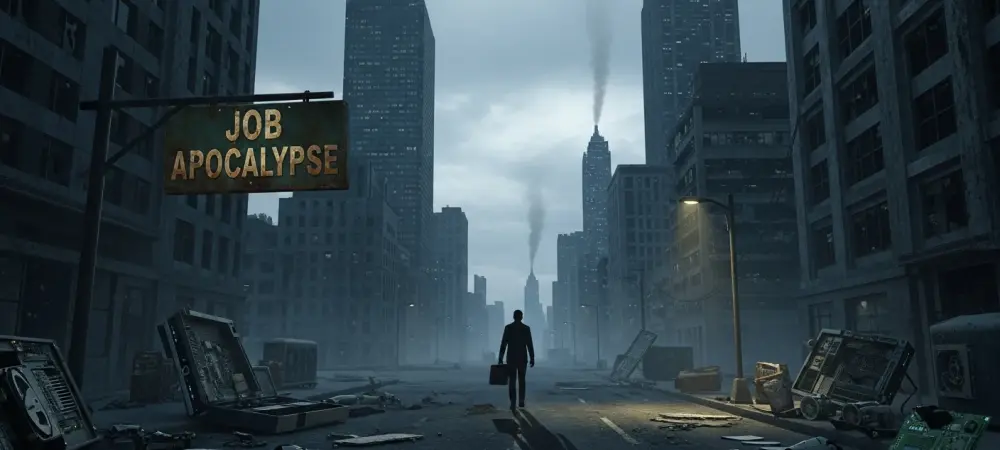
The constant and alarming drumbeat from industry leaders about an imminent, AI-driven employment catastrophe risks creating the very economic turmoil it purports to predict. A chorus of dire forecasts, predicting that millions of white-collar jobs will soon evaporate, has prompted many executives to react preemptively, basing critical business decisions on speculative future impacts rather than current realities. This cycle of fear and reaction mirrors the mechanisms that can accelerate economies toward recession, where widespread anxiety, rather than fundamental economic weakness, dictates behavior and ultimately shapes outcomes. The central question then becomes not whether artificial intelligence can automate tasks, but whether our collective response to the surrounding hype is the more immediate and tangible threat to economic stability.
Are We Talking Ourselves into an AI-Driven Recession
The narrative surrounding AI’s impact on employment is increasingly dominated by sensational predictions. High-profile figures in the technology sector have forecasted that most white-collar tasks could be fully automated within the next two years, fueling a climate of uncertainty and apprehension among business leaders. This deafening noise creates immense pressure on organizations to act decisively, often before the technology’s true capabilities and limitations are fully understood.
This environment raises a critical concern: the greatest danger may not be the technology itself, but rather the panicked, premature reactions it inspires. When executives make significant strategic moves, such as freezing hiring or initiating layoffs, based on future-facing anxieties, they contribute to a slowdown in economic activity. This preemptive caution, if adopted widely, could trigger a widespread economic downturn born not of technological displacement, but of the fear of it.
The Economics of Fear and How Prophecies Shape Reality
Economic history offers compelling parallels to the current wave of AI-related anxiety. Financial markets and broader economies are profoundly susceptible to sentiment, where a shared belief in a future outcome can directly cause that outcome to materialize. For instance, if enough people believe a bank is on the verge of collapse and withdraw their funds, their collective action can create the very insolvency they feared. The same principle applies to predictions of mass unemployment.
The cycle is dangerously simple yet powerful. When influential voices declare an impending job apocalypse, business leaders may feel compelled to preemptively halt hiring, reduce spending, and trim their workforce to prepare for a leaner future. This reduction in corporate investment and employment directly stifles economic activity and consumer demand. Consequently, the economy slows, validating the initial dire forecasts and creating a reality shaped by the prophecy itself.
Separating Hype from Happening at Work
A closer examination of AI’s current role in the workplace reveals a significant disconnect between alarming predictions and on-the-ground reality. Most layoffs attributed to artificial intelligence are occurring in anticipation of its future impact, not as a result of its present-day ability to replace human workers. A comprehensive survey of over 1,000 global executives found that a mere 2% could definitively state that job reductions were made because AI had assumed the corresponding tasks. This highlights a crucial “anticipation gap,” where actions are outpacing actual technological integration.
Despite the lack of widespread, current job replacement, the same survey revealed that 60% of executives have already initiated headcount reductions, and another 29% are hiring less in preparation for AI’s future role. This suggests that for some organizations, “AI” has become a convenient public-facing rationale for traditional, and sometimes blunt, cost-cutting measures. Furthermore, the notion of simply swapping a human for a bot oversimplifies the complexity of modern jobs. AI typically automates specific tasks, not the multifaceted roles humans perform, which involve a blend of technical skill, critical thinking, and interpersonal collaboration. A notable case study is radiology; a decade ago, predictions claimed AI would make radiologists obsolete within five years, yet today, a significant shortage of these specialists persists.
Insights from the Front Lines of Expert Analysis
Amid the public panic, a more measured perspective emerges from careful research and analysis. In their work, analysts Thomas Davenport and Laks Srinivasan present a voice of reason, pointing out that historical predictions about technology-driven job loss have consistently been overly pessimistic. They argue that forecasts regarding the volume of jobs lost and the timelines for such disruption have proven to be much slower to materialize than initially expected.
Their research underscores that organizations are not yet prepared for a wholesale transition from human to AI labor. The process of identifying which human jobs can be effectively taken over by AI is both challenging and time-consuming. Determining the true productivity impact of generative AI requires disciplined experiments and careful measurement, which few organizations have undertaken. This sober analysis suggests that the reality of AI integration is far more nuanced and gradual than the apocalyptic headlines imply.
A Strategic Pivot from Reactive Fear to Proactive Integration
Instead of reacting to fear with broad, disruptive layoffs, a more strategic and sustainable approach is available. Organizations can begin by conducting controlled experiments, testing AI in narrow and deep use cases. This allows for the accurate measurement of its impact on specific roles and overall productivity without committing to irreversible, large-scale changes. Such a methodical approach provides concrete data to guide decision-making, replacing speculation with evidence.
A practical framework for managing workforce evolution involves prioritizing natural employee attrition to adjust staffing levels over time. This incremental approach avoids the shock of mass layoffs, which often eliminates critical institutional knowledge and skilled talent that is difficult to replace. Concurrently, organizations should launch business process redesign initiatives, involving existing employees in envisioning new workflows where AI serves as an enabler. By framing the narrative internally and externally that AI is a tool for augmentation—one that frees humans from mundane work to focus on more valuable, strategic tasks—companies can foster a culture of collaboration rather than one of fear and replacement. This proactive strategy not only mitigated risk but also positioned the organization to harness the true potential of human-AI partnership.