

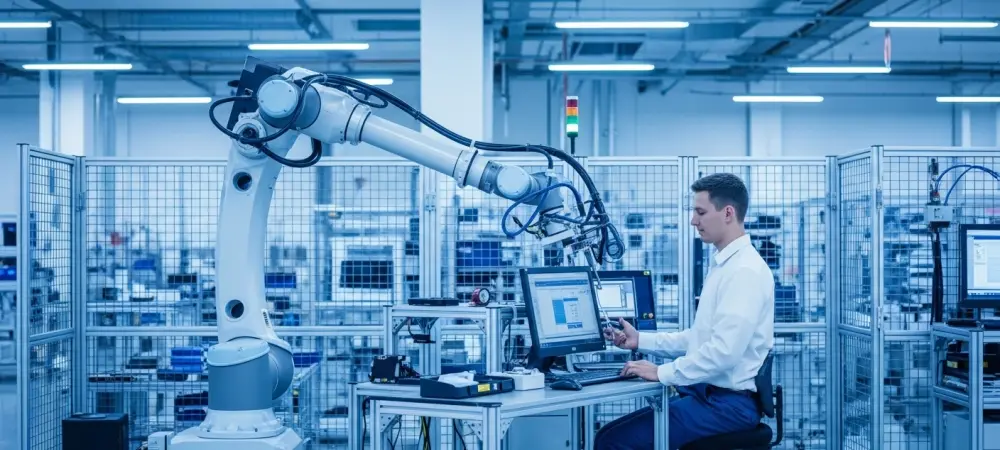
The era of the heavy industrial robot sequestered behind a high-voltage cage is rapidly fading into the history of manufacturing. Today, the factory floor is a landscape of constant motion where autonomous systems navigate the same corridors as human workers with an agility that was once considered science fiction. This transition represents more than a simple upgrade in hardware; it is the fundamental infrastructure for a Robotic Process Automation (RPA) market now valued at over $31 billion. Proactive safety is no longer a secondary feature or a compliance hurdle, but rather the essential digital awareness that allows mobile AI to function in complex, high-stakes environments. By replacing physical barriers with wireless fail-safes and context-driven intelligence, industries are unlocking a level of operational flexibility that traditional safety standards could never permit.
The Evolution of Robotic Safety Standards
Data and Market Adoption Trends
The shift from fixed automation to Autonomous Mobile Robots (AMRs) and humanoids is currently reshaping global supply chains. As we look toward 2030, market projections suggest a massive surge in the adoption of physical AI, driven by the need for systems that can handle unpredictable tasks. This movement is fueled by more than just technological capability; it is a response to increasing regulatory pressures. Stricter OSHA standards are currently forcing a modernization of industrial safety, demanding that companies move away from reactive “stop-on-contact” systems toward frameworks that prevent incidents before they occur. This regulatory climate has turned proactive safety into a competitive advantage for firms seeking to scale their robotic fleets without increasing their liability profile.
Real-World Applications and Proactive Frameworks
In the bustling logistics hubs of today, context-aware navigation has become the standard for maintaining high throughput. Modern AMRs are equipped with onboard AI that does more than just detect an object in their path; they interpret the nature of the obstacle. For instance, a robot can now distinguish between a stray pallet that requires a simple reroute and a human worker who might be moving into its trajectory. This level of discernment prevents the frequent, unnecessary system shutdowns that once plagued early automated warehouses. Furthermore, large-scale facilities have begun replacing traditional wall-mounted emergency stops with high-integrity wireless fail-safe controls, ensuring that safety oversight remains mobile and responsive, regardless of where the robot is located on the floor.
Expert Perspectives on the Safety-Productivity Paradigm
Industry leaders have spent the last few years debunking the long-standing myth that safety and productivity are at odds with one another. In fact, the emerging consensus suggests that a “safety vs. productivity” trade-off is a false dichotomy that only exists in outdated, reactive systems. Experts now argue that “conscious decision-making” within robotic intelligence is the only way to achieve true efficiency. When a machine understands its surroundings, it can maintain its momentum by making subtle speed adjustments rather than triggering a hard stop. This intelligent modulation keeps the workflow fluid, proving that the most productive robots are often the ones that possess the highest degree of safety-oriented environmental awareness.
Maintaining operational resilience is another critical focus for distributed intelligence. In high-density industrial environments, sensor degradation is an inevitable reality—lenses get dusty, and lighting conditions change throughout the day. Leading roboticists emphasize that a proactive safety framework must be resilient enough to handle these sub-optimal conditions without paralyzing the entire facility. By synthesizing data from multiple local sensors and remote cloud-based inputs, modern systems can continue to operate safely even when a single data point is compromised. This distributed approach ensures that the “brain” of the operation is never single-handedly defeated by a minor hardware glitch or a dirty sensor.
The Future of Human-Robot Collaboration
As we look toward the next stage of industrial development, the role of digital twins and high-fidelity simulations will become even more pronounced. These virtual environments allow engineers to stress-test “corner case” safety scenarios—rare, high-risk events that are too dangerous or expensive to replicate in a physical warehouse. By training AI in a digital sandbox, developers can refine proactive safety protocols until they are near-perfect before the robot ever touches a factory floor. This simulation-first approach is rapidly becoming a non-negotiable step in the deployment of mobile AI, ensuring that every movement is backed by millions of hours of virtual experience.
The long-term implications of these advancements point toward a world where decentralized control systems and high-integrity safety communication are the backbone of all industrial labor. We are moving toward a reality where the interaction between humans and machines is governed by invisible, digital boundaries that are far more effective than any steel cage. This shift ensures that as robotics become more autonomous and physically capable, the safety of the human workforce remains anchored in data-centric frameworks. Proactive safety has evolved into an enabler of growth, providing the trust necessary for humans to work alongside increasingly powerful AI without hesitation.
Moving forward, the focus must shift toward the universal standardization of these proactive communication protocols. Organizations should prioritize the integration of decentralized safety logic that can communicate across different brands of robotic hardware, creating a unified safety ecosystem within the workspace. Investing in “safety-as-code” will allow facilities to update their protection measures as quickly as they update their operational software. By treating digital awareness as a dynamic asset rather than a static rulebook, the industrial sector has successfully bridged the gap between human intuition and machine precision. This transition ensured that worker well-being remained the primary driver of the data-centric economy, setting a new benchmark for how technology serves humanity in high-risk environments.