

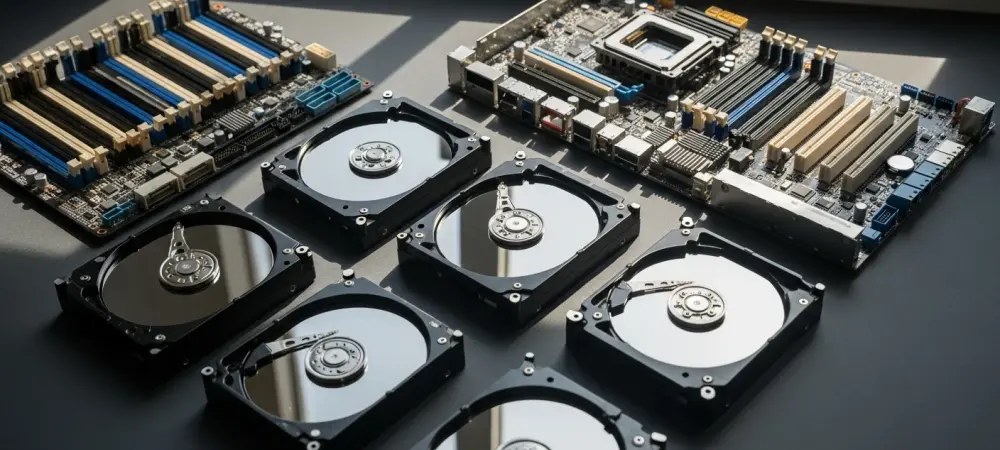
The rapid expansion of specialized artificial intelligence infrastructure is fundamentally reshaping the global landscape of data storage requirements as we approach the end of the current decade. Since the start of 2026, the industry has witnessed a profound shift where general-purpose compute facilities are being replaced by high-density clusters designed specifically for large language models and generative media. This evolution has created an insatiable appetite for storage capacity that can keep pace with the massive datasets required for both initial training and ongoing inference. Analysts now observe that the demand for high-capacity hard disk drives is on a trajectory to triple by 2030, driven by the realization that solid-state technology remains cost-prohibitive for the sheer scale of archival data needed. Consequently, data center architects are prioritizing a tiered storage approach where mechanical drives provide the essential backbone for massive data lakes. This resurgence highlights that intelligence is built on accessible storage.
The Infrastructure Transition: Scaling for Intelligence
Rising Demands of Deep Learning Repositories
Building on this foundation, the requirements of deep learning repositories necessitated a rethink of information management across the modern enterprise. Training a single state-of-the-art model involves processing trillions of tokens, requiring repositories that span multiple petabytes and remain online for constant refinement. Furthermore, the trend toward multimodal AI—integrating video, high-resolution imagery, and sensor data—has expanded the footprint of these datasets. While high-speed flash storage is used for the active computation phase, the majority of the data life cycle resides on mechanical media. This ensures that massive volumes of raw input and historical checkpoints are preserved without overwhelming the operational budget. This approach naturally leads to a scenario where the efficiency of the storage layer is measured by its ability to scale horizontally. As organizations integrate these models into operations, the reliability of high-density hard drives becomes the primary safeguard for the digital assets that define a modern competitive advantage.
Strategic Integration of High-Density Storage
To address these challenges, the adoption of Heat-Assisted Magnetic Recording emerged as a pivotal solution for increasing density without expanding the physical footprint of the server rack. Engineers successfully pushed the limits of physics to provide thirty-terabyte drives that maintained necessary thermal profiles for dense environments. Strategic planning for these requirements focused on the implementation of software-defined storage architectures that allowed for seamless integration of new hardware. This transition emphasized the need for standardized protocols that could manage the massive throughput generated by AI-driven analytics. Organizations that prioritized long-term storage viability secured their infrastructure against the volatility of the components market and ensured that their data remained a liquid asset. Ultimately, the successful management of this storage surge depended on a balanced investment in mechanical engineering and robust data governance. These steps provided a clear roadmap for sustaining the growth of autonomous systems while managing costs.