

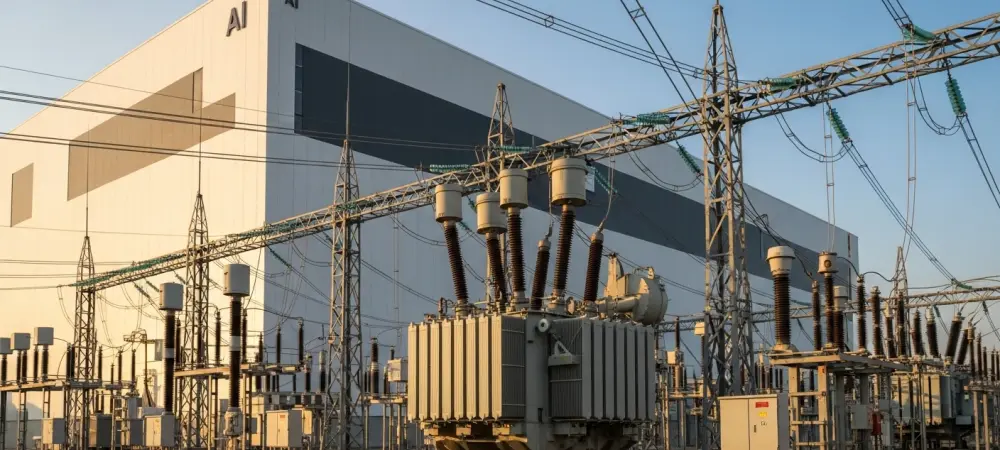
The unprecedented speed of the generative AI revolution has transformed the quiet, predictable landscape of digital infrastructure into a high-stakes arena where physics and economics collide at the gigawatt scale. This fundamental transition is moving the industry away from general-purpose enterprise datacenters toward specialized facilities now known as AI factories. The shift is necessitated by the emergence of Large Language Models (LLMs) and the specialized hardware required to train them, such as high-performance Graphics Processing Units (GPUs) that demand far more than traditional compute environments can provide.
Central to this transformation is a concept often described as the grid calculus, a complex balancing act where utility infrastructure must now account for individual power loads comparable to those of entire cities. For instance, the Terawulf site on Lake Ontario represents this new era of scale, pushing the boundaries of what local grids can support. Organizations like the Electric Power Research Institute (EPRI) have noted that this evolution marks the end of linear growth models. While traditional datacenters supported steady cloud computing and enterprise applications, AI factories serve a much more aggressive purpose, requiring a total reconsideration of power delivery, heat management, and financial risk.
The legacy model of digital infrastructure relied on a predictable relationship between software iterations and hardware deployment. However, the sheer intensity of generative AI training has forced a decoupling from these old standards. Traditional sites were designed for stability and consistent uptime for various light-duty tasks. In contrast, the AI factory is a singular, high-performance machine where every component is optimized for the massive throughput required by modern neural networks. This specialized architecture is the only way to sustain the computational yield necessary for the current technological landscape, effectively ending the era of one-size-fits-all server hosting.
The Evolution of Digital Infrastructure: From Traditional Sites to AI Factories
Transitioning from a standard enterprise facility to an AI factory involves moving from a general-purpose utility mindset toward a specialized industrial one. In the traditional model, a datacenter acted as a landlord for various tenants, each running disparate applications with relatively low power density. These environments were built to accommodate a wide variety of hardware, but they were never intended to house thousands of interconnected GPUs operating at peak capacity simultaneously. The shift toward AI factories represents a recognition that the computational requirements of LLMs are so distinct that they require a dedicated, ground-up architectural philosophy.
This evolution is defined by the massive scale of the hardware clusters and the organizations supporting them. Companies are no longer looking for space and power in 10-megawatt increments; they are seeking locations that can provide hundreds of megawatts, or even gigawatts, of capacity. The Terawulf facility exemplifies this trend, utilizing large-scale power access to fuel massive clusters of NVIDIA or AMD processors. As EPRI researchers have pointed out, the utility infrastructure of the past is simply not equipped for these city-sized loads, creating a new set of challenges for grid operators who must now plan for unprecedented spikes in demand.
Furthermore, the purpose of these facilities has shifted from passive storage and retrieval to active manufacturing. A traditional datacenter manages steady-state cloud apps, where the primary goal is ensuring that a website or database remains accessible. An AI factory, however, is a production line where electricity is the raw material and data tokens are the finished product. This industrialization of compute changes everything from the physical layout of the racks to the financial models used to justify the investment. The goal is no longer just “uptime” but “computational yield,” a metric that measures how effectively the facility can turn power into intelligence.
Comparative Breakdown of Infrastructure and Operational Efficiency
Power Architecture and Grid Interconnection Timelines
When comparing traditional facilities to AI factories, the most striking difference is the sheer magnitude of power required. A typical enterprise datacenter historically operated within a range of 5MW to 100MW, a load that most regional utility substations could handle with standard equipment. Modern AI clusters, however, are pushing into the gigawatt-scale, creating a massive operational mismatch. While a traditional site could often become functional within a two-year window, the wait for high-capacity grid interconnection for an AI factory has stretched to seven or even ten years in some regions.
This delay is a result of the grid’s inability to scale at the speed of silicon. While AI hardware cycles evolve in months, the copper and concrete infrastructure of the electrical grid requires a decade to plan and construct. This timing mismatch has forced utility providers to abandon their old long-term planning frameworks. Now, load forecasts are being revised almost monthly to account for the unpredictable demands of AI developers. The grid has essentially become the primary gatekeeper of the technological revolution, and its slow pace of expansion is the industry’s most significant bottleneck.
The nature of the electrical load itself also differs significantly between these two types of facilities. Traditional cloud applications draw power in a relatively steady and predictable manner based on user traffic. AI training workloads, conversely, exhibit a pulsing phenomenon. During training cycles, thousands of GPUs draw massive amounts of power simultaneously, only to have that load drop off a cliff when a cycle finishes or a checkpoint is synchronized. These violent swings in demand can destabilize local utility substations, requiring the development of localized buffer systems and creative flexibility partnerships that were never necessary for standard enterprise datacenters.
Cooling Methodologies: Evaporative Air vs. Direct-to-Chip Liquid
As the power density of server racks increases, traditional air-cooling systems are reaching their physical limits. Legacy datacenters rely on massive fans and evaporative water systems to pull heat away from the hardware. While this was sufficient for older server generations, it is woefully inadequate for modern GPUs, which generate intense, concentrated heat. To combat this, AI factories are moving toward direct-to-chip liquid cooling. This method utilizes copper cold plates mounted directly onto the silicon, with liquid coolant circulating in a closed loop to carry heat away more efficiently than air ever could.
This technical shift offers a surprising environmental benefit that debunks the narrative of datacenters as “hydrological vampires.” Traditional air-cooling systems often rely on evaporation, which consumes vast quantities of water to keep the facility at an operational temperature. In contrast, the direct-to-chip liquid systems used in AI factories are typically closed-loop, meaning the water or coolant remains within the pipes. By using “dry coolers” or outdoor radiators, these facilities can reject heat into the atmosphere without constant water consumption. This transition is leading the industry toward a near-zero water usage model, even as power demands continue to climb.
The move to liquid cooling also allows for much higher rack densities, which is essential for the low-latency communication required between GPUs in a training cluster. In a traditional air-cooled room, servers must be spaced out to allow for airflow, increasing the physical footprint of the facility. Liquid cooling allows the hardware to be packed tightly together, reducing the distance data must travel and improving the overall performance of the LLM training. This shift from air to liquid is not just a preference but a mandatory requirement for any facility aiming to support the next generation of high-density AI workloads.
Performance Metrics: Power Usage Effectiveness vs. Tokens per Watt
For nearly two decades, the gold standard for measuring datacenter efficiency was Power Usage Effectiveness (PUE), a ratio of the total power entering the building compared to the power delivered to the IT equipment. While PUE remains a useful measure of facility efficiency, it is increasingly viewed as an incomplete metric for AI factories. In the new era, the focus has shifted toward application-layer productivity. Success is now measured in “tokens per watt” or the “cost per token,” metrics that more accurately reflect the revenue-generating potential of the electricity being consumed.
This shift in metrics highlights the importance of preventing thermal throttling, a phenomenon where a GPU automatically slows its clock speed to protect itself from overheating. In a traditional datacenter, a slight increase in temperature might only result in a minor loss of efficiency. However, in an AI factory, thermal throttling causes token production to drop precipitously while the chips continue to draw significant power. By maintaining stable, optimal temperatures through liquid cooling, these facilities ensure that every watt of electricity is utilized to its maximum potential, preventing the waste of expensive computational cycles.
Ultimately, the AI factory model treats electricity as a direct raw material for revenue generation rather than just an operational expense. In a traditional cloud environment, power is a necessary cost to keep the lights on and the servers running. For an AI developer, however, power is the primary input that determines how many tokens their model can produce in a given day. This change in perspective is driving a obsession with computational yield, forcing facility operators to optimize every part of the physical stack to ensure that no energy is lost to heat-related bottlenecks or inefficient power distribution.
Critical Challenges and Limitations in Gigawatt-Scale Operations
The most daunting challenge facing the industry is the fundamental timing mismatch between hardware innovation and grid infrastructure. While AI developers can iterate on new model architectures or GPU designs in less than a year, building the transmission lines and substations needed to power these innovations takes a decade. This creates a scenario where the most advanced AI hardware is often ready to be deployed long before there is a place to plug it in. This bottleneck has led to a desperate search for alternative energy solutions that can bypass the slow-moving public utility sector.
To solve this, some companies are exploring the creation of “behind the meter” energy islands, where power generation is located on-site and decoupled from the public grid. One of the more surprising developments in this space is the massive revival of natural gas turbines. With a seven-year backlog for standard turbines and roughly 100GW of capacity currently on order, tech firms are turning to “aeroderivative” engines—essentially modified jet engines—to provide immediate power. While these solutions offer a way to get facilities online faster, they carry significant risks, including high capital costs and the potential for a “shadow grid” that undermines global carbon goals.
There is also the looming concern of “stranded assets.” Public utilities are often hesitant to invest billions in infrastructure for an AI factory if they fear the developer might move to a different region or change their hardware strategy in a few years. This regulatory hurdle creates a standoff where neither the utility nor the tech firm wants to bear the full financial risk of new construction. Furthermore, while Small Modular Reactors (SMRs) are often hailed as a long-term solution for carbon-free, high-density power, their commercial timelines remain unproven, and they are currently hamstrung by massive upfront costs and regulatory complexity.
Strategic Recommendations for Infrastructure Selection and Integration
Choosing the right infrastructure requires a clear understanding of the specific workload. Traditional datacenters remain perfectly suitable for standard enterprise applications, such as hosting websites, managing databases, and running internal business software. These facilities offer a lower-cost, lower-complexity environment for tasks that do not require high-density GPU clusters. However, for organizations involved in Large Language Model training or high-intensity generative AI, an AI factory is mandatory. Attempting to run modern AI workloads in a legacy environment will almost certainly lead to thermal bottlenecks, inefficient power usage, and significantly higher costs per token.
A successful transition to AI-scale operations also requires a new economic approach to utility partnerships. The “shared risk” model is emerging as the most viable path forward, where tech firms and public utilities co-invest in the transmission lines and localized buffer systems necessary to support gigawatt-scale loads. This collaborative approach ensures that the infrastructure is built in a way that benefits both the developer and the broader community, preventing the financial inefficiency of isolated “energy islands.” By providing upfront capital or long-term guarantees, AI developers can secure the power they need while helping utilities modernize the grid for everyone.
Maximizing success in this next era will ultimately depend on optimizing for tokens per watt. Facility operators must move beyond simple PUE measurements and look at how effectively their cooling and power delivery systems support peak GPU performance. This means prioritizing direct-to-chip liquid cooling and investigating on-site, dispatchable power generation to manage the “pulsing” nature of AI training. Those who treat power as a raw material and design their facilities as specialized manufacturing plants will be the ones who define the future of the digital economy, while those who cling to traditional datacenter models may find themselves unable to compete.
In the end, stakeholders recognized that the old ways of isolated planning failed to meet the moment. The transition from general-purpose datacenters to specialized AI factories was seen as an inevitable response to the laws of physics and the demands of generative AI. By moving toward liquid cooling and city-scale power architectures, the industry addressed the immediate cooling and energy constraints that once threatened to stall progress. Developers who embraced the shift toward “tokens per watt” successfully transformed electricity into a high-value asset, while those who remained tethered to legacy infrastructure struggled with thermal limits and soaring operational costs. The collaborative models established between tech firms and utilities provided the necessary foundation for a more resilient and high-performing digital landscape. This period of infrastructure evolution proved that the future of intelligence depended as much on copper and coolant as it did on code and silicon. Success was achieved by those who viewed the facility not as a building, but as a primary component of the AI model itself. Through these strategic shifts, the industry moved from a focus on simple facility uptime toward a more sophisticated era of application-layer productivity. Thus, the era of the AI factory was firmly established as the cornerstone of the global digital economy.