

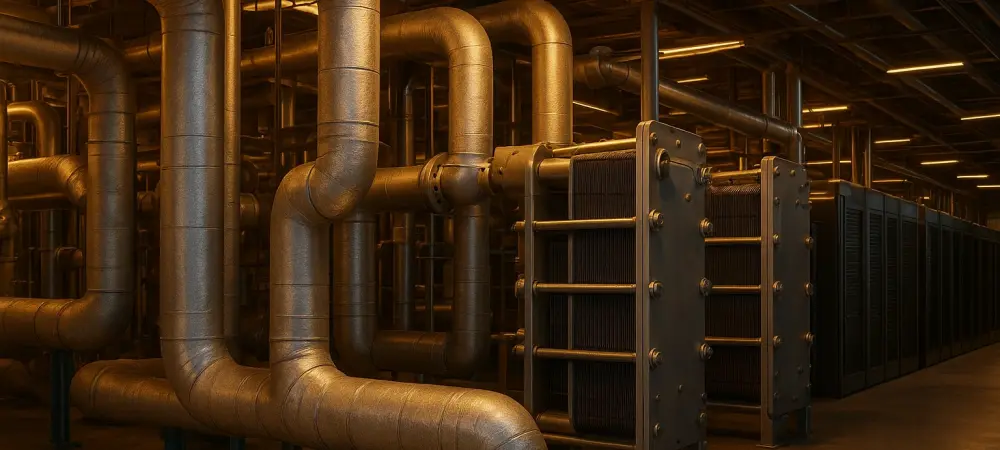
The relentless thermal demands of artificial intelligence are pushing traditional air cooling toward obsolescence, forcing a radical rethink of how we sustain massive compute loads without depleting local water supplies. This review explores the critical transition to advanced liquid systems that manage the intense power density inherent in modern GPU clusters.
As digital infrastructure evolves, the focus has shifted from mere heat rejection to integrated resource recovery. This development represents a significant leap in maintaining hardware stability while addressing the environmental costs of the global AI expansion.
Evolution of Thermal Management in High-Density Computing
Transitioning from air to liquid is no longer an optional upgrade as AI power density continues to skyrocket. This shift necessitates hardware originally perfected in the competitive world of cryptocurrency mining, where efficiency determines survival.
Repurposing this infrastructure allows firms to manage the extreme heat produced by dense compute environments. By adapting these legacy systems, operators can significantly reduce energy overhead while maintaining peak performance in power-dense racks.
Core Technologies: Integrated Infrastructure
Advanced Liquid Cooling and Heat Rejection Systems
Integrated liquid systems move heat away from processors with surgical precision, supporting loads ranging from 60kW to 2MW. This granularity ensures that even the most demanding high-performance setups remain thermally stable under continuous operation.
This technology offers a more efficient energy transfer than air-based alternatives. Such precision is vital for training large language models, which generate a volume of heat that traditional fans simply cannot dissipate.
Atmospheric Water Generation and Resource Recovery
The true innovation lies in using metal-organic frameworks to harvest water particles directly from the waste heat servers discard. This process effectively transforms a problematic waste product into a valuable cooling resource. This capability allows data centers to operate in arid regions without straining limited municipal water lines. It clearly differentiates this technology from competitors who rely on closed-loop systems that still require external water makeup.
Emerging Trends in Sustainable AI Infrastructure
We are seeing a pivot toward water-neutral designs where the ecological footprint is as critical as processing speed. This convergence of cooling and atmospheric generation represents a major shift toward active resource recovery.
This trend reflects a broader industrial movement where digital infrastructure must justify its resource consumption through circular engineering. Data centers are becoming sophisticated systems that contribute to their local environments rather than just draining them.
Real-World Applications: Industrial Deployment
Major projects like the 600MW Nexus Data Center illustrate the impressive scalability of this approach. These campuses serve as proof that energy-intensive processing can coexist with ecological health on a global industrial scale.
Specialized electrical switchgear is employed to manage these enormous compute loads, bridging the gap between raw power and thermal stability. These deployments demonstrate that liquid-based cooling is now ready for massive, campus-wide implementation.
Technical Obstacles: Market Adoption Challenges
Despite the technical promise, the high initial capital expenditure remains a significant barrier for many developers. Scaling liquid cooling to hundreds of megawatts involves complex maintenance risks that traditional operators are often hesitant to embrace.
Furthermore, regulatory bodies are increasingly scrutinizing the energy overhead required to run recovery systems. Balancing the power needed for atmospheric water generation with the demands of AI workloads remains a delicate engineering challenge.
The Future Trajectory of Data Center Cooling
Future development will focus on fully autonomous cooling loops that require almost zero external intervention. Material science breakthroughs from 2026 to 2028 are expected to make metal-organic frameworks more efficient at capturing moisture. The ultimate goal is a self-sustaining ecosystem where the data center functions as a net contributor to local resources. These advancements will likely integrate cooling directly into the global energy grid as a heat-recovery utility.
Final Assessment: Strategic Outlook
The strategic merger of moisture-capture technology and industrial cooling provided a compelling answer to the most pressing sustainability questions. This integration proved that thermal management could successfully evolve into a productive utility rather than a simple cost center. Analysts viewed the move toward resource-recovery cooling as a necessary standard for the next decade of infrastructure. This transition ensured that high-density computing remained viable in an increasingly water-stressed world.