

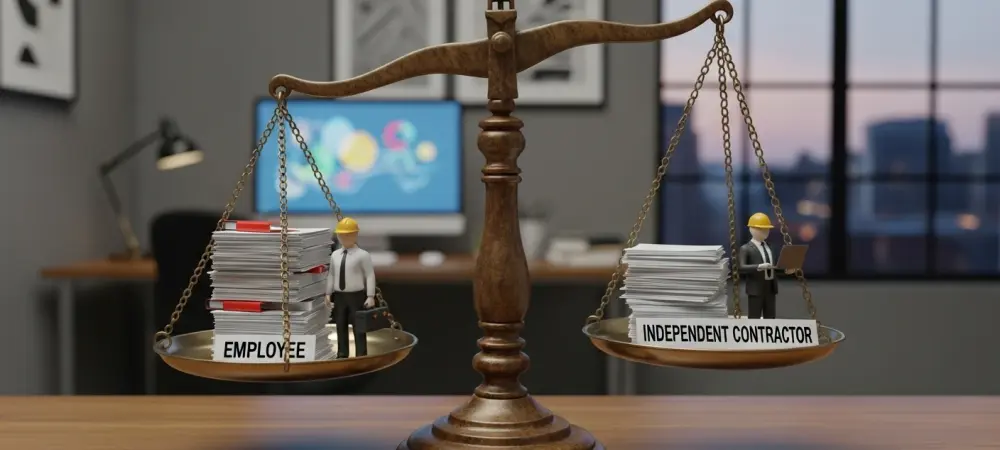
The line between an employee and an independent contractor has become one of the most fiercely contested battlegrounds in the modern American economy, a dividing line that shifts with the political winds and leaves millions of workers and businesses in a state of persistent uncertainty. This classification is far from a simple administrative detail; it determines access to fundamental protections like minimum wage and overtime, shapes the operational costs for entire industries, and defines the very nature of work in the gig economy. The following analysis dissects the recent regulatory whiplash under different presidential administrations, compares the competing legal frameworks, and examines the future trajectory of this critical issue.
The Shifting Landscape of Worker Classification
The Regulatory Pendulum a Timeline of Recent Changes
The recent history of worker classification is best understood as a pendulum swinging between competing philosophies. The first Trump administration aimed to provide a clearer, more streamlined test, finalizing its “economic reality” rule in January 2021. This standard was designed to offer businesses greater predictability by focusing on two primary factors. However, its tenure was short-lived, as the incoming Biden administration moved swiftly to reverse course.
Following a delay and formal rescission of the Trump-era rule in 2021, the Biden Department of Labor (DOL) spent years developing a new standard. This effort culminated in a rule that took effect in March 2024, which implemented a broader “totality-of-the-circumstances” analysis. This shift was again reversed with the return of a Trump administration. In the spring of 2025, a directive was issued to halt enforcement of the Biden rule, and a new proposed rule, signaling a return to the previous administration’s principles, was formally submitted to the Office of Management and Budget for review.
Dueling Standards Defining the Modern Worker
At the heart of this policy whiplash are two fundamentally different approaches to defining a worker. The Trump administration’s “economic reality” test prioritized two “core factors”: the worker’s degree of control over their work and their opportunity for profit or loss based on initiative or investment. By giving these factors greater weight, the standard was widely viewed as more business-friendly, making it easier to classify workers as independent contractors and promoting a model of entrepreneurial flexibility. In contrast, the Biden administration’s “totality-of-the-circumstances” standard gave equal consideration to a broader range of factors, including the skill required, the permanence of the relationship, and how integral the work is to the employer’s business. This holistic analysis made it more likely for workers to be classified as employees, thus granting them protections under the Fair Labor Standards Act (FLSA). The current administration’s direction is already becoming clear; a recent May DOL opinion letter concerning virtual marketplace providers heavily referenced the concept of “economic reality,” offering a concrete example of its leanings even before a new rule is finalized.
Expert Perspectives on the Policy Whiplash
Advocates for business and industry have consistently emphasized the need for legal certainty and operational flexibility. From their perspective, the frequent regulatory changes create a difficult compliance environment, particularly for small businesses and innovative startups. Experts in this camp argue that the “economic reality” test provides a clear and predictable framework that fosters entrepreneurship. They contend that this standard allows gig economy platforms and other modern business models to thrive without being burdened by the significant costs and administrative complexities associated with traditional employment, ultimately benefiting consumers through lower prices and more accessible services.
Conversely, labor unions and worker rights groups champion the necessity of robust protections against misclassification. These experts argue that business-friendly standards like the “economic reality” test can open the door to exploitation, allowing companies to sidestep their obligations to provide minimum wage, overtime pay, and other legally mandated benefits. They posit that the broader “totality-of-the-circumstances” analysis is essential for ensuring that workers who are economically dependent on a single company receive the protections they are due. This viewpoint holds that the flexibility offered by contractor status often comes at the expense of economic security and a social safety net.
Legal and policy analysts, meanwhile, focus on the profound instability generated by this back-and-forth. The constant shifting of federal standards creates significant compliance challenges for businesses that operate across the country, forcing them to navigate a patchwork of federal and state laws that are often in conflict. This regulatory uncertainty also fuels litigation, as the boundaries of each new rule are tested in court. Analysts warn that without a more durable, bipartisan solution, both businesses and workers will remain caught in a cycle of ambiguity that stifles long-term planning and investment.
Future Outlook Navigating an Unsettled Terrain
The most probable regulatory path forward involves the finalization of a new rule that largely formalizes a return to the 2021 “economic reality” standard. Once this rule is implemented, it will almost certainly face legal challenges from labor unions and states with more stringent worker classification laws, perpetuating the cycle of litigation. This ongoing conflict raises the possibility of congressional intervention, where lawmakers could attempt to pass legislation creating a more permanent, nationwide standard to end the administrative see-saw, though such a bipartisan agreement remains a significant political challenge.
This regulatory direction has wide-ranging implications for the American economy. Industries that rely heavily on independent contractors—such as transportation, delivery services, and creative fields—may see reduced operational costs and greater flexibility. However, this could come at the cost of worker stability, as more individuals find themselves without access to employer-sponsored health insurance, retirement plans, and unemployment benefits. The long-term consequences involve a delicate trade-off between the gig economy’s promise of autonomy and the traditional protections afforded by W-2 employment.
The primary challenge remains the creation of a durable legal framework that can adapt to a rapidly evolving economic landscape. The persistent tension between federal rules and differing state-level regulations, most notably California’s stringent “ABC test,” ensures that a single federal standard will not resolve all classification disputes. As long as the definition of an employee is subject to reinterpretation with each new administration, a cloud of uncertainty will hang over a significant and growing segment of the American workforce.
Conclusion The Enduring Quest for a Modern Standard
The cyclical nature of worker classification rules exposed the deep, unresolved tensions between business innovation and worker protection in the United States. The fundamental differences between the “economic reality” and “totality-of-the-circumstances” tests highlighted fundamentally opposing views on the modern social contract. This regulatory oscillation had a profound and often destabilizing impact on the daily realities of both businesses striving for predictability and workers seeking security. The persistent debate ultimately underscored the critical need for a stable, balanced, and forward-looking standard. It left a lasting challenge for policymakers: to craft an enduring solution that could finally support both economic dynamism and worker dignity in a 21st-century economy.