

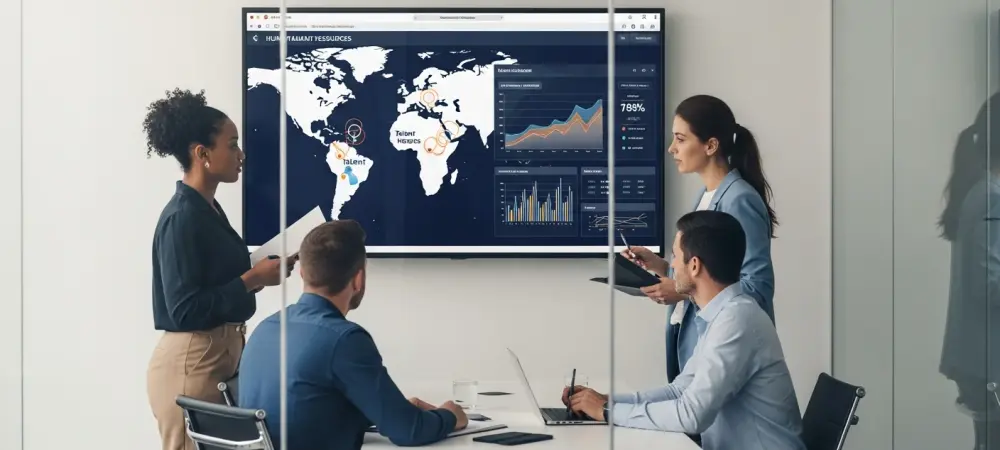
With decades of experience helping organizations navigate change through technology, HRTech expert Ling-yi Tsai has a unique perspective on the evolution of recruitment. She has seen firsthand the challenges talent teams face, from data overload to the struggle of translating metrics into actionable strategies. Today, she discusses a significant shift in the industry: the move from static, dashboard-driven reporting to a more intuitive, conversation-driven approach to analytics, exploring how AI is not just presenting data, but explaining it, forecasting outcomes, and providing the crucial context of the wider labor market.
Many recruiting teams are overwhelmed by complex dashboards. How does a conversation-driven analytics experience change the daily workflow for a talent acquisition leader, and what new insights can they uncover without needing deep data expertise?
It completely transforms the daily grind. Instead of a TA leader spending their morning wrestling with filters and multiple reports just to understand basic performance, they can now start their day with a simple, direct question like, “Why did our cost-per-application for software engineers spike last week?” The experience shifts from a frustrating data-mining expedition to a strategic conversation. This frees up an incredible amount of time, but the real magic is in the insights uncovered. For instance, the AI might reveal that the spike wasn’t due to a single source failing, but a competitor launching a major hiring campaign in the same region, an insight that would have taken hours of cross-referencing to discover manually. It’s about getting to the “why” in seconds, not hours.
Traditional analytics often show what happened but not why. Could you provide a concrete example of how the AI agent explains a change, like a sudden rise in cost-per-application, and then recommends a clear, actionable step to improve ROI?
Absolutely. Imagine a recruiter sees their cost-per-application has jumped. A traditional dashboard would just show the number, leaving them to guess the cause. An AI agent, however, digests all the underlying data and explains, “Your cost-per-application increased because your top-performing source for this role experienced a 30% drop in candidate supply last week, while demand in the market simultaneously increased.” This immediately clarifies the problem. Then, it moves to a solution, recommending a tangible action like, “To improve your ROI, I recommend reallocating 15% of your budget from the underperforming source to two emerging platforms where talent supply is currently high and competition is lower.” It provides not just the diagnosis but the prescription, turning a moment of panic into a clear, confident decision.
Integrating real-world labor market data seems critical. Can you explain how this external context helps a recruiter better understand their own campaign performance and make more informed decisions?
This external context is a complete game-changer because it stops teams from analyzing their performance in a vacuum. Your campaign might be underperforming, but without market data, you don’t know if it’s your strategy that’s flawed or if you’re fighting an uphill battle against immense market pressure. For example, a recruiter might be frustrated with a low volume of applicants for a nursing role in Denver. The AI, by integrating labor market intelligence, can show them that local demand for nurses has skyrocketed while the available candidate supply has dwindled. Suddenly, the recruiter understands they aren’t failing; they’re competing in an incredibly tough market. This insight allows them to pivot from just spending more to having a strategic conversation with hiring managers about adjusting salary benchmarks or offering remote work options to attract talent from other regions.
The ability to model “what if” scenarios is powerful for budget planning. Can you walk us through how a manager might use this predictive feature to test a new campaign strategy before committing spend and what key metrics they would monitor?
This is where analytics becomes a strategic partner rather than a rearview mirror. A hiring manager planning for a new quarter could use a predictive feature to ask, “What if we increase our budget for engineering roles by 20% and focus our spend on the West Coast?” The system would then model a forecast based on historical performance and current market data. The manager would closely monitor projected metrics like the expected number of qualified applicants, the forecasted cost-per-hire, and the time-to-fill for those roles. They could even test a second scenario, like keeping the budget flat but reallocating it to different sources, and compare the two predicted outcomes side-by-side. This allows them to make a data-backed decision and build a business case for their budget before a single dollar is spent, dramatically reducing financial risk.
Bringing all talent source and hiring funnel metrics into one place aims to create a single source of truth. How does this consolidation solve the problem of inconsistent reporting, and what is the first tangible benefit a team typically sees?
The problem of inconsistent reporting is a silent killer of efficiency. One recruiter pulls a report from a job board, another from the ATS, and a manager looks at a spreadsheet—all telling slightly different stories. It creates confusion and erodes trust in the data. Consolidating everything into one platform ensures everyone is looking at the exact same numbers, from the initial click on a job ad all the way to the final hire. The first tangible benefit teams almost always see is the incredible time savings. The weekly scramble to manually compile and reconcile performance reports disappears overnight. This newfound time allows the team to shift their focus from arguing about which report is correct to strategizing on how to act on the unified data in front of them.
What is your forecast for the future of AI-driven talent intelligence?
I believe we’re on the cusp of AI becoming a true, proactive strategic partner in talent acquisition, not just a reactive tool. In the near future, AI won’t just wait for you to ask a question. It will proactively alert you to opportunities and threats before they become obvious. Imagine your system sending you a message saying, “We’ve detected a significant drop in competitor hiring for data scientists in Austin, and candidate supply is rising. Now is an optimal time to launch a campaign to capture top talent.” It will evolve from an analyst you consult into a vigilant co-pilot that constantly scans the horizon, guiding your strategy, optimizing your spend in real-time, and ensuring you are always one step ahead of the market. The focus will shift entirely from data interpretation to strategic action.