

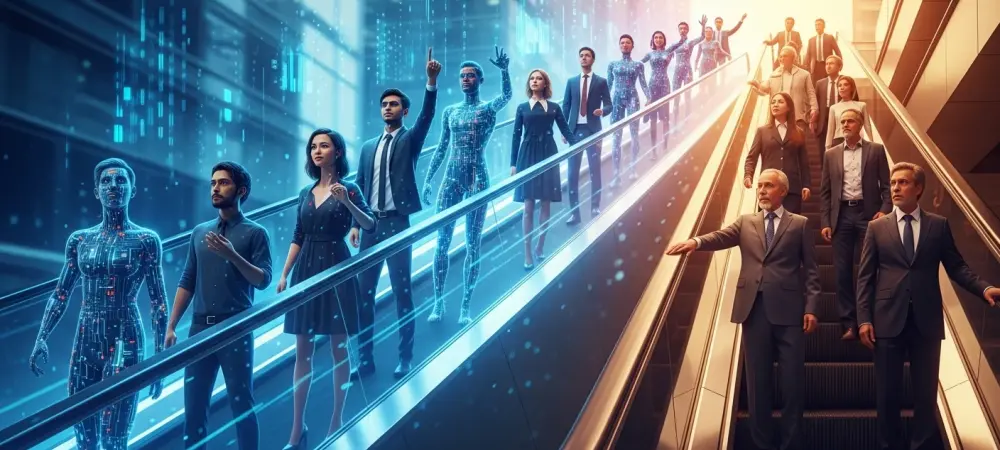
Corporate boardrooms are currently witnessing a startling paradox where organizations aggressively hunt for AI-native talent while simultaneously ignoring the widening chasm of competence among the leaders hired to supervise them. This friction stems from the rapid emergence of a workforce that considers generative intelligence a default operating system, creating an environment where technical knowledge flows upward rather than downward. This shift challenges the very foundations of corporate hierarchy, as traditional seniority no longer guarantees a superior understanding of the tools driving daily productivity. This phenomenon, often described as an expertise inversion, threatens to destabilize organizational structures if management fails to adapt to the new reality of digital-first execution.
The significance of this gap cannot be overstated, as it creates a vacuum in mentorship and strategic oversight. When a subordinate possesses a more profound grasp of core operational technologies than their supervisor, the traditional feedback loop breaks down, leaving the manager unable to effectively vet quality or provide meaningful career guidance. This analysis examines the growing statistical disconnect in hiring trends, incorporates academic perspectives on the changing nature of managerial expertise, and explores the necessary evolution toward becoming an architect of trust. As the workplace continues its transition into an intelligence-driven era, the success of the modern firm will depend less on technical parity and more on the ability to orchestrate complex human-machine collaborations.
The Data Behind the Disconnect: Growth and Adoption Trends
Analyzing the Confidence Split in Modern Management
Recent empirical data from widespread industry surveys, including collaborative research by Indeed and YouGov, highlights a jarring lack of alignment between hiring goals and leadership capabilities. While approximately 45% of employers are currently actively recruiting for AI-native roles, the internal infrastructure to support these hires remains fragile. Only 13% of managers report feeling “strongly equipped” to lead teams that rely heavily on artificial intelligence for their primary output. This disparity suggests that while the front lines of the workforce are being reinforced with cutting-edge skills, the mid-level and executive tiers remain anchored in legacy methodologies.
The psychological impact of this gap is manifesting as a crisis of authority. Nearly half of the managers who currently oversee AI-proficient employees admit that their direct reports possess technical skills that far exceed their own. This expertise inversion serves as a growing hurdle for traditional corporate hierarchies, where authority was historically derived from a mastery of the craft being supervised. Without this foundation, managers often struggle to set realistic deadlines or distinguish between genuine innovation and simple machine-generated automation, leading to a breakdown in operational trust and professional respect.
From Recruitment to Reality: Real-World Training Gaps
A troubling trend of reactive strategy characterizes the current corporate approach to AI adoption, where training programs are often an afterthought. Statistical evidence indicates that 88% of companies already engaged in hiring AI-native talent offer some form of managerial training, yet this figure drops to a staggering 8% for organizations that have not yet begun their recruitment push. This implies that most firms are waiting for the arrival of new talent to highlight their own internal deficiencies before attempting to rectify them. Such a “wait and see” approach leaves current leadership in a vulnerable position, forced to play catch-up in a high-stakes environment.
This lack of institutionalized preparation has fostered a DIY culture of experimentation within many firms, where managers are left to navigate the complexities of AI integration on their own. Instead of a structured roadmap provided by the organization, leaders are often relying on trial and error to understand how to manage AI-augmented workflows. This decentralized approach leads to inconsistent standards across departments and creates a fragmented corporate culture. Without a cohesive strategy for leadership development, companies risk losing their most talented AI-native employees to competitors who offer a more sophisticated and supportive management environment.
Expert Insights: Redefining Expertise in the Age of Intelligence
The Manager as Orchestrator Rather Than Technical Expert
Insights from the Columbia Business School suggest that the current anxiety over technical parity is misplaced, drawing a historical parallel to the widespread introduction of spreadsheet software. When digital ledgers replaced manual entry, managers did not need to become better at formula creation than their analysts; they simply needed to understand how to interpret the results and apply them to business strategy. In the same vein, the AI revolution requires managers to transition into the role of an orchestrator. Their value lies not in their ability to write the perfect prompt, but in their capacity to understand strategic outputs and the ethical or operational implications of those results.
This shift argues for a leadership model that prioritizes discernment over execution. Experts reinforce the idea that in an intelligence-augmented economy, a manager’s primary responsibility is to define the “what” and the “why,” while the “how” is increasingly handled by a blend of human talent and automated tools. Leadership in this era requires a distinct skill set focused on high-level integration, quality control, and the alignment of disparate technical outputs with the organization’s long-term mission. Consequently, the most successful leaders will be those who embrace their role as strategic curators rather than trying to compete with the technical fluency of their younger staff.
Addressing the Structural Complexity of AI-Enabled Workflows
Research from the McCombs School of Business highlights a significant coordination problem inherent in modern, high-tech environments. The transition from managing linear, human-only tasks to overseeing complex, hybrid human-AI webs introduces a level of structural complexity that traditional management training does not cover. Managers are no longer just supervising a series of individual contributions; they are now managing the friction points where human creativity meets machine efficiency. This requires a granular understanding of how various AI tools interact within a team’s workflow and where the human element provides the most critical value-add.
The cognitive challenge of this new reality is substantial, as managers must integrate discrete, often high-speed AI outputs into broader team objectives without losing the nuance of human judgment. Leaders must be able to identify which parts of a project are best suited for automation and which require the high-stakes critical thinking that only a human can provide. Solving this coordination problem is the next great hurdle for organizational design, requiring a fundamental reimagining of how teams are structured and how work is validated.
Future Implications: The Evolution of Leadership and Performance
Navigating the Evaluation Crisis and the “Black Box” of Productivity
As deliverables become increasingly polished through the use of AI, organizations face a brewing evaluation crisis. Distinguishing between genuine human insight and high-quality machine output is becoming nearly impossible for the untrained eye, creating a “black box” around individual productivity. If a manager cannot determine how much of a report was generated by an algorithm versus the employee’s unique analysis, they cannot accurately assess that employee’s merit or potential for growth. This lack of visibility threatens to turn performance reviews into arbitrary exercises based on appearances rather than actual skill development.
To mitigate this risk, forward-thinking organizations are beginning to establish AI benchmarks to work backward and identify true human value-add. By understanding the baseline of what a standard AI model can produce for a specific task, managers can better isolate the specific improvements, strategic pivots, or creative flourishes provided by the human worker. This necessitates a total overhaul of performance metrics to focus on the human delta—the unique value that remains once the AI’s contribution is accounted for. Without such a framework, firms risk promoting individuals who are simply adept at using tools without possessing the underlying expertise needed for senior leadership.
Long-Term Projections: Leadership as the Primary Differentiator
The World Economic Forum’s forecast that 40% of worker skills will change by 2030 underscores the volatility of the current market. In this shifting landscape, the importance of relational leadership is projected to rise as technical skills become commoditized by automation. We are seeing a move away from “operational gift” management—where the boss is simply the most efficient worker—toward the “Architect of Trust” model. This new archetype prioritizes transparency, psychological safety, and the ability to foster a culture where employees feel comfortable disclosing their use of AI rather than hiding it to appear more productive.
Proactive firms that invest in this leadership transition will likely see higher retention rates and more successful AI integration, while those clinging to pre-AI playbooks will face increasing internal friction. The ability to build a culture of trust and shared purpose will become the primary differentiator for organizations competing for top-tier talent. As AI takes over the routine cognitive labor of the workplace, the human elements of empathy, ethical judgment, and visionary thinking will become the most valuable assets a manager can possess. The long-term winners will be those who view AI not just as a tool for efficiency, but as a catalyst for a more human-centric approach to leadership.
Summary and Strategic Path Forward
The research into the AI leadership readiness gap revealed that the primary obstacle to digital transformation was not the technology itself, but the lack of preparation among those tasked with overseeing it. The data indicated a stark disconnect between the aggressive hiring of AI-proficient talent and the stagnant training levels provided to management. This analysis explored how the expertise inversion disrupted traditional hierarchies and identified the coordination problem as a major structural hurdle. It was clear that the role of the manager shifted from a technical supervisor to an orchestrator of complex, hybrid workflows, requiring a new set of metrics to evaluate human performance in an automated world.
The transition toward becoming an architect of trust served as a necessary response to the evaluation crisis and the increasing “black box” of productivity. Organizations that succeeded in this environment were those that proactively redesigned their workflows and updated their performance models to account for the human delta. The investigation underscored that the AI revolution was, at its heart, a leadership challenge that demanded a move away from technical oversight toward strategic orchestration. Ultimately, the firms that thrived were those that recognized the importance of relational skills and transparency, ensuring that their managers were equipped to lead a new generation of digital-first professionals. This evolution was not merely about adopting new software, but about fundamentally redefining what it meant to lead in a post-manual labor economy.