

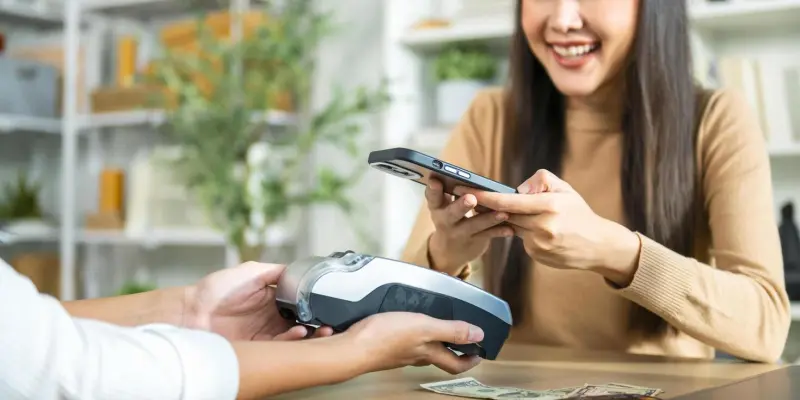
When was the last time you left the house without your smartphone? If the mere thought of that makes you feel uneasy, you can join three-quarters of all Americans. Smartphone adoption is long past its infancy. Around 90% of the global population owns a smartphone, and we’re using them for more than calling family or scrolling through social media. Mobile commerce—the act of shopping from your cellphone—accounts for an estimated 68% of all retail sales. Because it’s quicker and easier than remembering your credit card every time you want to shop. Mobile payment processing lets you take advantage of the shift to mobile within your retail store. This guide shares how to implement it, the technology you’ll need, and the types of mobile payments you can accept.
What is mobile payment processing?
Mobile payment processing happens when a customer makes a transaction using their smartphone. Instead of relying on cash or chip-and-pin in-store, mobile payments are processed using technology such as near-field communication (NFC) on a smartphone. This gives consumers greater flexibility in how they pay for goods and services. Not just a way for customers to pay, retailers also can use a mobile device to complete transactions in-store. Shopify’s Tap to Pay, for example, turns your cellphone into a mobile POS terminal. You can reference customer details, view inventory levels, and process transactions by turning your smartphone into a mobile card reader—without the need for a fixed checkout desk.
How mobile payment processing works
Mobile credit card processing works when customers use their smartphones or RFID credit cards to make a payment. Both use NFC technology to transmit payment details securely via radio waves, which the POS terminal picks up and uses to process the transaction. Most wallets have extra security features to ensure that the mobile transaction is authorized by the cardholder, such as fingerprint or facial recognition. Shopify makes this easier for merchants with unified customer profiles, which are part of its unified data model. These profiles centralize customer data—such as payment preferences, purchase history, and contact information—across all touchpoints. As businesses adopt modern payment processing technologies, they can offer smoother, more convenient shopping experiences, reducing friction and boosting customer satisfaction.
Digital wallets
Digital wallets, also known as e-wallets, are tools that have transformed how individuals store and utilize their financial information. Providing a wide range of functionalities, these wallets allow users to conveniently make payments, transfer funds, and even manage cryptocurrencies. A digital wallet is an electronic payment method that customers use to pay for products via their smartphone. By 2027, Statista estimates that more than one-third of all US retail sales will be made with a digital wallet. That’s a stark increase from just 10% in 2020. Leading the shift is the convenience that mobile wallets offer.
Peer-to-peer payment apps
If you’ve ever tried to send money to a friend or tip an entertainer, you’ve likely encountered a peer-to-peer (P2P) payment app. Brands like PayPal, Venmo, and Cash App let users send money to other people with just their email address or phone number—no need to sign into your online banking and initiate the payment using the recipient’s account details.
However, P2P payment apps can still play a role in niche retail scenarios. For instance, small vendors, market stalls, or pop-up shops might find P2P apps useful for accepting quick and convenient payments without investing in more complex payment systems. Keeping an eye on evolving trends and advancements in P2P payment technologies could also present new opportunities for retailers to leverage these platforms effectively in the future.
QR code-based systems
QR codes let customers point their smartphone camera at the image and be redirected to a secure payment link to complete their purchase. Apps like WeChat Pay and Alipay rely on this technology to give customers a touch-free way to complete their purchase. QR code-based systems offer a flexible and convenient way for customers to make purchases, blending the in-store and online shopping experiences seamlessly.
Mobile point-of-sale (mPOS) solutions
A mobile point-of-sale (POS) system isn’t fixed to the checkout desk. Unlike countertop terminals, which are hardwired and offer limited flexibility, an mPOS system gives you the freedom to process payments from anywhere in-store. The conversation isn’t disrupted; the shopper gets an immediate answer to their question, leaving less time to second-guess their purchase.
What’s great about mPOS solutions is that you don’t need to maintain specialist equipment. For example, Shopify Payments’ Tap to Pay feature turns your existing smartphone into a mobile POS device. Implementing mPOS solutions empowers retailers to create a more engaging and efficient shopping experience, driving higher conversions and customer satisfaction.
Contactless payments and NFC technology
In the evolving landscape of modern finance, contactless payments have become increasingly popular due to their convenience and safety. Near Field Communication (NFC) technology is at the core of this innovation, allowing users to complete transactions with a simple tap of their card or smartphone. As a result, businesses and consumers alike are adopting contactless payments at a rapid pace, making NFC technology a staple in the future of financial transactions.
How to implement mobile payments in your store
To get started, you’ll first need to select a mobile payment provider that fits your business needs. Once you’ve chosen a provider, you must equip your store with the necessary hardware and software to support mobile payments. The theory behind mobile payment processing sounds great, here’s how to actually put it into practice within your retail store. A merchant service provider offers a set of tools that retailers use to accept multiple payment methods in-store. They act as the intermediary between your business’s bank and your customers.
Set up your hardware and software
A POS system is made up of two elements: hardware (the physical components that let you process payments, such as a mobile card reader or smartphone) and software (the operating system of said hardware). Most vendors offer both, so you can mix and match your system depending on your needs.
Determine the payment methods that best suit your business and customer preferences. Offering a variety of payment methods that align with customer preferences can boost satisfaction and sales.
Train your staff
Retail associates and cashiers will be the people responsible for taking mobile payments in your store. By investing in thorough training programs and leveraging user-friendly POS systems, you can ensure a smooth transition to mobile payment processing, enhancing both employee efficiency and customer satisfaction.
Test and launch the mobile payment system
Once you’ve got the technical infrastructure set up, conduct a test transaction to confirm that the mobile payment processes properly. Testing and launching the mobile payment system ensures that everything functions smoothly and that any potential issues are addressed before going live.
When was the last time you stepped out without your smartphone? If you can hardly imagine doing that, you’re not alone. About three-quarters of Americans feel the same way. Today, approximately 90% of people worldwide own a smartphone. Mobile commerce, or shopping from your phone, now accounts for about 68% of all retail sales. Mobile payment processing allows retailers to capitalize on this shift. By adopting mobile payment options, you can enhance the shopping experience for your customers, making it quicker and easier for them to make purchases and keep your business up-to-date with the latest consumer trends.