

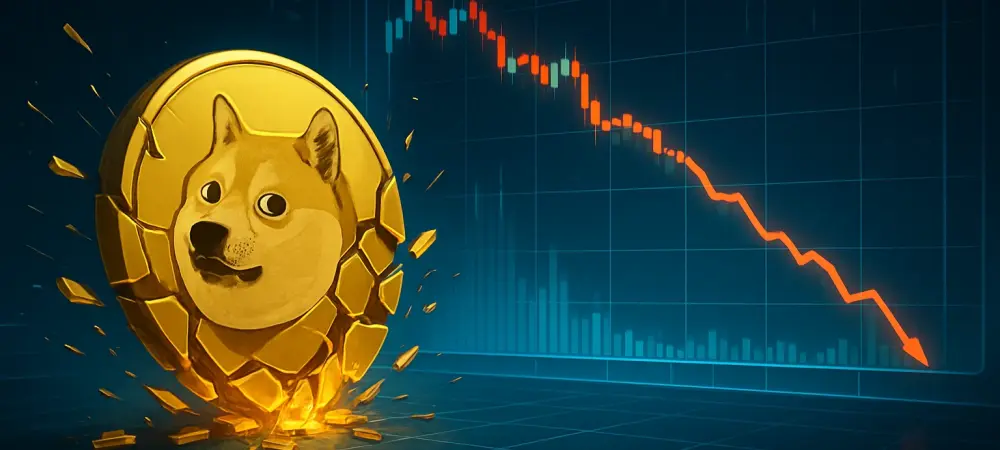
What happens when a cryptocurrency born as a joke faces a financial freefall that could wipe out nearly half its value, leaving investors in a state of panic? Dogecoin, once the darling of internet memes and speculative investors, is teetering on the edge of a staggering 45% crash, with its price already down 25% from $0.28 to $0.24 in just a month. This alarming descent, driven by massive sell-offs from major holders, has sent shockwaves through the crypto community, raising questions about the sustainability of meme coins in a market known for wild swings. As the digital asset battles to hold its ground, the stakes couldn’t be higher for millions of investors watching their portfolios shrink.
Why Dogecoin’s Fall Matters in Today’s Crypto Landscape
The significance of Dogecoin’s decline extends far beyond the balance sheets of its holders. As a pioneer of meme coins since its playful launch over a decade ago, this cryptocurrency has often served as a barometer for speculative enthusiasm in the volatile world of digital assets. Its current struggles signal a potential shift in investor confidence, not just for Dogecoin but for the broader meme coin sector, influencing perceptions of crypto as a legitimate investment avenue. This downturn challenges the cultural phenomenon of meme-driven trading, where community hype often outweighs traditional financial metrics.
Moreover, the ripple effects touch retail traders who once rode the wave of endorsements from high-profile figures. The erosion of value in a coin that symbolized internet-driven financial rebellion underscores the inherent risks of speculative markets. For many, this isn’t just about numbers—it’s about the dream of quick gains turning into a harsh reality check, prompting a reevaluation of risk in an unpredictable arena.
The Perfect Storm: What’s Pushing Dogecoin Down?
A confluence of troubling factors has placed Dogecoin in a precarious position, with data painting a grim picture. Major holders, often called whales, have initiated significant sell-offs, exemplified by a massive transfer of 900 million DOGE—valued at over $200 million—to a leading exchange, hinting at potential liquidation. On-chain analytics reveal a 6% drop in holdings among wallets with 10 to 100 million DOGE since late July, suggesting that even the biggest players are losing faith in a short-term rebound.
Technical indicators further darken the outlook, as the price hovers near a critical support level of $0.218 within a rising wedge pattern. Analysts warn that a break below this threshold could trigger a plunge to $0.12, representing the feared 45% crash. The Relative Strength Index (RSI) has also slipped from an overbought 85 to a neutral 49, reflecting a sharp loss of bullish momentum that once fueled Dogecoin’s meteoric rises.
Adding to the woes, engagement metrics show a steep decline in interest. Futures open interest has fallen from $5.25 billion to $3.24 billion, indicating waning speculative activity, while daily active addresses on the network have plummeted to 58,000 from peaks over a million. This drop-off in retail participation and blockchain usage highlights a fading community spirit that once defined Dogecoin’s appeal.
Voices from the Market: Experts Weigh In on the Crisis
Analysts are sounding the alarm on Dogecoin’s trajectory, emphasizing the urgency of holding key support levels. “If the price dips below $0.19 to $0.20, where the 100-day and 200-day moving averages converge, a further slide to $0.16 becomes almost inevitable,” noted a prominent crypto strategist. Such warnings underscore the delicate balance Dogecoin must maintain to avoid spiraling deeper into bearish territory.
On-chain data providers add credibility to these concerns, with reports showing consistent whale activity trending toward selling rather than accumulation. Meanwhile, market observers point to emerging competitors like Maxi Doge, a new meme coin that raised $1.6 million in its first month, as a sign of shifting investor focus. “The meme coin space is ruthless—attention moves fast,” remarked a market commentator, hinting at the unpredictable tides that could further challenge Dogecoin’s dominance.
Riding the Waves: Strategies for Investors Amid Dogecoin’s Turmoil
For those invested in Dogecoin or eyeing the meme coin market, navigating this downturn requires a proactive approach. Keeping a close watch on the $0.218 support level, as well as the $0.19 to $0.20 range, offers critical insight into whether a deeper crash looms or if recovery might be on the horizon. These thresholds serve as vital markers for gauging market sentiment in real time.
Beyond price watching, tracking whale movements through platforms like Whale Alert or on-chain analytics tools can provide early warnings of major sell-offs or buying sprees that sway the market. Additionally, diversifying exposure by exploring newer projects such as Maxi Doge, which boasts a 190% APY staking reward, might hedge against Dogecoin’s volatility—though the speculative risks of meme coins remain a constant caveat. Staying updated on network health metrics, like daily active addresses and futures open interest, also helps in assessing whether retail interest might spark a turnaround.
Reflecting on Dogecoin’s Turbulent Chapter
Looking back, Dogecoin’s sharp decline stood as a stark reminder of the volatile nature of meme coins, where hype could quickly turn to despair. The 25% drop within a month, compounded by whale sell-offs and fading technical strength, had left investors grappling with uncertainty. Yet, the rapid rise of alternatives like Maxi Doge showed that the meme coin arena remained a hotbed of opportunity and risk. Moving forward, stakeholders needed to prioritize vigilance—monitoring key price levels, whale activity, and network engagement—to make informed decisions. The path ahead demanded a balance of caution and curiosity, as the crypto market continued to evolve with relentless unpredictability.