

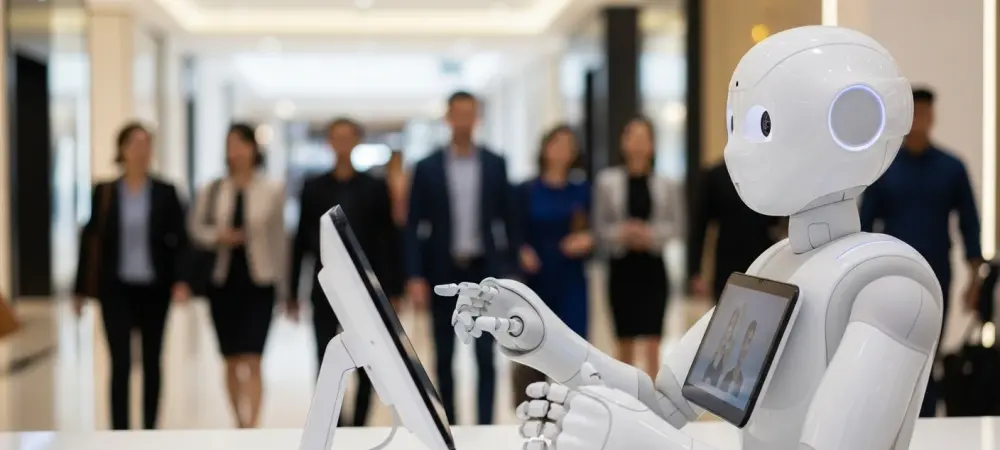
The global workforce is currently undergoing a radical transformation as service industries grapple with the stark reality of shrinking labor pools and aging demographics. Traditional automation, once limited to static kiosks and repetitive software scripts, is no longer sufficient to meet the nuanced demands of modern retail and hospitality sectors. To address these gaps, a new generation of embodied intelligence is stepping out of the research lab and onto the storefront, replacing digital-only avatars with versatile humanoid robots capable of navigating the physical world.
The Rise of Embodied Intelligence in Global Markets
Market Drivers: The Shift Toward Autonomous Humanoids
Economic pressures in developed nations have reached a tipping point, forcing a pivot from single-function machinery to general-purpose physical AI. As the availability of frontline workers continues to decline from 2026 into the late 2020s, businesses are seeking solutions that can multitask in ways that static kiosks simply cannot. This shift represents a move beyond the screen, where the goal is to provide a presence that feels as substantial and capable as a human colleague. The transition toward robotics is backed by significant growth trends in hardware investment and spatial computing. Companies are increasingly moving away from two-dimensional digital assistants, recognizing that a physical body allows for better spatial awareness and more meaningful interaction. By embedding advanced AI into humanoid forms, the industry is creating a bridge between digital intelligence and the physical tasks that define the service experience.
Real-World Deployment: The KDDI and AVITA Partnership
A primary example of this evolution is the strategic collaboration between the telecommunications giant KDDI and the robotics innovator AVITA. This partnership serves as a blueprint for the industry by scaling from small-scale remote-assistance pilots in convenience stores like Lawson to comprehensive, autonomous trials. By leveraging massive connectivity and computational power, these entities are proving that robots can handle the complexities of a bustling retail environment. The success of these deployments hinges on the synergy between real-time visual data and centralized processing power. KDDI provides the essential backbone by utilizing GPU-heavy data centers to manage the immense flow of information required for robotic motion. This setup allows the machines to react to their surroundings with a level of precision that was previously impossible, transforming them from mere curiosities into reliable operational tools.
Technical Foundations and Human-Centric Design
Infrastructure Requirements: High-Latency Environments
Building a functional physical AI requires more than just a sophisticated robot; it demands a robust digital ecosystem. High-capacity networks and ultra-low-latency data centers are non-negotiable for real-time control, as even a split-second delay can disrupt the fluidity of a robot’s movement. These systems must process massive streams of environmental data to ensure that the AI can navigate safely around human customers and obstacles.
In this high-stakes environment, high-performance GPUs and advanced models like Google’s Gemini play a critical role in interpreting complex motion data. Every interaction serves as a feedback loop, where the data collected from physical movements is used to further refine the robot’s autonomy. This continuous learning cycle ensures that the machine becomes more accurate and efficient with every customer it serves, eventually reaching a point of seamless integration.
Overcoming the Uncanny Valley: Non-Verbal Interaction
The design philosophy led by experts like Hiroshi Ishiguro emphasizes that hospitality is rooted in reassurance rather than just technical efficiency. To avoid the “uncanny valley,” where near-human replicas evoke unease, these robots utilize specialized silicone skin and silent pneumatic systems. These materials allow for subtle micro-movements that mimic the softness and rhythm of human gestures, making the interaction feel more natural and less mechanical. Beyond mere appearance, the importance of non-verbal cues such as synchronized nodding and steady eye contact cannot be overstated. These small but significant actions are essential for building trust and rapport with customers who may be skeptical of automated service. By focusing on the nuances of human expression, designers are creating machines that can provide a sense of comfort and personalized attention during social interactions.
Expert Perspectives on Service Automation
Industry leaders are increasingly vocal about the necessity of bridging the gap between digital “brains” and physical “bodies.” The consensus suggests that while generative AI is excellent at language-driven tasks, its true value in the service sector is unlocked when it is embodied. Experts argue that the future of automation lies in “empathetic engagement,” where a machine can understand the physical context of a customer’s needs and act accordingly.
The shift toward embodied action represents a departure from the era of simple chatbots. In complex social settings, a robot must do more than just provide information; it must be able to gesture, move, and physically assist when necessary. This level of sophistication requires a blend of high-level cognitive processing and fine motor control, marking the next frontier in how technology serves society.
Future Outlook and Strategic Implications
As commercial facilities prepare for major trial milestones through the end of the decade, the landscape of frontline service will look vastly different. The integration of physical AI is expected to streamline operations in malls, airports, and hotels, providing a consistent level of quality that is difficult to maintain during labor shortages. However, the path forward will require careful navigation of data governance and privacy, as the collection of visual data becomes a standard part of the service interaction. From a strategic standpoint, the long-term return on investment for physical AI will be measured by its ability to resolve specific service bottlenecks. Rather than a total replacement of staff, the most successful implementations will likely involve a hybrid model where robots handle routine engagement, allowing human employees to focus on high-stakes problem solving. This evolution will force businesses to rethink their operational frameworks to accommodate a blended workforce.
Conclusion: Navigating the New Frontier of Frontline Service
The transformation of customer service was solidified by the successful marriage of high-speed infrastructure and advanced robotic design. Organizations realized that the most effective way to maintain service standards was to deploy physical AI in areas where human-like interaction provided the most tangible value. This journey demonstrated that technical efficiency alone was not enough; the true breakthrough came from creating machines that could engage with the world through both logic and empathy. Moving forward, the most competitive businesses adopted a strategy that prioritized specific pain points where robotic presence offered a clear advantage over traditional digital tools. The inevitable shift toward a cohesive human-robot ecosystem provided a sustainable answer to the global workforce challenges of the late 2020s.