

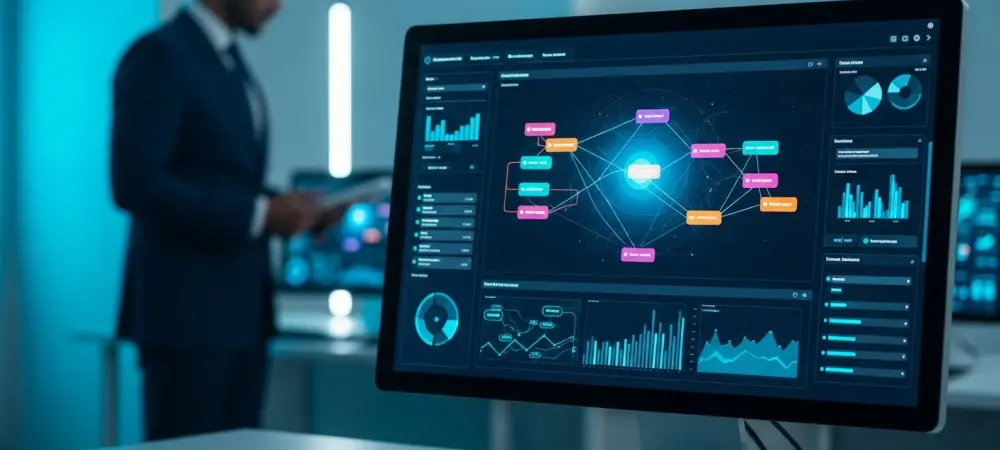
The rapid metamorphosis of enterprise software has reached a critical juncture where the primary value of artificial intelligence is no longer found in its ability to chat, but in its capacity to act. As organizations contend with overwhelming data fragmentation and the relentless pressure of rising consumer expectations, a fundamental shift toward “agentic” systems is redefining the boundaries of scalable, outcome-driven operations. This transition signifies a move away from simple generative assistance—which largely focused on summarizing information—toward autonomous execution. By integrating reasoning-based AI directly into the core of customer experience (CX) frameworks, businesses are now establishing a new standard for how work is performed and how revenue is generated.
The Shift from Generative Assistance to Autonomous Execution
Market Evolution: From Chat to Actionable Workflows
Recent shifts in the enterprise sector demonstrate a clear departure from the initial excitement surrounding basic AI assistants toward a more rigorous demand for “action-based” agentic workflows. Current market statistics reveal that organizations are increasingly prioritizing AI solutions capable of performing complex computation and logical reasoning over those that merely provide text summarization or drafting support. This evolution is driven by the realization that while generative AI can spark ideas, agentic AI can finish tasks. Consequently, unified data models have become the essential prerequisite for any successful implementation, as they provide the necessary context for an agent to navigate the intricacies of a business without constant human intervention.
The growing demand for these sophisticated systems reflects a broader trend toward precision in automation. Companies are no longer satisfied with general-purpose tools that require significant human oversight to be useful in a professional setting. Instead, the focus has shifted toward specialized agents that understand specific business logic and can operate within defined parameters to achieve measurable goals. This trend is expected to accelerate as more industries recognize that the competitive edge lies in the speed of execution rather than the volume of information processed.
Practical Implementation: Workspace Models and Command Centers
In the modern enterprise, traditional static dashboards are being systematically replaced by dynamic “Workspace” and “Command Center” models. These environments serve as the operational hubs where AI agents and human professionals collaborate. For instance, leaders like Oracle are now integrating these agents into expansive ecosystems covering ERP, SCM, and HCM, ensuring that a decision made in customer service is immediately reflected in supply chain logistics or financial forecasting. This cross-departmental synergy ensures that the organization moves as a single, cohesive unit rather than a collection of siloed departments.
Real-world applications of this technology are already yielding significant results in high-stakes environments. One of the most impactful examples is found in the reduction of lead-to-revenue cycles through automated semantic analysis. By deploying agents to scan vast portfolios of enterprise contracts, companies can identify potential legal risks or financial deviations in seconds—a task that previously required weeks of manual legal review. This proactive approach not only mitigates risk but also accelerates the pace of business, allowing teams to close deals faster while maintaining strict adherence to corporate policy.
Industry Perspectives on Agentic Transformation
The consensus among technology leaders suggests that the industry is witnessing the sunset of “systems of record” in favor of “systems of action.” Historically, software was designed to store data and wait for a human to manipulate it; however, the new paradigm demands that software anticipates needs and initiates the necessary processes. Experts emphasize that the true breakthrough is not just the AI itself, but the ability to grant these agents autonomy while maintaining ironclad security guardrails. This balance ensures that while an agent might autonomously negotiate a contract or resolve a service ticket, it does so strictly within the permissions and ethical boundaries defined by the enterprise.
Thought leaders are increasingly vocal about the necessity of “always-on” revenue expansion models to survive in a hyper-competitive landscape. In this view, traditional reactive marketing and sales strategies are becoming obsolete. The industry perspective holds that businesses must leverage autonomous agents to continuously monitor customer signals and identify growth opportunities in real-time. By shifting the burden of routine analysis to machines, organizations can maintain a constant state of optimization, ensuring that no lead is ignored and no customer risk goes unaddressed.
The Future of CX and Potential Implications
Looking ahead, the emergence of a “human-agent workforce” represents the most significant structural change in the professional environment. In this model, machines are tasked with high-volume routine analysis and administrative execution, which allows human employees to pivot toward roles that require high-stakes empathy, creative judgment, and complex problem-solving. This democratization of AI development is being furthered by low-code platforms such as the Agentic Applications Builder, which empowers non-technical staff to create and deploy specialized agents. Such tools lower the barrier to entry, allowing various departments to tailor automation to their specific needs without taxing centralized IT resources.
However, the path forward is not without its complexities, as the rise of autonomous decision-making introduces new challenges in observability and ethical management. As agents take on more responsibility, the need for robust frameworks to measure return on investment and ensure algorithmic transparency becomes paramount. Organizations must navigate the risks associated with automated bias and the potential for “black box” logic. Nevertheless, the convergence of high-performance cloud infrastructure and specialized Large Language Models is expected to continue lowering the cost and technical complexity of these systems, making sophisticated automation an accessible standard for businesses of all sizes.
Conclusion: Navigating the New Era of Agentic CX
The transition toward Fusion Agentic Applications fundamentally altered the trajectory of enterprise technology by replacing manual, reactive workflows with proactive, reasoning-based execution. Strategic value was no longer found in the mere collection of data, but in the seamless integration of that data into secure frameworks capable of independent action. Organizations that successfully adopted these autonomous engines of execution realized unprecedented scale and accuracy, effectively moving beyond the limitations of human bandwidth. As the professional landscape adapted, the focus shifted toward establishing clear governance for AI agents and refining the synergy between machine efficiency and human intuition. Ultimately, the move toward agentic systems provided the necessary foundation for a more resilient and responsive business model, ensuring that enterprise operations could keep pace with the accelerating demands of the global market.