

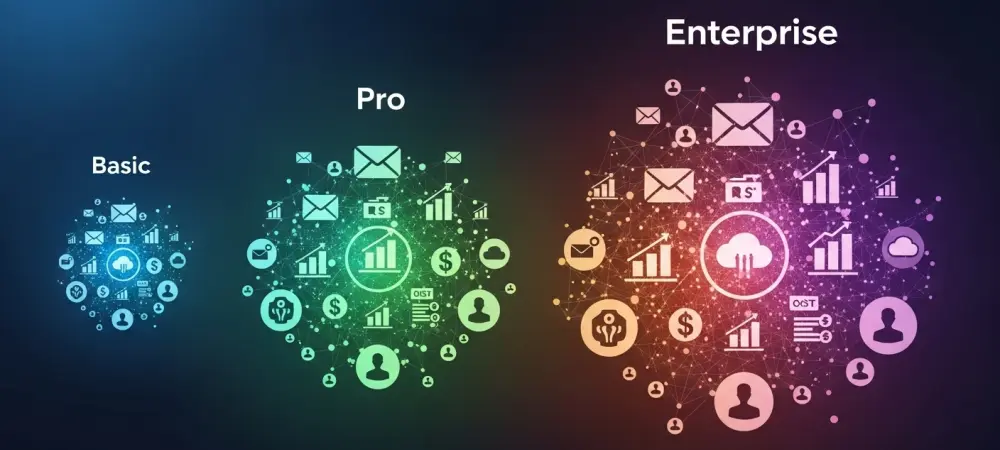
Navigating the labyrinth of modern digital outreach requires a keen understanding of how software costs evolve as a brand scales its influence across the global marketplace. In the current digital marketing landscape, the fundamental question is no longer whether email marketing remains a profitable endeavor, but whether expanding businesses are unknowingly paying a growth tax that silently erodes the bottom line. While email continues to deliver a staggering return on investment of up to forty-two dollars for every dollar spent, the pricing structures governing this medium have transitioned into a realm of unprecedented complexity. The shift from simple, flat-rate subscriptions to tiered models that penalize the expansion of contact lists represents a significant challenge for marketing departments tasked with maintaining high margins. This analysis scrutinizes the economic realities of the sector, categorizing current pricing tiers while exploring expert perspectives on market consolidation and the strategic integration of artificial intelligence into financial planning.
The State of Email Marketing Pricing in 2026
Market Adoption and the Growth Tax Phenomenon
The current fiscal climate for digital tools reveals a fascinating paradox where higher adoption rates coincide with increasing user friction regarding subscription escalations. Recent data from the G2 Spring Grid Report indicates a decisive movement toward sophisticated, tiered subscription models where the cost of service rises exponentially as contact databases grow. This trend introduces the concept of the growth tax, a financial phenomenon where a business is essentially penalized for its success in audience acquisition. Because many platforms base their pricing on the total number of contacts rather than the frequency or quality of engagement, organizations often find themselves paying premium rates for a significant portion of their audience that may no longer be active or reachable.
Statistics regarding database health further complicate this pricing dynamic, as email lists naturally experience a decay rate of approximately twenty-three percent annually due to job changes, platform shifts, and general churn. Despite this organic contraction of the reachable audience, a vast majority of software providers continue to charge for inactive subscribers, creating a massive financial inefficiency for seventy percent of market participants. This lack of alignment between the utility of the data and the cost of maintaining it has led to a noticeable shift in user sentiment. While businesses remain committed to the medium, there is a growing sense of frustration with entry-level sticker prices that mask the true cost of ownership once a company enters its primary scaling phase.
The adoption of email marketing software remains high across all sectors, yet the focus has shifted toward cost-containment strategies that address these inherent inefficiencies. Companies are increasingly auditing their digital infrastructure to identify where “ghost subscribers” are inflating monthly invoices. This heightened awareness is driving a demand for more transparent billing practices that reflect actual engagement rather than static database volume. Furthermore, as the market matures, the differentiation between a simple delivery tool and a comprehensive growth platform becomes clearer, forcing providers to justify their pricing tiers through enhanced functionality rather than just capacity increases.
Real-World Applications and Vendor Benchmarking
Analyzing the specific offerings of industry leaders provides a clearer picture of how different pricing philosophies impact the bottom line for diverse business models. Brevo, for instance, has carved out a significant market share by utilizing a volume-based pricing model that starts at approximately eight dollars and eighty cents per month. This approach proves particularly ideal for small and medium-sized businesses that possess large databases but follow infrequent or seasonal sending patterns. By decoupling the cost from the number of contacts, such platforms allow brands to maintain vast lists without the fear of immediate price hikes, shifting the financial focus toward actual campaign execution rather than passive data storage.
In contrast, Intuit Mailchimp remains a widely recognized industry standard for its scalability and user-friendly interface, maintaining an entry point of approximately thirteen dollars per month. However, this platform often serves as a primary example of the pricing friction that occurs as users cross specific subscriber thresholds. As a brand matures, the transition between tiers can be abrupt, leading to significant budget variances that require careful forward-looking management. Despite these challenges, the platform’s extensive integration ecosystem and advanced automation capabilities continue to provide a high level of utility that many organizations find indispensable, even as the “cost per contact” metrics begin to climb during rapid expansion.
Specialized outreach platforms such as Lemlist and Instantly demonstrate the rise of premium, high-intent pricing models that cater to sales professionals and B2B outreach. These tools charge considerably higher monthly rates, typically ranging from thirty-seven to sixty-three dollars, by bundling advanced features like artificial intelligence personalization and multi-channel synchronization. While the initial investment is higher, these platforms often boast a faster return on investment payback period, frequently occurring within five to six months. This illustrates a broader market trend where the focus shifts from minimizing expenses to maximizing the efficiency of every sent message, suggesting that users are willing to pay a premium for tools that offer direct, measurable revenue generation.
Industry Perspectives on Value and Software Consolidation
The perception of value in the software sector is undergoing a radical transformation as businesses re-evaluate the role of email marketing within their broader technological stack. Over ninety percent of pricing feedback currently originates from small businesses that no longer view email software as a single-use tool but rather as a core business operating system. For these entities, the cost of a subscription is measured against its ability to replace multiple disparate tools. A platform that combines lead generation, customer relationship management, and automated sequences is viewed as a high-value asset, even if its monthly premium is higher than a standalone email delivery service. This move toward a “unified workspace” is redefining the competitive landscape for software developers.
Industry thought leaders suggest that the most cost-effective platforms in the current environment are those offering consolidation value. By integrating features that were previously outsourced to external funnel builders or analytics suites, these platforms justify their pricing by reducing the total cost of a company’s marketing technology stack. This consolidation trend is not merely about saving money; it is about reducing the operational friction that comes with managing multiple subscriptions and data silos. When a single source of truth is established for customer data, the accuracy of marketing efforts improves, leading to a higher quality of engagement and, ultimately, a more sustainable financial model for the business.
The shifting dynamics of the switching economy further highlight a move away from traditional brand loyalty toward functional and fiscal efficiency. Insights into user migration patterns show that sixty-five percent of users who move to integrated platforms like Systeme.io do so not necessarily to find the lowest possible price, but to find a better feature-to-cost fit. This indicates a highly sophisticated buyer base that prioritizes the long-term viability of the platform over introductory discounts. Users are increasingly willing to undergo the technical challenge of migration if the destination platform promises a more predictable pricing structure that aligns with their specific growth trajectory, signaling a significant evolution in how software value is assessed.
Future Projections: AI Integration and Financial Evolution
The integration of artificial intelligence into the fabric of email marketing is fundamentally altering both the performance of campaigns and the structure of software billing. As sixty-three percent of marketers now leverage artificial intelligence for hyper-personalization and timing optimization, software providers are beginning to experiment with new cost variables. Future pricing models are expected to incorporate artificial intelligence credits, creating a secondary layer of variable costs that exist alongside standard subscription fees. This shift reflects the significant computing resources required to generate predictive analytics and personalized content, moving the industry closer to a “pay-for-performance” model where advanced technology usage dictates the total investment.
Automation continues to be the primary differentiator between mid-tier and enterprise-level pricing, with high-value triggered campaigns demonstrating a clear superiority over manual efforts. Data shows that automated sends, such as welcome sequences or behavior-based reminders, achieve click rates of five point fifty-eight percent, compared to a mere one point sixty-nine percent for traditional manual broadcasts. This performance gap encourages providers to gate advanced automation features behind higher pricing tiers, positioning these tools as essential upgrades for businesses that have reached a certain level of maturity. Consequently, the ability to automate complex customer journeys has become the hallmark of premium service offerings, driving much of the revenue growth for high-end providers.
Long-term implications for the industry suggest that while the return on investment for email remains unrivaled among digital channels, the true cost of success will increasingly include the management of human talent and data hygiene. Businesses that fail to address the issue of database decay will face diminishing returns regardless of how innovative their chosen platform becomes. The future of the sector lies in the balance between sophisticated technological capabilities and the rigorous maintenance of the underlying data. As the market continues to evolve, the most successful organizations will be those that view their email marketing spend as a dynamic investment that requires constant oversight and strategic recalibration to ensure that growth remains profitable rather than just voluminous.
Summary and Strategic Recommendations
The exploration of the modern email marketing landscape has revealed a decisive shift from contact-based billing toward value-oriented pricing models. This transition has highlighted the critical importance of identifying hidden costs, such as the persistent practice of billing for inactive or “ghost” subscribers, which can quietly diminish the profitability of even the most successful campaigns. The emergence of specialized sales engagement tools has also demonstrated that a higher initial investment can be justified by a significantly accelerated return on investment, provided the features align closely with the specific revenue-generating activities of the business. By examining the benchmarking of major vendors, it became clear that there is no universal “best” price, only a “best fit” based on a company’s unique sending frequency and list size.
Furthermore, the analysis showed that the rise of artificial intelligence and advanced automation has introduced new variables into the total cost of ownership. These technologies have proven their worth by dramatically increasing click rates and engagement levels, yet they also require a more nuanced approach to budgeting that accounts for potential credit-based usage. The industry consensus points toward a future where software consolidation becomes the primary method for small and medium businesses to maintain their margins. By selecting platforms that serve as a comprehensive operating system, organizations can eliminate redundant subscriptions and streamline their data management, thereby mitigating the impact of the growth tax.
Moving forward, the focus for any growth-oriented business should be on the proactive management of their digital assets. It was observed that the most resilient marketing strategies were those that prioritized data hygiene as a core financial practice rather than an afterthought. Successful organizations audited their subscriber lists to remove decay and projected their growth over a twelve-month horizon to ensure their software providers remained partners in scaling rather than barriers to profit. The era of “set it and forget it” subscriptions has passed, replaced by a need for continuous strategic alignment between a company’s marketing goals and its software expenditure.
Strategic decisions regarding platform selection were increasingly influenced by the “payback period” and user adoption rates rather than just the monthly fee. High adoption rates often signaled a more intuitive user experience, which reduced training costs and accelerated the timeline to profitability. Businesses that succeeded in this environment were those that looked beyond the introductory offers to understand the full lifecycle of their technological investment. They recognized that the cheapest option often lacked the necessary infrastructure for sophisticated automation, while the most expensive enterprise tools could be underutilized by smaller, more agile teams. Finding the point of operational equilibrium became the ultimate goal for marketing leadership.
In the final assessment, the landscape of email marketing software in this era demanded a high degree of fiscal vigilance and technological adaptability. The inherent value of the email channel remained a cornerstone of digital strategy, yet the methods for capturing that value had become more complex. Organizations that thrived were those that viewed their email infrastructure as a dynamic component of their revenue engine, constantly seeking ways to optimize both the performance of their messages and the efficiency of their spending. This approach ensured that the unrivaled return on investment traditionally associated with email was not only achieved but sustained through every stage of business expansion.
Final reflections on the state of the market suggested that the most impactful change was the psychological shift among buyers. No longer content with being passive subscribers, businesses acted as informed investors who demanded transparency and functional integration. This demand forced software vendors to innovate not just in their feature sets, but in their financial relationships with their clients. The result was a more competitive and diverse marketplace where value was clearly defined by the intersection of technological capability and fiscal responsibility. As the industry moved beyond simple delivery, the strategic management of costs became just as important as the creative execution of campaigns.
Ultimately, the strategies adopted during this period emphasized the necessity of a forward-thinking mindset. Leaders who anticipated the evolution of pricing models and the impact of emerging technologies like artificial intelligence were better positioned to protect their margins. They utilized data-driven insights to make informed transitions between platforms, ensuring that their marketing stack remained a source of strength. By focusing on consolidation and the elimination of wasteful spending on inactive data, they proved that email marketing could remain the most profitable tool in the digital arsenal, provided it was managed with the same rigor as any other significant business investment.