

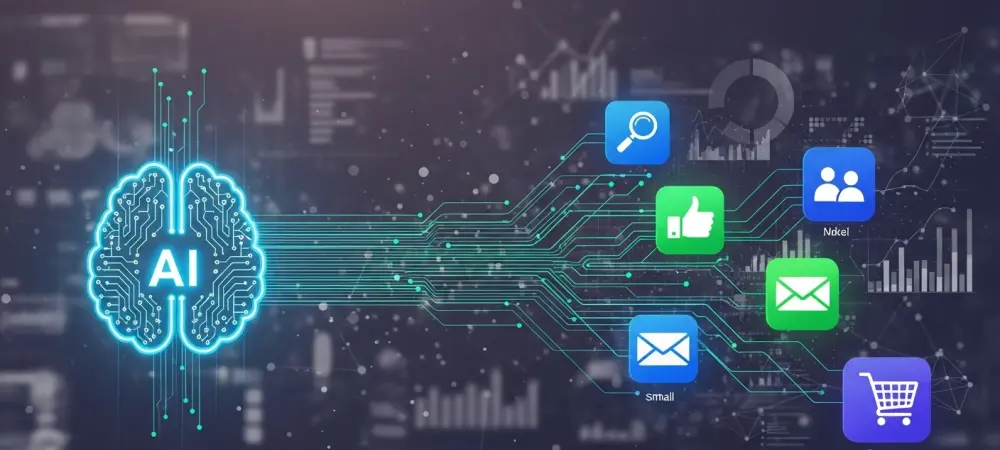
The traditional concept of a buyer journey has undergone a radical transformation as consumers move away from keyword-based search queries toward complex, conversational interactions with large language models. This structural shift is not merely a change in user interface; it represents a fundamental collapse of the marketing funnel, where the stages of awareness, consideration, and intent are now compressed into a single session with an AI assistant. As of now, the data indicates that these systems are no longer just information providers but have become the primary drivers of high-intent lead flow for businesses that have successfully integrated into the AI ecosystem.
The Shift Toward LLM-Driven Discovery and Lead Flow
Quantifying the Growth of AI-Referred Leads
The dominance of traditional search engines has been challenged by the meteoric rise of “search-to-conversion” behavior within large language models (LLMs). Current statistics reveal that ChatGPT maintains a commanding lead, accounting for 90.1% of all AI-referred leads, particularly in sectors where consumers prioritize speed and immediate answers. However, the landscape is becoming increasingly fragmented. Perplexity has emerged as a powerhouse for high-consideration research, capturing 6.3% of the market share, while Google’s Gemini and Anthropic’s Claude are carving out specialized niches in the business services and real estate sectors.
This evolution is particularly visible in high-consideration verticals such as travel, manufacturing, and healthcare. In these industries, the research phase is often lengthy and data-intensive. Consequently, users are leaning on AI tools to synthesize vast amounts of information before ever reaching out to a provider. For instance, in the manufacturing sector, nearly one in ten AI-driven leads now originates from Perplexity, a rate significantly higher than in more transactional industries. This suggests that the complexity of the query often dictates which AI tool a prospect chooses, creating a tiered lead generation environment.
Real-World Applications in High-Intent Verticals
The practical application of AI in lead generation is most evident in its ability to drive high-intent phone calls and form fills for small businesses. In sectors like legal and hospitality, the “pre-vetted” nature of AI-referred callers is a game-changer. Because the AI has already provided the user with comparative data, pricing estimates, and service summaries, the individuals who finally click to call are much further along in the sales cycle than those arriving via traditional SEO. These prospects are not just browsing; they are ready to transact, having already satisfied their preliminary curiosity through an LLM interface.
Furthermore, the implementation of AI voice agents has solved the age-old problem of lead leakage during off-hours. Small businesses often struggle with answering every inbound inquiry, but early adopters of automated lead handling have seen a 44% increase in answered calls. By using AI to capture overflow and after-hours leads, companies are ensuring that high-intent prospects do not bounce to a competitor. These agents qualify the lead in real time, collect essential intake information, and even schedule appointments, allowing the human team to focus exclusively on closing the deal.
Industry Perspectives on the Fragmented Lead Landscape
Marketing professionals are increasingly vocal about the necessity of moving away from “black box” reporting. The consensus among digital strategists is that traditional attribution models, which often group all non-paid traffic into a single bucket, are no longer sufficient. There is a growing demand for granular LLM attribution that identifies exactly which AI model sparked a conversion. Without this level of detail, agencies are essentially flying blind, unable to determine whether their content is being indexed by ChatGPT or referenced by Gemini.
In contrast to the steady pace of traditional search, SEO and PPC experts are noting a “compression” of the brand touchpoint journey. Historically, a customer might have interacted with a brand five or six times before converting. Today, that interaction is often filtered through a single AI response that summarizes the brand’s value proposition against its competitors. This has led to a consensus that content must be more authoritative and fact-rich than ever before. Thought leaders emphasize that the challenge lies in connecting these fragmented data points across various communication channels to maintain a coherent picture of the customer’s intent.
The Future of AI-Integrated Marketing Funnels
As the market matures, the concept of “AI-Aware” SEO is becoming the gold standard for digital visibility. Content strategy is shifting away from keyword density and toward the creation of structured, fact-rich data sets that are easily digestible by LLMs. This means that technical SEO is evolving to focus on how well an AI can parse a website’s unique value. Companies that fail to provide clear, structured answers to complex questions will likely find themselves excluded from the “recommendation” lists generated by AI assistants, regardless of their traditional search rankings.
Moreover, the role of marketing agencies is transitioning from simple lead providers to “growth partners” who manage deep data integration. This shift is driven by the rise of automated lead qualification, where the primary value of an agency lies in its ability to tune the AI models that handle the initial customer contact. Data visibility is becoming the ultimate competitive advantage. As search behavior continues to evolve, the reliance on self-reported attribution and specialized GA4 channel groups will be essential for maintaining a clear view of how AI traffic contributes to the bottom line.
The risks of maintaining a slow response time are also escalating. In an AI-driven market, where consumers receive instant answers from their digital assistants, a delay of even a few minutes in human follow-up can result in a lost opportunity. Real-time, 24/7 lead handling is moving from a luxury to a requirement. As LLMs become more integrated into the fabric of daily life, the expectation for immediate service will only intensify, forcing businesses to adopt automated solutions to keep pace with the accelerated sales cycle.
Strategic Summary and Key Takeaways
The modernization of lead generation rests on three fundamental pillars: precise identification of traffic sources, the seamless connection of that traffic to revenue, and the radical acceleration of response times. Organizations must move beyond basic analytics to embrace unified lead intelligence platforms that eliminate data blind spots across calls, texts, and chats. Identifying which specific AI platform is driving visitors allows for a targeted content strategy, while integrating that data into a central dashboard ensures that marketing spend is always tied to actual conversions.
In the current landscape, the ability to qualify and respond to leads automatically has become the dividing line between market leaders and those struggling to keep up. The transition toward AI-driven discovery requires a shift in mindset from chasing clicks to providing high-value, structured information that LLMs can trust. By adopting sophisticated attribution tools and automated follow-up systems, businesses successfully positioned themselves to capture the high-intent traffic that defines the modern marketing funnel. This proactive approach allowed companies to turn the disruption of AI search into a predictable engine for growth.