

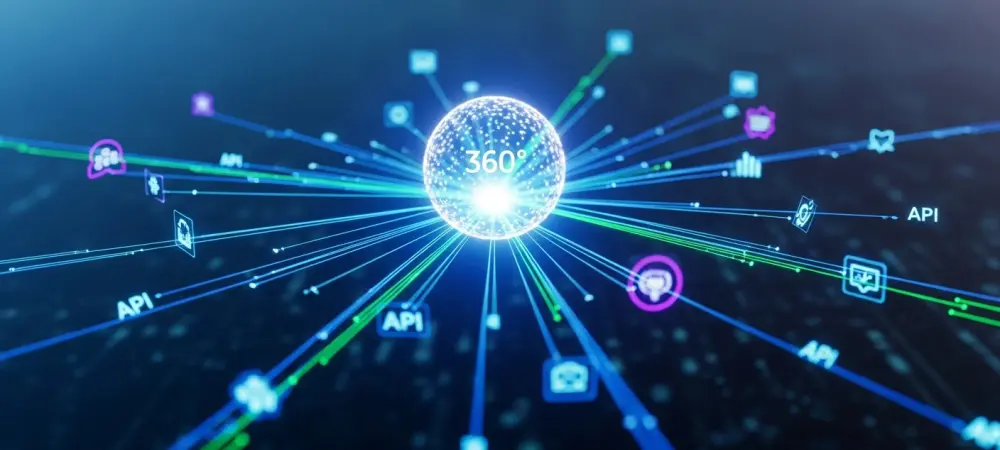
The frantic clicking of buttons and navigating nested menus is fading as the enterprise software interface transforms into an invisible engine powering modern business. For decades, the effectiveness of a customer relationship management platform was measured by the density of its sidebars and the complexity of its navigation panels. However, the shift toward Headless 360 suggests that the user interface has become a hurdle to efficiency rather than a facilitator of it. Salesforce has responded by turning the world’s most ubiquitous CRM into a silent, background utility that operates without requiring a human to stare at a screen.
This transition signals the end of an era where employees were required to become software specialists just to log a sales call. Instead, the focus has shifted toward high-performance execution, where the software acts as an automated infrastructure. By making the graphical interface optional, the industry is acknowledging that speed and accuracy in a data-driven market cannot depend solely on human manual entry. The evolution represents a move from a visual application toward a pervasive digital layer that integrates directly into every facet of a business operation.
Why the Era of Button-Clicking Is Coming to an End
The era of manual navigation is drawing to a close because the sheer volume of data now exceeds the capacity of human operators to manage through traditional mouse clicks. When every transaction or customer interaction requires a dozen steps across multiple tabs, productivity inevitably stalls under the weight of administrative overhead. Enterprises are finding that the time spent training employees to master complex UI layouts is better spent on higher-value activities. Consequently, the CRM is being stripped of its visual skin to allow data to flow more freely between systems. This fundamental shift transforms the CRM into a background engine of execution rather than a destination for data entry. By prioritizing background processes over foreground visuals, organizations can reduce the friction that has historically slowed down sales and service cycles. The interface is no longer the center of the universe; rather, the underlying logic takes the lead. This allows for a much more agile response to market demands, as the system can perform complex operations in milliseconds without waiting for a user to find the right button.
The Architectural Evolution: From UI-Centric to API-First
The movement toward an API-first model represents a profound departure from the legacy “system of record” concept. Historically, a CRM was a passive repository where information resided until a human decided to manipulate it. This often led to data silos and inconsistencies, as different departments used different parts of the interface in conflicting ways. In contrast, the modern headless architecture functions as a “system of execution,” where business logic is applied automatically and consistently across all interaction points.
Moving toward this active model ensures that business rules are no longer trapped within a specific screen or application. When the logic is decoupled from the UI, it becomes a universal truth that governs every touchpoint, whether that interaction occurs via a chatbot, a mobile app, or an automated email. This architectural reframing ensures that data integrity is maintained through deterministic execution. In this environment, the CRM acts as a dependable engine that guarantees the same result regardless of the entry point or the trigger, effectively eliminating the fragmentation of the customer experience.
Decoupling Capabilities: From the Presentation Layer
By separating core functions from the presentation layer, companies are now able to treat CRM features as modular, plug-and-play capabilities. Users are no longer restricted to “opening an app” to verify a customer’s warranty status or approve a custom discount. Instead, these specific tasks are treated as independent services that can be embedded directly into any digital workspace. This composable approach allows organizations to build highly customized experiences that fit the exact needs of their staff without the bloat of a standard enterprise software suite.
Moreover, this decoupling allows the workforce to focus on intent rather than navigation. When a specific business action—like a case update or a lead conversion—is accessible as an API, the need for context switching disappears. Employees can remain within their primary tools, such as messaging platforms or specialized industry software, while still leveraging the full power of the CRM in the background. This transition significantly lowers the cognitive load on staff, enabling them to complete tasks through intuitive actions rather than memorized software paths.
Natural Language: The Logic of AI Agents
The headless architecture provides the necessary foundation for the current generation of artificial intelligence to function as a core business participant. Unlike human workers, AI agents do not perceive the world through icons or dropdown menus; they require structured, programmatic pathways to interact with data. By exposing CRM functions through APIs, companies create the “nervous system” that allows these agents to perform complex workflows reliably. This infrastructure turns the CRM into an intent-driven environment where natural language serves as the primary command layer.
As these agents take over transactional duties, the human role within the CRM ecosystem is undergoing a dramatic transformation. The traditional interface is evolving into a high-level command center where managers oversee strategy, refine AI logic, and intervene only in cases requiring nuanced human judgment. This division of labor ensures that while the API layer handles the heavy lifting of data processing and routine updates, the human element is reserved for empathy and creative problem-solving. Natural language effectively bridges the gap, turning verbal instructions into immediate digital actions.
Strategies: Transitioning to a Headless CRM Environment
Adopting an API-first approach requires a deliberate audit of existing business processes to identify which actions should be exposed as core capabilities. Organizations should begin by mapping out high-frequency workflows, such as entitlement checks or order updates, and converting them into modular services. This ensures that the most valuable functions of the CRM are available across every channel, maintaining consistency and speed. Governance becomes critical in this phase, as centralized business rules must be enforced across all API calls to prevent data corruption.
Transitioning to a headless environment also necessitates a redesign of the employee experience to prioritize intent-driven workflows. Instead of forcing teams to adapt to the software’s layout, leadership should bring the software’s power to the teams where they already spend their time. This might involve embedding CRM actions into collaboration tools or developing lightweight, task-specific interfaces for mobile workers. Standardizing logic and security protocols across these new interaction points will ensure that the transition remains secure and scalable while maximizing the utility of the headless model. The transition toward a headless model clarified that the future of enterprise technology resided in invisible, high-performance execution rather than manual interaction. Organizations that embraced this shift focused on identifying their core capabilities rather than merely maintaining their software apps. Leaders moved toward a strategy of decoupling logic from the front end, which allowed them to deploy AI agents with greater precision and speed. This proactive approach simplified complex environments and prepared the groundwork for a more agile, intent-driven workforce.
Moving forward, the primary objective shifted to the refinement of API governance and the integration of natural language commands into every operational layer. Teams prioritized the creation of a centralized logic bank that governed every customer touchpoint, ensuring that data integrity remained intact regardless of the interface used. By treating the CRM as a silent engine, companies successfully reduced employee burnout and accelerated their digital transformation goals. The focus remained on continuous improvement of the underlying pathways that powered the next generation of business intelligence.