

Introduction
Managing a website in an environment where search engines prioritize topical authority and user experience requires a shift away from the legacy mindset of keyword stuffing. Modern algorithms are increasingly adept at recognizing when multiple queries represent the same underlying intent, which means that creating near-identical pages can actually harm a site’s performance through internal competition. When two or more pages on a single domain target the same query cluster, they often suffer from keyword cannibalization, a phenomenon where search engines struggle to identify the most relevant source, leading to fluctuating rankings and lower visibility for all involved URLs.
The scope of this discussion covers the analytical steps required to validate a keyword’s potential for independence. This process involves more than just looking at search volume; it requires a deep dive into how competitors are currently ranking and how the existing site content already addresses the topic. Readers can expect to learn how to use diagnostic tools to uncover hidden overlap and how to evaluate the structural integrity of a proposed page. By the end of this exploration, the goal is to provide a clear methodology for choosing the most efficient action for any given keyword, ensuring that every published page contributes to the overall strength of the digital platform.
Key Questions or Key Topics Section
Should the Website Already Own the Topic?
Before the decision is made to produce a new page, it is vital to assess how the website currently interacts with the keyword in question. In many instances, a site may already be earning impressions or even ranking on the second or third page of search results for a term that was previously overlooked. This existing visibility serves as a strong signal that the search engine already associates the domain with that specific topic. By examining these signals, an organization can determine if the keyword is a natural extension of an existing page or if it truly lacks a dedicated home within the current content library. A thorough investigation begins within Google Search Console to identify which URLs are currently appearing for the target query. If a high-ranking page is already capturing traffic for the term, creating a second page might result in the new content simply stealing traffic from the old, rather than generating incremental growth. For example, if a software company has a primary page for small business accounting tools and finds it already ranks well for freelancer invoicing queries, the most effective strategy may be to bolster that existing page. Adding a dedicated section or a specialized case study to the current URL can often provide enough relevance to climb higher in the rankings without the risks associated with starting a new page from scratch.
How Does the Page Independence Test Provide Clarity?
The page independence test acts as a rigorous filter to ensure that a keyword can support a standalone URL without redundancy. This evaluation relies on three distinct pillars of evidence: the behavior of the search engine results pages, the uniqueness of the potential content, and the logistical placement of the page within the site architecture. Without passing these criteria, a new page often becomes a liability, adding technical debt to the site without providing a measurable return on investment. The test forces a critical look at whether the keyword represents a genuinely different user journey or merely a semantic variation of a topic that is already well-covered.
Evidence from search behavior is particularly telling because it reveals how the algorithm clusters different intents. If the results for two different keywords are nearly identical, the algorithm has already decided that one page can satisfy both needs. Furthermore, the test requires the creator to prove that the new page can offer a distinct value proposition that cannot be easily replicated by existing assets. If the proposed content lacks unique examples, specialized data, or a different conversion pathway, it fails the test. This systematic approach prevents the common mistake of building content based solely on high search volume while ignoring the practical requirements of the user experience.
Part 1: Why Is it Essential to Compare Two Search Results?
Performing a side-by-side comparison of the organic results for a candidate keyword and the site’s primary keyword is a fundamental diagnostic step. This analysis, often referred to as SERP overlap, involves recording the top ten URLs for both searches to see how many individual pages appear in both sets. A high degree of overlap, such as seven or eight shared URLs, indicates that the search engine views the two queries as fundamentally the same. In such cases, the algorithm prefers to rank broad, comprehensive pages that cover multiple facets of a topic rather than specialized, narrow pages.
Consider a scenario where a retail brand is debating whether to create a separate page for winter hiking boots versus general waterproof boots. If the search results for both terms are dominated by the same product category pages from major competitors, it suggests that the intent is overlapping significantly. However, if the search for winter hiking boots brings up specialized guides, cold-weather testing data, and insulated product lines that are absent from the general waterproof boot search, a clear gap exists. This divergence in ranking URLs provides the justification needed to build a separate, more focused experience that speaks directly to the needs of winter hikers, rather than forcing them through a generic category page.
Does Content Outlining Improve the Decision Process? Developing a detailed outline before a single word of the final copy is written can expose potential content thinness or redundancy that was not apparent during the initial research. This stage involves mapping out the subheadings, the specific problems the page will solve, and the unique data or imagery that will be featured. By comparing this theoretical outline to the structure of existing pages, the marketing team can see if they are simply repeating the same claims and features. A keyword might look distinct in a spreadsheet, but if the resulting page would essentially say the same thing as a current landing page, it does not deserve its own URL.
For instance, a service provider might target both real estate lead management and mortgage broker lead management. While these appear to be different audiences, the actual software features used by both groups might be identical. If the outline for both pages relies on the same three bullet points about automated follow-ups and cloud storage, the content will feel repetitive and low-value. To justify separate pages, the real estate outline would need to include specific integrations with property listing sites and buyer-seller workflows, while the mortgage outline would need to focus on compliance, lender communication, and financial document security. If these unique elements cannot be produced, the better choice is to merge the audiences into a broader industry solutions page.
Does the New Keyword Fit within the Existing Site Structure?
A page cannot exist in a vacuum; it must have a logical parent and a clear path for internal navigation to be effective. Before committing to a new URL, the site architecture must be audited to ensure there is a natural place for the page to live. A separate page is only as strong as the internal links that support it. If a page can only be reached through a single link buried in an old blog post, it will likely struggle to gain authority and may be viewed as an orphan page by search crawlers. Every new addition should strengthen a topical cluster and provide a clear next step for the visitor.
In an ecommerce context, this means checking if there is a sufficient inventory to support a new category page. If a keyword like organic cotton baby blankets has high search volume, but the store only carries two such products, creating a dedicated category page would lead to a thin user experience. Instead, a better approach would be to use a filtered view or a targeted section on the broader baby blanket page. Similarly, for a B2B site, an industry-specific page must connect to a core product or service. If the page does not fit into the primary navigation or a relevant sub-menu, its commercial value is diminished, and it may be better served as a specialized blog post rather than a permanent landing page.
Which Specific Action Should be Taken for Each Keyword?
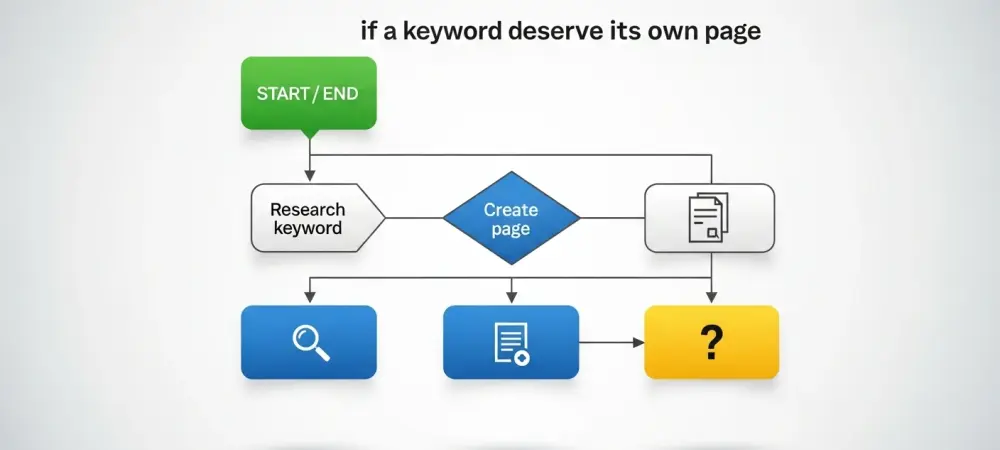
Once the analysis is complete, the marketer must choose the most appropriate path forward, which is not always the creation of a new page. The evidence gathered during the testing phase usually points toward one of four actions: creating a new URL, expanding an existing one, merging multiple pages, or using a scalable template. When the search intent is unique and the content is robust, creating a separate page is the right move. However, if the keyword is a slight variation of a topic already covered, expanding the current page with a new subsection or an updated FAQ can often yield better results by concentrating authority in one place. In situations where a website has already created too many similar pages, merging them is the most effective way to recover lost rankings. This involves taking the best elements from several thin pages and consolidating them into one comprehensive powerhouse URL. For large-scale operations, such as directory sites or international stores, a scalable template allows for the creation of numerous pages that follow a consistent logic, such as location-specific service pages or integration landing pages. This ensures that while the site grows, it maintains a standardized quality and structure. Each of these actions requires a different level of investment and provides a different type of strategic value, making the selection process vital to long-term success.
How Can Performance Data Confirm if a Page Earned its Place?
The final step in the process occurs after the content has been live for enough time to accumulate meaningful data, typically a few months after indexing. Monitoring the performance in Search Console reveals whether the page is attracting the specific query cluster it was designed for or if it is still competing with other parts of the site. If the new page and an old page are constantly swapping positions for the same keyword, it indicates that the search engine still views them as redundant. This feedback loop is essential for refining the content and making necessary adjustments to internal linking or title tags to clarify the distinction between URLs.
Beyond just rankings, user engagement metrics provide the ultimate proof of a page’s necessity. If visitors are landing on the page and immediately leaving, or if the conversion rate is significantly lower than the site average, it may suggest that the keyword does not actually require a dedicated experience. Perhaps the user was looking for a broader overview rather than a niche deep dive. On the other hand, if the page sees high engagement and successfully moves users further down the sales funnel, it has successfully earned its place. This ongoing evaluation ensures that the site structure remains dynamic and responsive to actual searcher behavior rather than relying on static research.
Summary or Recap
The process of determining if a keyword deserves its own page revolves around a series of analytical checks that prioritize quality over quantity. Effective keyword management requires constant vigilance to ensure that new content adds unique value rather than diluting existing authority. By auditing current visibility in Search Console, marketers can identify whether a site already has a foothold in a topic. The page independence test provides a framework for evaluating search result overlap and content uniqueness, while site structure analysis ensures that every new URL has a logical home and sufficient internal support. These steps help prevent the common pitfalls of cannibalization and thin content.
Selecting the correct action—whether it is creating, expanding, merging, or templating—is essential for maintaining a healthy and scalable search presence. The evidence from search engine results pages serves as a guide for how the algorithm views intent, which in turn dictates how the site should be organized. Monitoring performance data after launch provides the final confirmation needed to validate the initial hypothesis. Through this disciplined approach, organizations can build a web presence that is both comprehensive and efficient, ensuring that every page serves a specific purpose for both the user and the search engine.
Conclusion or Final Thoughts
The strategic evaluation of keyword opportunities transformed from a simple volume-based exercise into a complex study of intent and architecture. In the preceding analysis, it was observed that the most successful digital platforms did not necessarily have the most pages, but rather the most intentional ones. Teams discovered that by resisting the urge to publish a new URL for every keyword variation, they could focus their resources on creating deeper, more authoritative resources that commanded higher positions in search results. This shift in perspective allowed for a more sustainable growth model where every update strengthened the core domain rather than fragmenting its reach.
Moving forward, the focus should remain on the evolving nature of search intent as artificial intelligence and natural language processing continue to refine how queries are grouped. The next step for any content strategy is to perform a comprehensive audit of existing assets to identify opportunities for merging or expansion before adding new complexity to the site. By treating the site as a living structure that requires regular pruning and refinement, marketers can ensure their content remains relevant in an increasingly crowded digital landscape. In the end, a keyword only truly deserves its own page if it creates a better, more direct path for the user to find exactly what they are looking for.