

The shifting landscape of artificial intelligence has moved beyond a simple race for speed, evolving into a complex struggle for sustainable memory density and architectural efficiency. While a few dominant players have held a tight grip on the workstation market, the Intel Arc Pro B70 emerges as a disruptive force designed to challenge the status quo. This hardware represents more than just a product launch; it is a calculated attempt to democratize high-level AI computing by addressing the primary bottleneck of modern development: the extreme cost of entry for specialized silicon.
Introduction to the Intel Arc Pro B70 and Xe2 Architecture
Intel’s strategic pivot into professional GPU hardware marks a decisive departure from its history as a secondary player in the graphics space. By targeting the workstation sector with precision, the company is attempting to fill a vacuum left by premium competitors whose pricing has increasingly alienated mid-tier enterprises. The B70 is the vanguard of this movement, representing a shift toward hardware that prioritizes the specific mathematical demands of machine learning and professional rendering over general-purpose consumer features.
At the heart of this transition is the second-generation “Battlemage” (Xe2) architecture. Moving away from the foundational “Alchemist” design, Xe2 focuses on refining how the GPU handles complex data pipelines. This transition is not merely a branding exercise; it reflects a deep internal overhaul aimed at maximizing the utility of every transistor. For professionals, this means a more reliable platform that can handle the rigorous, around-the-clock duty cycles required by modern data science environments without the overhead typically associated with experimental first-generation hardware.
Core Technical Specifications and Performance Drivers
The Battlemage Xe2 Architecture and AI Processing
The mature Xe2 design provides a significant leap in Tera Operations Per Second (TOPS), a metric that has become the gold standard for measuring AI performance. This architecture optimizes the execution of tensor-heavy workloads, allowing for smoother AI upscaling and more efficient computational cycles. By integrating dedicated hardware for matrix multiplication directly into the core design, Intel has ensured that the B70 can process the intricate layers of neural networks with a level of fluidity that previous generations lacked.
Furthermore, the computational efficiency of the Xe2 chip design addresses the power-to-performance ratio that often plagues high-end workstations. Instead of simply increasing raw power draw to achieve results, the architecture utilizes more intelligent scheduling and data caching. This ensures that the specialized AI engines within the chip stay saturated with data, reducing idle time and allowing developers to squeeze more productivity out of the silicon during intense training or inference sessions.
Memory Capacity and High-Bandwidth Subsystem
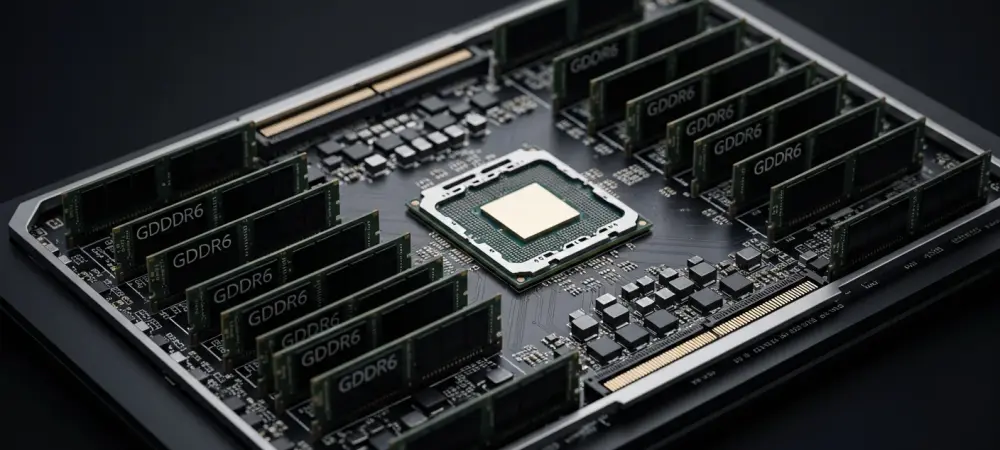
Modern AI models are notoriously “greedy” for memory, and the B70 answers this demand with an impressive 32GB of GDDR6 VRAM. This capacity is supported by an upgraded 256-bit memory controller, creating a robust pathway for data to move between the storage and the processing cores. Such a large memory buffer is critical because it determines whether a complex large language model can run locally or if it must be offloaded to slower system RAM, which often results in a massive performance penalty.
With a bandwidth of 608GBps, the B70 ensures that the high-capacity memory does not become a bottleneck during high-throughput tasks. This subsystem is particularly vital for hosting large, complex AI models that require frequent access to massive datasets. By providing this level of bandwidth in a workstation-class card, Intel allows for a smoother flow of information, which directly translates to faster token generation and more responsive AI-driven applications for the end user.
Strategic Market Positioning and Economic Trends
The most compelling aspect of the B70 is its $949 price-to-performance value proposition. When compared to Nvidia’s RTX Pro 4000 or AMD’s Radeon AI Pro R9700, Intel’s offering provides a significantly lower barrier to entry. This aggressive pricing strategy is a clear signal that Intel is willing to sacrifice short-term margins to capture market share from established giants. It positions the B70 as the go-to option for startups and research labs that require high-density memory but cannot justify the steep premiums charged by the industry leaders.
This market maneuver has already begun to shift investor confidence, reflected in the upward trend of Intel’s stock following the hardware’s announcement. Market analysts recognize that the industry is moving toward more agile and affordable AI infrastructure components. As companies look to scale their internal AI capabilities without inflating their capital expenditures, the B70 represents a pragmatic choice that aligns with the broader economic trend of cost-effective technological scaling.
Real-World Applications and Enterprise Scalability
In practical enterprise environments, the B70 is proving its worth through specialized fanless designs optimized for server racks. These configurations allow data centers to pack high-density compute power into tight spaces without the thermal management issues typical of traditional active-cooled cards. This flexibility makes the hardware ideal for edge computing and localized data centers where space and cooling are at a premium, yet high performance is non-negotiable.
The true power of this hardware is realized through parallel deployments. By pooling memory across arrays of two, four, or eight cards, organizations can create a unified memory space that handles massive datasets far beyond the capability of a single unit. This scalability is essential for multi-user token throughput and hosting large language models (LLMs) in a production environment. Such a modular approach allows businesses to start with a modest investment and expand their hardware footprint as their AI needs grow.
Technical Hurdles and Competitive Limitations
Despite the hardware’s impressive specs, Intel faces a formidable “software moat” built by Nvidia’s proprietary CUDA ecosystem. Most existing AI libraries and development tools are deeply integrated with CUDA, creating a significant hurdle for any newcomer. While Intel has made strides with its open-source initiatives and cross-platform compatibility layers, overcoming the muscle memory of the developer community remains a long-term challenge. Adoption requires more than just good hardware; it requires a seamless transition for the engineers who build the software.
Furthermore, market inertia in the professional workstation segment is difficult to break. Large enterprises often prioritize long-standing relationships and proven software stability over raw price-to-performance metrics. Intel is currently engaged in a massive effort to bridge this gap, providing dedicated support and optimized drivers to ensure that developers feel confident switching to the Xe2 architecture. The success of the B70 will ultimately depend on how quickly Intel can prove that its software environment is as reliable as its hardware is powerful.
Future Development and Long-Term Industry Impact
Looking ahead, Intel is positioning itself as a cornerstone for the next wave of AI infrastructure implementations. The lessons learned from the Battlemage generation will likely influence future pooled memory configurations, potentially leading to even more integrated and efficient architectures. As the demand for localized AI processing continues to rise, Intel’s presence in the market will force a much-needed correction in hardware pricing, driving innovation cycles across the entire sector.
The long-term impact of this release extends beyond a single product line. By offering a high-value alternative, Intel is preventing a monopoly from stagnating the pace of hardware development. This competition ensures that all players in the market must continue to innovate and offer better value to their customers. As architectural iterations continue to evolve, the distinction between high-end and mid-tier hardware will likely blur, resulting in a more accessible landscape for AI researchers and developers worldwide.
Final Summary and Assessment
The Intel Arc Pro B70 successfully demonstrated that high-tier AI capabilities do not necessarily require a prohibitive financial investment. By focusing on substantial memory capacity and an efficient, mature architecture, the hardware offered a compelling alternative for organizations that prioritize scalability and cost-efficiency. The transition from the Alchemist design to the Battlemage Xe2 reflected a professional maturation that allowed the company to move beyond being a mere market follower and instead become a versatile competitor.
As the industry moved toward 2027 and beyond, the influence of this hardware on pricing and infrastructure standards became evident. The B70 provided a blueprint for how agile, accessible silicon could effectively disrupt established software moats and hardware monopolies. The deployment of this technology across server racks and professional workstations catalyzed a shift toward more open and affordable AI development environments. Ultimately, the B70 proved that a well-designed, competitively priced GPU could indeed reshape the AI hardware landscape by providing the necessary tools for the next generation of digital innovation.