

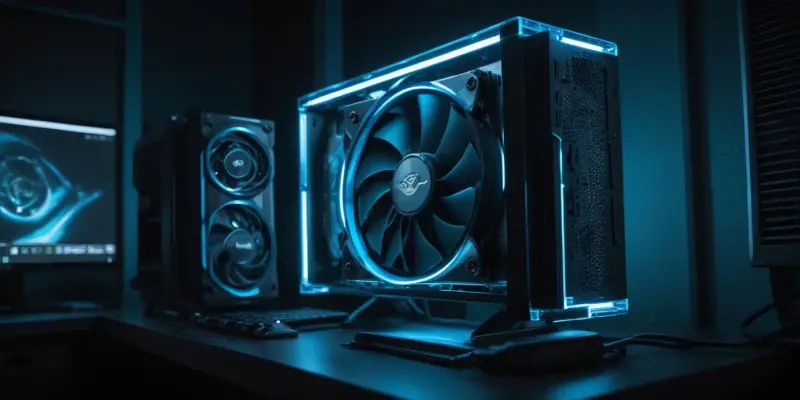
Recent developments in AI have marked a significant transformation in technology, with Nvidia’s latest introduction, Blackwell Ultra, standing out as a pivotal move. Unveiled at the Nvidia GTC event in San Jose, Blackwell Ultra promises to revolutionize AI and autonomous systems with its advanced capabilities. This new platform is designed to enhance AI reasoning, agentic AI, and physical AI applications dramatically. With an impressive improvement in computational power and memory, Blackwell Ultra’s ability to create synthetic, photorealistic training videos for robots and autonomous vehicles further solidifies its position. Major industry players are already gearing up to integrate these human-like AI models to achieve better operational efficiencies.
Unparalleled Performance for AI Applications
One of the most notable aspects of Blackwell Ultra is its substantial boost in computational capabilities. The platform boasts 11 times faster inference for large language models compared to its predecessor, alongside a sevenfold increase in computational power and four times the memory capacity. These advancements play a crucial role in improving the accuracy and efficiency of AI systems, especially during the inference stages. By enabling faster and more accurate analysis of vast datasets, Blackwell Ultra addresses one of the key challenges in AI development – the need for accelerated processing speeds to keep up with the increasing complexity of AI models. Additionally, Blackwell Ultra’s ability to support the creation of photorealistic training videos is expected to significantly impact the development of autonomous vehicles and robotics. By generating high-quality synthetic data, the platform enables more effective training of AI systems, thus enhancing their performance in real-world scenarios. As organizations strive for higher levels of automation and efficiency, the ability to develop and deploy more reliable and sophisticated AI models will be a game-changer. Blackwell Ultra’s integration into the operations of companies like Zoom and Deloitte exemplifies the potential it holds to transform various industries with its advanced AI capabilities.
Seamless Integration and Industry Adoption
Further enhancing its capabilities, Blackwell Ultra allows for AI models to utilize Nvidia’s Grace CPU technology. This enables the decomposition of complex tasks into manageable solutions, thereby optimizing the overall performance of AI systems. This feature becomes particularly important as AI continues to evolve, with more intricate applications requiring robust and efficient processing capabilities. The platform’s availability on Nvidia’s DGX Cloud extends its accessibility, making it easier for organizations to leverage its advanced features without significant infrastructure investments. Several major companies, including Cisco, Dell, Lenovo, and Supermicro, have already committed to integrating Blackwell Ultra into their server systems. This widespread adoption highlights the confidence in Blackwell Ultra’s capabilities and its expected impact on the industry. Additionally, leading cloud service providers like AWS, Google Cloud, Microsoft Azure, and Oracle Cloud will offer instances powered by Blackwell Ultra, making the platform’s advanced features available to an even broader audience. The integration of Blackwell Ultra into these cloud environments underscores the growing demand for high-performance AI platforms that can deliver enhanced computational power and efficiency.
The Road to Physical AI
According to industry experts like Gaurav Gupta, a vice president analyst at Gartner, the advancements in Blackwell Ultra align with the industry’s roadmap towards more autonomous AI systems. While achieving fully autonomous, physical AI remains an aspirational goal, the progress seen in generative and agentic AI serves as critical milestones. Blackwell Ultra’s enhanced computational capabilities and memory support the development of these sophisticated AI models, bringing the industry closer to realizing AI systems that can operate with minimal human oversight in complex settings. However, Gupta also notes the importance of addressing the complexities and safety considerations associated with these advancements.
Nvidia’s focus on creating more human-like AI models with Blackwell Ultra highlights the importance of continuous innovation in AI technology. The platform’s advanced features are poised to drive significant improvements in AI reasoning and autonomous functionalities. Companies across various industries are already recognizing the potential of Blackwell Ultra to transform their operations, with enhanced AI models offering greater efficiency and effectiveness. As the industry continues to evolve, the impact of Blackwell Ultra is expected to be far-reaching, driving advancements in AI applications and setting new standards for computational capabilities.
Moving Forward with AI Innovation
Recent advancements in AI have heralded a significant transformation in technology, with Nvidia’s latest introduction, Blackwell Ultra, emerging as a groundbreaking development. Unveiled at the Nvidia GTC event in San Jose, Blackwell Ultra is poised to revolutionize the fields of AI and autonomous systems due to its advanced capabilities. This innovative platform is engineered to significantly boost AI reasoning, agentic AI, and physical AI applications. Featuring a notable upgrade in computational power and memory, Blackwell Ultra can generate synthetic, photorealistic training videos for robots and autonomous vehicles, enhancing their development and efficiency. Additionally, major industry players are preparing to integrate these advanced, human-like AI models to achieve superior operational efficiencies. The introduction of Blackwell Ultra marks a significant leap forward, promising to reshape how AI and autonomous technologies are developed and utilized in various sectors, from automotive to robotics, making it a key player in the future landscape of technology.