

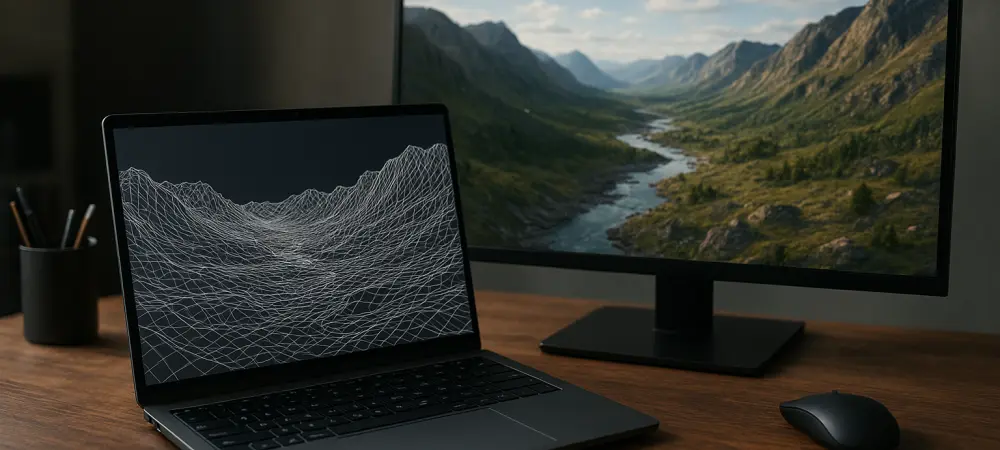
Engineers at Visual Concepts are utilizing neural enhancements to maintain precise creative control over scanned 3D player models within the game engine. This shift represents a fundamental change in how real-time graphics are processed, moving away from traditional rasterization toward a fully integrated neural pipeline. As high-fidelity assets become increasingly complex, the reliance on brute-force hardware power has reached a point of diminishing returns. Nvidia’s latest iteration, DLSS 5, aims to bridge the gap between cinematic quality and interactive performance by leveraging deep learning architectures that go far beyond simple spatial upscaling or frame interpolation. By treating every pixel and polygon as a predictable data point within a temporal sequence, this technology allows for a level of visual fidelity that was previously reserved for offline render farms. The integration of these tools into modern engines like Unreal Engine 6 has already started to transform how light and shadow interact with organic surfaces.
Neural Pipelines: The Shift from Scaling to Synthesis
Building on the foundation of previous temporal upscaling techniques, the current iteration focuses on neural geometry synthesis to alleviate the strain on the vertex pipeline. This advancement allows the hardware to render a significantly lower polygon count while the AI reconstructs intricate surface details in real time, effectively eliminating visual artifacts common in traditional level-of-detail transitions. Such a method ensures that even at extreme distances, objects maintain their structural integrity without the flickering or popping that has plagued open-world environments for years. Moreover, the introduction of neural texture compression enables developers to ship games with higher-resolution assets that occupy a fraction of the traditional VRAM footprint. By utilizing the specialized tensor cores found in the latest GPU architectures, the system can decompress these assets on the fly with negligible latency. This specific approach has redefined the standard for visual density in modern gaming titles. The synergy between the neural software layer and physical hardware has reached a zenith where the distinction between native and reconstructed resolution is virtually imperceptible to the human eye. Modern displays with high refresh rates demand a level of consistency that raw processing power alone struggles to maintain, especially when complex ray-tracing effects are active. DLSS 5 addresses this by implementing a predictive motion vector analysis that anticipates frame transitions before they are fully calculated by the primary render engine. This anticipatory logic significantly reduces the input lag typically associated with AI-generated frames, providing a more responsive experience for competitive players. Furthermore, the efficiency of these neural models has allowed high-end graphics to proliferate on power-constrained devices, such as handheld consoles and ultrathin laptops. This democratization of visuals means that the technical ceiling for artistic expression is no longer dictated by the size of the power supply.
Industrial Impact: Reimagining Content Creation and Delivery
From a developmental standpoint, the shift toward a neural-centric rendering pipeline has necessitated a reimagining of traditional asset creation workflows. Artists are now able to focus on high-level design and aesthetic consistency rather than the technical minutiae of optimizing low-poly proxies or baking complex lightmaps. The current toolsets allow for a more iterative process where changes to a scene’s lighting or geometry are reflected instantly with production-quality accuracy. This efficiency is particularly evident in the creation of hyper-realistic environments where physical accuracy is paramount. By offloading the most computationally expensive tasks to specialized AI models, studios have redirected their resources toward expanding the scope and narrative depth of their projects. This change has not only accelerated development timelines but has also lowered the barrier to entry for smaller teams seeking to achieve AAA-level parity. The transition to these systems marks a milestone in digital art production. The industry transitioned toward these sophisticated neural frameworks because the limitations of traditional silicon scaling became undeniable. Decision-makers in the hardware sector recognized that the path to true photorealism required a departure from linear processing in favor of probabilistic AI-driven reconstruction. Developers who adopted these early neural standards secured a competitive advantage by delivering unprecedented visual quality without sacrificing performance stability. To maintain this momentum, stakeholders focused on standardizing neural APIs to ensure cross-platform compatibility and long-term sustainability. This move encouraged a broader ecosystem where software innovations could outpace hardware refresh cycles. Future considerations involved the integration of these neural models directly into the silicon design phase to further minimize power consumption. By prioritizing the development of robust AI training sets, the community ensured that these tools remained adaptable to various artistic styles.