

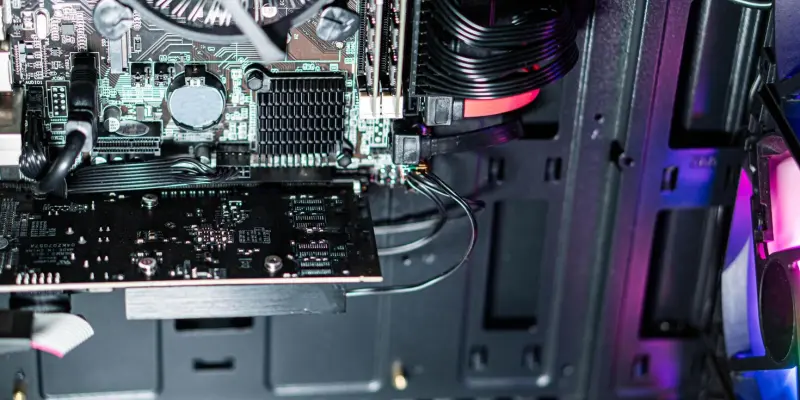
The development of Kioxia’s next-generation optical PCIe 5.0 SSDs represents a major leap in data storage technology, characterized by its ability to operate up to 40 meters from the host system without any performance degradation. By replacing traditional copper connections with optical communication, Kioxia ensures consistent high throughput over these long distances. This innovation has achieved and maintained full multi-gigabyte-per-second speeds, with confirmed successful operation of PCIe 5.0 32GT/s x4 lanes, which delivers double the bandwidth of prior prototypes.
Energy Efficiency and Innovation
This groundbreaking development was made possible through a collaborative effort between Kioxia, AIOCore, and Kyocera, seamlessly aligning with Japan’s NEDO Green Innovation Fund’s objective to cut data center energy consumption by at least 40%. Integral to this project is Kyocera’s OPTINITY optical-electrical module and AIOCore’s photonics-electronics convergence devices, which have been integrated into Kioxia’s existing PCIe 4.0 SSD platform. This strategic focus highlights a dual emphasis on energy efficiency and improved thermal management, which are pressing concerns in modern data centers.
Furthermore, this innovation tackles substantial challenges presented by contemporary data center setups. The ability to place SSDs in separate, cooler rooms up to 40 meters away from CPUs introduces a transformative change, significantly reducing the need for intensive cooling near crucial systems. Optical interfaces also bring additional benefits, including slimmer cabling, more compact drive designs, reduced heat production, and minimal electromagnetic interference. Nevertheless, the journey to seamlessly integrate these optical SSDs into existing data centers poses an ongoing challenge. To that end, Kioxia, AIOCore, and Kyocera are actively working on improving compatibility, with proof-of-concept tests already providing promising results.
Future Implications for Data Centers
While the initial results are promising, Kioxia has yet to announce a specific launch window for these advanced optical SSDs. The potential impact of these storage solutions is immense, as they promise not only to increase energy efficiency but also to boost overall performance in data center operations. This move to optical connectivity marks a strategic pivot towards future-proofing data storage solutions, ensuring they are equipped to handle the escalating demand for data processing and storage. The most compelling advantage of these optical interfaces lies in their potential to deliver sustained high-speed performance across extended distances without traditional drawbacks associated with copper connections. Besides enhancing cooling strategies and spatial efficiency, these SSDs could revolutionize data center designs, promoting a new wave of innovation that optimally balances performance with sustainability. As these technologies evolve, the landscape of data centers is poised for substantial transformation, driven by these advancements.
Conclusion and Future Considerations
Kioxia’s latest development in optical PCIe 5.0 SSDs marks a significant advancement in data storage technology. These state-of-the-art devices can operate up to 40 meters from the host system without any loss of performance. This breakthrough is achieved by substituting traditional copper connections with optical communication, ensuring a consistent and high throughput over such extensive distances. Kioxia’s innovation successfully maintains full multi-gigabyte-per-second speeds, utilizing PCIe 5.0 32GT/s x4 lanes. This configuration delivers twice the bandwidth compared to earlier prototypes, proving the remarkable efficiency of this new technology. This leap forward not only emphasizes a stride in robust and scalable data storage solutions but also sets a new standard for future advancements in the industry. The ability to maintain peak performance over considerable distances will likely influence future designs and implementations of data storage systems, showcasing Kioxia’s commitment to pushing the boundaries of what is possible in digital storage technology.