

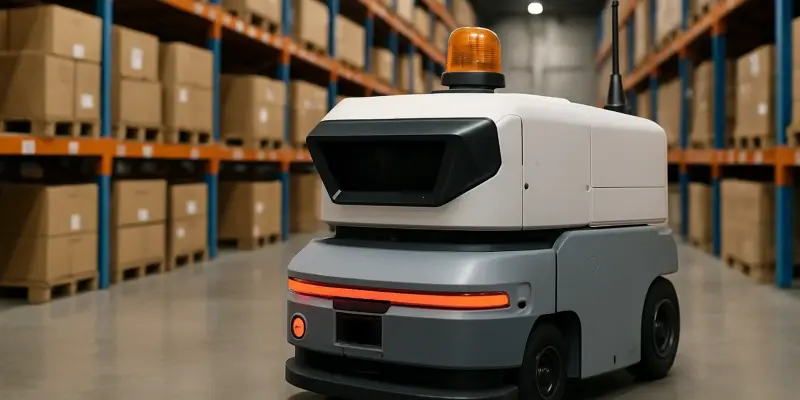
In recent years, Amazon has introduced the Vulcan robot as a groundbreaking advancement in warehouse automation, marking a significant shift in logistics and order fulfillment processes. The Vulcan robot operates within Amazon’s vast fulfillment centers, designed to streamline and enhance the efficiency of warehousing tasks through cutting-edge robotics and artificial intelligence. By integrating advanced technologies, Vulcan aims to offer a sophisticated solution that blends human-like touch sensitivity with automated precision, directly benefiting Amazon’s logistical operations. Its deployment reflects Amazon’s strategic movement towards more autonomous solutions in warehousing, focusing on utilizing technology to complement and augment human labor rather than replace it. As the Vulcan robot transitions from pilot projects to broader beta testing, its capabilities in managing inventory with accuracy and safety come under scrutiny, raising questions about its impact on the future of supply chain management. The robot’s introduction signifies not only a technological innovation but also a potential transformation in how warehouses operate, presenting a case study for the evolving intersection of human expertise and machine efficiency.
The Evolution of Vulcan Robotics
Amazon’s Vulcan robot represents a leap in warehouse technology, moving beyond the traditional confines of old-fashioned automation systems. Comparatively primitive sensor systems from a decade ago have evolved into more complex, multilayered systems, incorporating breakthroughs in machine vision, artificial intelligence, and robotics engineering. The Vulcan robot’s design centers around a sophisticated network of sensors and AI algorithms, each component serving to enhance the dexterity and intelligence of the machine. By combining tactile touch sensitivity, 3D force sensors, and state-of-the-art control systems, Vulcan stands apart in its ability to perform delicate tasks once considered achievable only by humans. Machine learning algorithms play a critical role in Vulcan’s operations, allowing the robot to adapt to varying environments and improve task performance over time. The coupling of robotic systems with AI technologies not only boosts their functional versatility but also augments their decision-making capabilities, an essential trait for contemporary automated systems. Central to Vulcan’s functionality is its ability to seamlessly blend vision technology with force feedback, offering an elevated platform for handling complex warehousing tasks. The trajectory of Vulcan from inception to implementation demonstrates a commitment to enhancing warehouse logistics by embracing robust technological upgrades. Amazon’s strategic insertion of Vulcan into fulfillment centers marks a shift toward smarter warehousing solutions, heightening both functionality and safety within logistical environments. The decision to integrate Vulcan across multiple locations reflects a keen interest in scaling the robot’s adaptability and assessing its role in daily operations. Through systematic testing phases, Vulcan has transitioned from an experimental prototype into an operational asset that aligns with Amazon’s broader goals of enhancing efficiency and reducing operational costs. The challenge lies in ensuring that Vulcan’s implementation does not solely focus on efficiency but also considers the holistic impact on workforce dynamics and the overall operational workflow. As Vulcan progresses through different stages of deployment, its ability to adapt and function within live environments serves as a testament to its robust, iterative design process, solidifying its place in the modern automation landscape.
Functional Mechanisms and Technological Integration
While the Vulcan robot’s imposing structure reaches nine feet tall, its physical dimensions only hint at underlying technological sophistication. The robot’s operations revolve around twin functional phases: picking and stowing, each leveraging the most advanced robotics technologies available. Its picking mechanism begins with conducting eligibility checks via sophisticated imaging systems that match tasks to the robot’s capabilities. This ensures a system where complex judgment tasks are deferred to human operators when necessary. For items deemed suitable, Vulcan leverages a structured light camera, enabling it to create accurate 3D depth maps for precise item selection. By utilizing a combination of machine vision and AI-driven neural networks, Vulcan can partition and segment images to identify respective objects amidst cluttered environments. Advanced frameworks like Mask DINO ensure that Vulcan can seamlessly execute object detection and segmentation, further enhancing its accuracy and efficiency in dynamic scenarios. This ability to integrate tactile grip mechanisms, coupled with precise imaging systems, offers a significant step forward in robotic warehousing solutions. Vulcan’s stowing mechanism mirrors an orchestration of advanced equipment and innovative design, combining conveyor belts and spatula-like tools to enhance organization efficiency. The robot employs stereo cameras and custom-trained algorithms to ensure accurate spatial assessment of storage pods. This technology also focuses on bypassing obstructions using detailed imaging techniques, increasing productivity and providing reliable solutions for storing a variety of items without error. The emphasis on data-driven decision-making is ever-present through constant surveillance, adjusting its methods in real time as it navigates complex warehouse environments. Furthermore, Vulcan’s incorporation of contrastive learning models establishes robust item recognition, unmarred by traditional barcode-scanning restrictions. With the combined application of AI and operational cameras, Vulcan ensures that tasks align swiftly and accurately with logistical demands. The robot’s capacity to assess and create bounding boxes allows it to maximize storage efficiency, aiding in comprehensive systematic organization within Amazon’s fulfillment centers.
Enhancing Human Labor, Not Replacing It
Rather than existing as a replacement, Vulcan serves as a complementary tool aimed at enhancing human labor by tackling repetitive or physically demanding warehouse tasks. Recognizing the potential of Vulcan to aid in operational safety and efficiency, Amazon maintains a focus on utilizing the robot to reduce the occurrence of work-related injuries by mitigating the burden of strenuous tasks. Vulcan’s role involves tackling heavy or precarious tasks, thus providing workers the time and opportunity to engage in higher-value activities. This automation evolution marks a shift where humans transition from task execution to control and management, leveraging Vulcan to handle routine jobs. Informing this narrative is Amazon’s commitment to employee development, empowering staff through focused upskilling programs. Through initiatives like the Reliability and Maintenance Engineering Mechatronics and Robotics Apprenticeship, Amazon not only supports workers in adapting to new technologies but also emphasizes the importance of integrating human skill with automated precision.
As automation continues to permeate various industries, the narrative surrounding Vulcan challenges the traditional view of robots as mere job-takers. By enhancing human capabilities through mechanized assistance, Amazon makes a case for improved workplace conditions and heightened operational output. The presence of Vulcan in warehouses elucidates a synergistic relationship between humans and machines, where technology acts as an enabler rather than a competitor. In redefining this dynamic, Amazon not only ups its efficiency but also fosters a corporate culture that embraces technological advancements while ensuring worker welfare. By leveraging Vulcan’s abilities to lift menial tasks from human handlers, Amazon underscores how blending human intuition with mechanical prowess can drive productivity to new heights. This approach paints a future where innovation does not undermine human roles but rather bolsters them through strategic empowerment and integration.
Future Considerations and Implications
Lately, Amazon’s Vulcan robot has emerged as a pioneering advancement in warehouse automation, representing a major change in logistics and order fulfillment. Designed to enhance efficiency within Amazon’s expansive fulfillment centers, the Vulcan robot employs cutting-edge robotics and artificial intelligence. The goal is to streamline warehousing tasks by merging human-like touch sensitivity with the precision of automation. This innovation aligns with Amazon’s strategic shift towards more autonomous warehouse solutions, aimed at supporting and enhancing human labor rather than replacing it. As Vulcan moves from pilot phases to a broader beta testing phase, its precision in managing inventory is scrutinized, raising important questions about its role in the future of supply chain management. Vulcan’s introduction is not only a technological breakthrough but also suggests a potential evolution in warehouse operations. It serves as a compelling study of how human expertise and machine efficiency increasingly intersect, offering insights into the modern logistics landscape and how it might evolve further.