

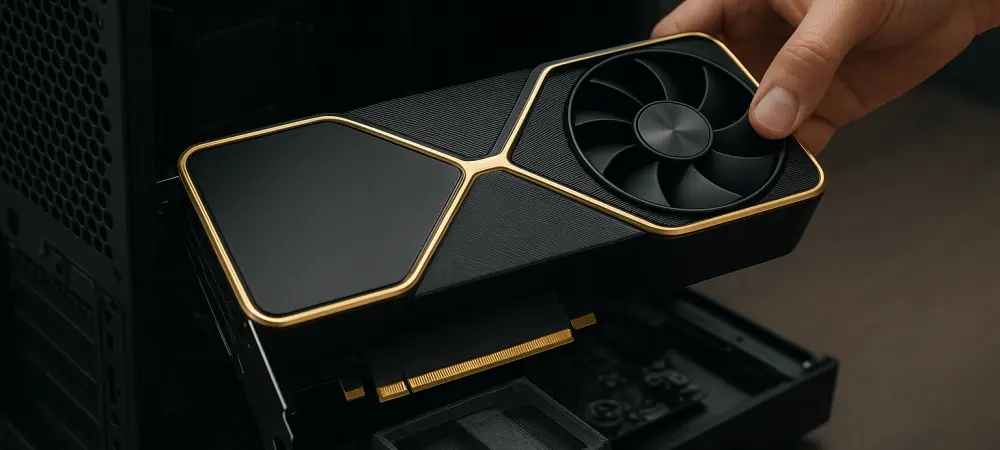
Assembling a high-performance local AI workstation now often involves sourcing retired 2017-era hardware to achieve the necessary throughput for modern inference tasks. While the broader technology sector typically obsesses over the latest nanometer-scale breakthroughs, the artificial intelligence landscape has rediscovered the Nvidia Tesla V100. This graphics accelerator, built on the venerable Volta architecture, was once the crown jewel of data centers but eventually faded into the background as Ampere and Hopper units took center stage. However, the surge in demand for local Large Language Models has fundamentally shifted the value proposition for legacy enterprise silicon. Developers and enthusiasts have realized that the sheer memory bandwidth provided by the V100 remains competitive even against modern mid-range consumer cards. This unexpected resurgence highlights a market where raw specifications, specifically regarding the memory bus, outweigh the benefits of newer architectural features found in modern alternatives.
Efficiency and Architectural Value
The Critical Role of Memory Bandwidth
The primary bottleneck in modern machine learning tasks, particularly when running quantized versions of large models, is rarely the compute clock speed but rather the speed at which data moves from memory to the processor. The Tesla V100 excels here by utilizing High Bandwidth Memory (HBM2), which allows it to reach speeds of approximately 900 GB/s. This is a staggering figure for a card that is nearly a decade old, and it places the hardware in a unique position for handling massive prompt processing and rapid token generation.
In contrast, many contemporary consumer-grade cards rely on standard GDDR6X, which often struggles to maintain the same level of sustained throughput during intensive inference cycles. For a researcher trying to run a 70-billion parameter model locally, the 32GB of VRAM available on specific V100 models provides a much-needed buffer that prevents the system from offloading calculations to significantly slower system RAM. This ensures that the workstation maintains a high tokens-per-second rate, which is essential for interactive model development.
Economic Viability in the Local AI Market
Current market dynamics show a clear trend where enterprise-grade legacy hardware is being repurposed for consumer and small-business AI applications. This shift has led to a noticeable price increase on specialized hardware forums, where the cost of a 32GB V100 has risen by roughly $200 over the past several months. Despite this inflation, the economics still heavily favor the older Nvidia cards when compared to the investment required for a modern professional GPU.
A dedicated enthusiast can construct a fully functional AI server, including a multi-GPU setup with 64GB or even 128GB of total VRAM, for roughly the same price as a single high-end consumer gaming desktop. This democratization of hardware allows smaller entities to experiment with fine-tuning and hosting their own private models without being tethered to expensive cloud subscription services. The V100 is no longer seen as e-waste but as a strategic asset for cost-effective local intelligence.
Integration Challenges and Technical Limitations
Overcoming Thermal and Power Constraints
One of the most significant hurdles when deploying a Tesla V100 in a non-traditional environment is its thermal management system. Unlike consumer graphics cards, these units were designed for rack-mounted servers where high-static-pressure fans in the chassis provide the necessary airflow. They are entirely passive, meaning they have no internal fans to dissipate the 250W of heat they generate under full load. To solve this, users have had to develop innovative cooling solutions to prevent thermal throttling.
These setups often involve 3D-printed shrouds and high-RPM blowers attached directly to the card’s heatsink to maintain stable operating temperatures. While this adds a layer of complexity to the assembly process, it has also fostered a vibrant community of hardware enthusiasts who share designs for converting server hardware for workstation use. This ecosystem further extends the lifecycle of these units despite the physical challenges presented by their original data center-focused design.
Strategies for Sustainable AI Infrastructure
The decision to utilize legacy hardware for modern AI tasks required a shift in perspective toward resource optimization and technical ingenuity. Hardware analysts observed that the raw bandwidth of the Tesla V100 provided a practical alternative to the expensive and often unavailable current-generation accelerators. For those seeking to build robust local workstations, the primary focus moved from seeking the highest clock speeds to securing the largest and fastest memory buffers possible.
This transition encouraged a more sustainable approach to tech consumption, proving that high-end silicon from previous cycles still held immense value for specialized workloads. Moving forward, developers prioritized systems that offered high interconnect speeds and robust thermal solutions to maximize the utility of these legacy units. Investing in adaptable cooling kits and exploring specialized form-factor adapters were essential steps for maintaining performance. Ultimately, the V100 proved that strategic selection bridged the gap between constraints and high-demand tasks.