

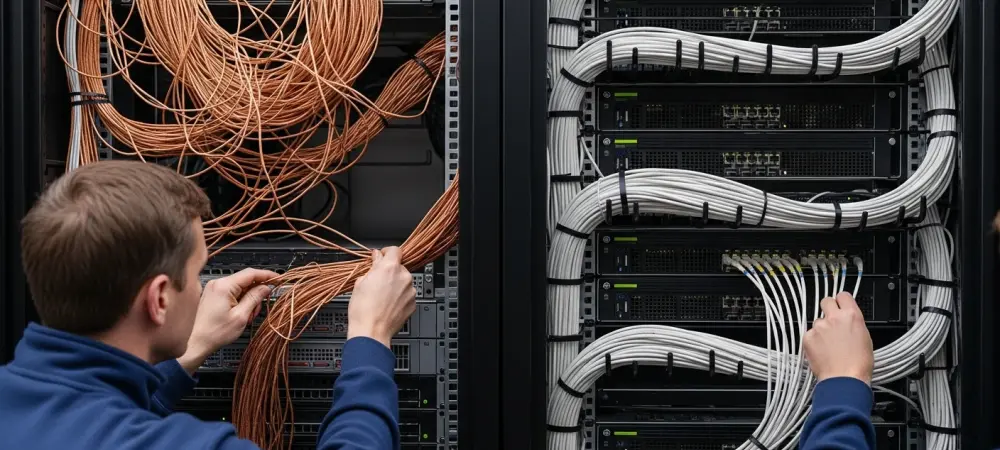
A state-of-the-art artificial intelligence cluster, representing tens of millions of dollars in GPU investment, sits nearly idle, its immense computational power choked not by complex algorithms or power shortages, but by the humble cables connecting it. This scenario is no longer a hypothetical; it is the operational reality in data centers that have prioritized processing power while neglecting the underlying network fabric. As artificial intelligence workloads become more distributed and data-intensive, the focus has shifted from the power of individual servers to the performance of the collective network. Consequently, a robust fiber optic architecture has evolved from a background utility into the strategic control plane governing the performance, scalability, and resilience of modern AI infrastructure.
When a Million-Dollar GPU Cluster Grinds to a Halt, Who’s to Blame?
When an AI training model stalls, the initial diagnostic impulse often targets the GPUs or the software stack. However, the root cause is frequently traced back to the physical network layer, a component historically viewed as simple plumbing. In the world of large-scale AI, where thousands of processors must communicate in near-perfect synchrony, the network is not just a path for data—it is an active participant in the computation itself. An under-provisioned or poorly designed interconnect fabric acts as a permanent bottleneck, ensuring that expensive processors spend more time waiting for data than processing it.
This exposes a critical vulnerability in legacy data center designs. The traditional north-south traffic model, where data flows between servers and end-users, is being supplanted by an east-west superhighway, where massive datasets move laterally between servers within a GPU cluster. This internal communication is constant, dense, and extremely sensitive to delays. Neglecting this internal fabric means that no amount of additional compute power can accelerate the workload, leaving costly assets underutilized and project timelines in jeopardy.
The Great Recalibration: Shifting from a Compute-First to a Connectivity-Critical Mindset
The explosive growth of AI has forced a fundamental recalibration in data center architecture. The industry is moving away from a compute-centric model, where the primary design challenge was packing more processing power into a rack, toward a connectivity-critical mindset. In this new paradigm, the network fabric is co-designed with the compute clusters, recognized as the essential element that unlocks their collective potential. The critical question for operators is no longer simply “How many GPUs can we fit?” but has become “How fast can our network allow these GPUs to communicate?”
This shift is a direct response to the unique demands of AI workloads. Unlike traditional enterprise applications, AI model training involves parallel processing across vast numbers of nodes. Each node must constantly share intermediate results and updates with its peers, creating an unprecedented volume of synchronous, low-latency traffic. Legacy infrastructure, particularly copper-based cabling, was never designed for this level of dense, high-speed interplay and is now being recognized as a primary inhibitor of AI scalability.
Unchoking AI: How Fiber Solves the Three Critical Bottlenecks of Modern Data Centers
The physical limitations of copper cabling create three critical chokepoints for AI performance: bandwidth, latency, and density. AI workloads demand enormous bandwidth to facilitate the “east-west” traffic essential for distributed training. Fiber optics offer vastly superior data-carrying capacity, providing multi-terabit-per-second pathways that allow GPU clusters to function as a single, cohesive supercomputer. Where copper’s signal degrades over short distances, fiber transmits data flawlessly over kilometers, enabling more flexible and expansive data center designs.
Moreover, in distributed computing, every millisecond of latency counts. The slight delays inherent in copper signaling can accumulate across a large cluster, creating significant computational drag and extending training times from days to weeks. Fiber’s ability to transmit data at the speed of light minimizes this latency, ensuring that processors remain synchronized and productive. Finally, as rack density increases, the physical bulk and thermal output of copper cabling become untenable. Thick copper bundles impede airflow, raising cooling costs and creating fire risks. Slender, lightweight fiber cables solve this density dilemma, improving thermal management and allowing for more efficient use of physical space.
From a Single Brain to a Global Nervous System: Fiber’s Role in Distributed AI Operations
Modern AI is not confined to a single building. It operates as a distributed global entity, with model training occurring in one region, fine-tuning in another, and inference deployed at edge locations worldwide. This geographic distribution creates an absolute dependency on high-capacity, inter-data center (inter-DC) fiber connections. These connections function as the central nervous system for the entire AI organism, linking disparate GPU clusters and enabling them to operate in concert.
This fiber-based nervous system provides the low-latency redundancy and diverse routing paths necessary for uninterrupted uptime, a non-negotiable requirement for mission-critical AI services. If one geographic link is compromised, traffic can be rerouted instantly without impacting performance. This inter-DC lifeline is what allows an organization to treat its scattered infrastructure as a single, resilient, and powerful AI ecosystem, ensuring that insights derived from data in one part of the world can be immediately actioned in another.
An Expert’s View: “GPU Cycles May Define AI Performance, but Fiber Defines AI Scalability”
This single statement encapsulates the new reality of data center design. While the processing speed of a GPU determines the raw computational performance of an AI model at a given moment, it is the underlying fiber optic network that dictates whether that performance can scale to meet future demands. Scalability is no longer about adding more servers; it is about having the network architecture in place to support exponential growth in data traffic and interconnected nodes without a corresponding drop in efficiency.
A strategically engineered fiber plant provides the architectural headroom needed for future AI advancements. It allows operators to add capacity, reconfigure clusters, or adopt next-generation hardware without needing to rip and replace the foundational communications layer. This makes the fiber plant the ultimate determinant of an organization’s long-term AI competitiveness, transforming it from a tactical component into a strategic asset that enables sustained growth and innovation.
Blueprint for Agility: Adopting a Modular, Fiber-First Design for Rapid Scaling
Leading data center operators are moving away from bespoke, one-off builds and standardizing on modular, fiber-first blueprints that prioritize speed and predictability. A key strategy involves using pre-terminated fiber trunks and repeatable “pod” designs. This approach allows for consistent, high-quality deployments that can be planned and executed with factory-like precision, dramatically reducing installation time and human error. This modular methodology transforms scaling from a lengthy, complex construction project into a streamlined and predictable operational motion. Instead of waiting months for a custom cabling installation, operators can deploy new capacity or reconfigure interconnects in a matter of days. The foundation of this agility is a resilient, engineered fiber plant designed for proactive management, not reactive patching. By building a well-documented and testable network from the outset, organizations can ensure their infrastructure can keep pace with the rapid cycles of AI model development.
The ESG Advantage: Achieving Sustainability and Efficiency Through Strategic Fiber Deployment
In an era of intense scrutiny from investors and boards, environmental, social, and governance (ESG) performance is a core design input, not an afterthought. A fiber-first architecture directly contributes to superior sustainability outcomes. By replacing bulky, heat-retaining copper bundles with slender fiber optic cables, data centers can significantly improve internal airflow and thermal efficiency. This simple change reduces the burden on cooling systems, a major source of energy consumption. The resulting decrease in power usage translates directly to a lower total cost of ownership and a smaller carbon footprint. Furthermore, a modular, engineered approach to fiber deployment minimizes material waste and the need for rework over the facility’s lifecycle. These quantifiable improvements provide a clear path for operators to meet ambitious emissions targets and demonstrate a tangible commitment to sustainable operations, satisfying the growing demands for responsible infrastructure management.
The organizations that successfully navigated the AI transition were those that recognized this fundamental shift early. They understood that the race to achieve AI dominance would be won not by processing power alone, but by the strategic implementation of superior connectivity. A fiber-first architecture proved to be the linchpin that converged the critical goals of rapid deployment, operational resilience, and ESG performance. Ultimately, the industry leaders who moved beyond pilot projects to build globally distributed AI environments were those who treated fiber as the essential strategic infrastructure it had become—the true backbone of the AI-ready data center.