

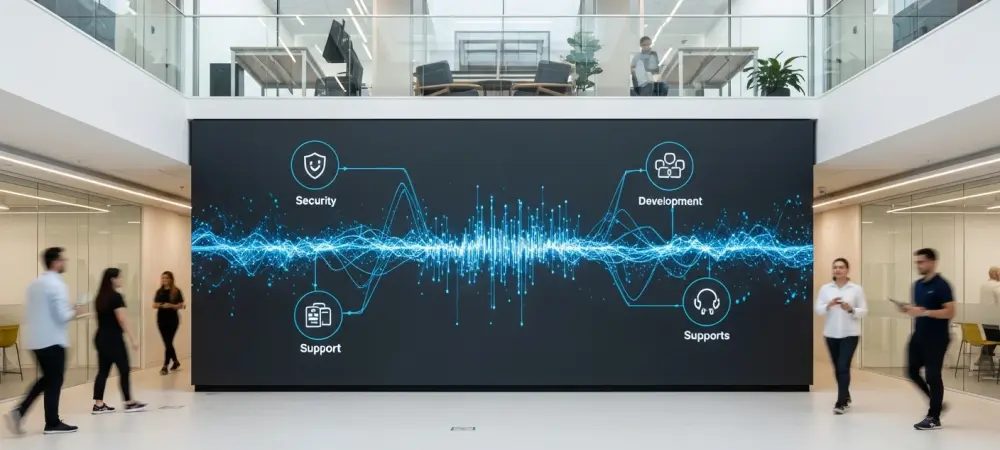
Software engineering teams currently experience a profound paradox where the velocity of individual coding tasks has reached unprecedented heights while the cumulative time required to ship a finished product remains stagnant. Even though artificial intelligence has effectively eliminated the friction once associated with boilerplate generation and unit testing, the modern pipeline is frequently choked by architectural complexities that sit outside the editor. The primary constraint in software development has migrated from the creation of raw code to the complex “wiring” required to connect various teams, specialized tools, and disparate organizational units. As the actual writing of syntax accelerates, the friction points now occur where data must move across the different layers of the integration environment. This transition represents a fundamental shift in the nature of technical debt, where the cost is no longer found in the logic itself but in the fragile bridges that link systems together. By failing to address these connective gaps, organizations risk negating the efficiency gains achieved at the individual level, leading to a state of stalled progress.
Fragmented Ecosystems: The Burden of Intelligent Silos
Current artificial intelligence implementations operate mostly within specific functional boundaries, creating what industry veterans recognize as intelligent silos that isolate expertise within restricted domains. Although developers can generate functional code faster than ever using specialized assistants, the various systems they rely on—such as Jira for project tracking, Snyk for security posture, and Zendesk for customer support—often lack a unified communication protocol. This technological fragmentation forces engineering departments to dedicate significant resources to bridging the gap between tools that were never designed to speak the same language. The manual labor required to synchronize these platforms negates much of the speed gained through automated code generation, as human intervention remains the only reliable way to translate intent across departmental borders. Consequently, the productivity gains realized at the workstation level are often swallowed by the administrative overhead of maintaining a cohesive view of the entire lifecycle. This disconnect leads to a significant “integration tax,” where critical business and technical context is lost during manual handoffs between different departments. Traditional methods like basic webhooks and custom-built scripts are often too brittle to handle the high volume of machine-generated updates, causing a major backlog at every intersection of the modern workflow. When an AI-driven tool produces hundreds of pull requests or security patches in a matter of minutes, the downstream systems often struggle to process the sudden influx of information without human oversight. This creates a scenario where the infrastructure becomes the primary limiting factor, rather than the skill of the developers or the quality of the requirements. Without a more robust way to manage the flow of data, organizations find themselves trapped in a cycle of constant firefighting, where the very tools meant to increase efficiency actually contribute to a growing sense of operational paralysis. This tax is paid in time and innovation, as talent is diverted from core product work to maintenance.
Algorithmic Solutions: Harmonizing the Data Pipeline
A new wave of AI-assisted integration tools is emerging to replace manual configuration with plain-language setups that prioritize accessibility and speed for all stakeholders involved. By using semantic mapping to align different data fields across disparate platforms, these tools reduce the time it takes to build complex, bidirectional workflows from weeks of intensive development to just a few hours of conversational logic. Instead of writing extensive glue code to ensure that a status change in a project management tool triggers the correct response in a deployment script, engineers can now describe the desired outcome in natural language. The underlying system then interprets these requirements and establishes the necessary connections automatically, ensuring that data integrity is maintained throughout the process. This shift allows technical teams to focus on high-level architecture rather than the minutiae of API documentation, effectively lowering the barrier for building highly responsive development environments.
Beyond the initial setup, artificial intelligence provides the resilience needed to maintain these connections by offering contextual troubleshooting for API errors and unexpected schema changes. This creates a consistent feedback loop between departments, ensuring that business context remains intact even as data travels between diverse organizational tenants and third-party vendors. In an environment where software dependencies change on a daily basis, the ability for an integration layer to self-heal or provide intelligent suggestions for repair is invaluable. By monitoring the flow of information in real-time, these smart connectors can identify patterns of failure before they escalate into full-scale outages, allowing teams to address potential issues proactively. This proactive stance ensures that the “wiring” of the organization is not just a passive conduit for data but an active participant in the software delivery process, capable of adapting to the evolving needs of the business without constant manual intervention.
Strategic Evolution: Integrating as a First-Class Concern
For organizations to fully realize the benefits of their modern investments, they must treat the integration layer as a first-class concern rather than a secondary task. Shifting focus toward building a seamless, automated, and resilient data pipeline is the only way to achieve true end-to-end velocity in an environment that is increasingly complex. This trend is expected to accelerate as organizations scale their operations from 2026 to 2028, necessitating a more robust approach to orchestration. This requires a cultural shift where the connectivity between tools is viewed with the same level of importance as the quality of the application code itself. When the integration layer is prioritized, it enables transparency and collaboration that allows teams to move in lockstep regardless of their tooling choices. By investing in the connective tissue of the pipeline, companies can finally break through the bottlenecks that have hindered progress, creating a truly unified workflow that leverages the potential of machine-assisted development.
The realization that integration had become the primary bottleneck prompted a significant reevaluation of how software delivery pipelines were constructed. Engineering leadership began to move beyond point solutions and instead adopted holistic strategies that treated the entire ecosystem as a single, interconnected organism. Organizations that successfully navigated this transition focused on mapping every data dependency to ensure that no context was lost between the development and security layers. They implemented semantic brokers that automatically resolved schema conflicts, which allowed for a truly fluid exchange of information across the supply chain. These efforts moved the focus away from individual productivity toward systemic throughput, establishing a new framework for continuous delivery. Ultimately, the industry shifted its attention toward the invisible threads that bound different stages of the lifecycle together, ensuring that the speed of creation was finally matched by the speed of delivery. This established a baseline for future architectural resilience.