

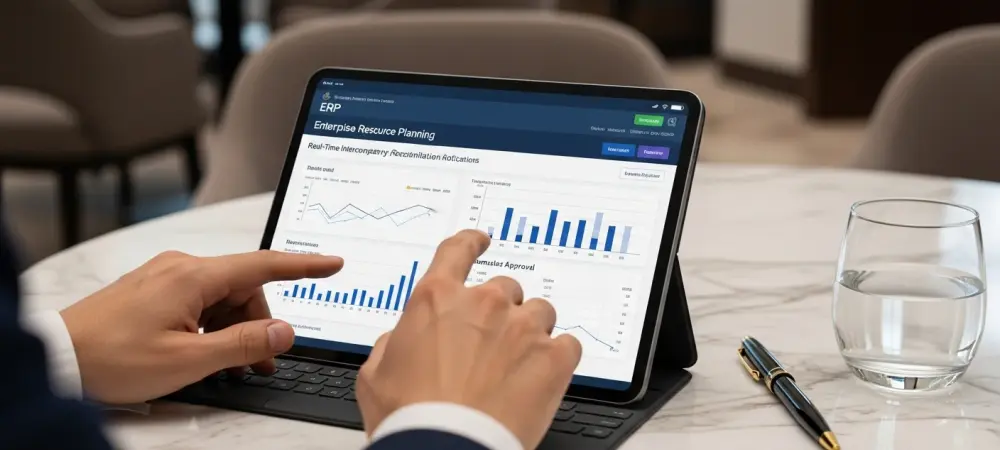
The role of the Chief Financial Officer has undergone a radical transformation, moving from a back-office accounting function to a primary driver of corporate strategy and digital transformation. Dominic Jainy, an IT professional with deep technical roots in artificial intelligence and blockchain, understands better than most how modern enterprise systems act as the nervous system for this evolution. Today, we delve into the intersection of technology and finance, exploring how advanced platforms like Dynamics 365 ERP allow leaders to move beyond the constraints of legacy software. Our discussion covers the critical themes of real-time operational visibility, the automation of complex financial cycles, and the strategic scaling required for global expansion, providing a roadmap for CFOs to reclaim their time and focus on high-impact leadership.
Many finance teams struggle with delayed month-end reports and manual data consolidation. When a CFO gains real-time visibility into liquidity and revenue by business unit, how does this shift their daily decision-making, and what specific metrics should they prioritize to move from reactive to proactive leadership?
The shift from waiting for end-of-month reports to having a live pulse on the business is like moving from a rearview mirror to a high-definition navigation system. When a CFO can access real-time dashboards, they stop managing by looking at what happened thirty days ago and start influencing what is happening today. This immediate access allows for faster, more confident decision-making because the data is current across all departments, entities, and locations. To truly lead proactively, a CFO must prioritize metrics like liquidity, revenue profitability by business unit, and the immediate variance between budget and actual performance. By monitoring working capital trends and outstanding payables or receivables in real-time, they can spot a cash flow crunch before it happens, allowing them to provide the board with data-backed guidance rather than excuses for missed targets.
Strengthening internal governance often involves implementing automated approval workflows and strict role-based access controls. What are the practical steps for balancing these rigorous controls with operational speed, and how do built-in audit trails specifically change the experience of preparing for a high-stakes external audit?
Balancing control with speed requires moving away from manual workarounds and adopting standardized, automated financial processes that live within the system. The first practical step is to implement role-based access controls and clear segregation of duties, ensuring that the right people have the right permissions without creating unnecessary friction. Automated approval workflows for expenses and purchases mean that requests don’t sit in an inbox; they move through a structured, policy-enforced pipeline that maintains momentum while ensuring compliance. When a high-stakes external audit arrives, the existence of built-in audit trails transforms the experience from a stressful, manual search for paper records into a streamlined verification process. Instead of chasing down signatures and spreadsheet versions, the finance team can present a transparent history of every transaction, change, and approval, which fosters immense confidence and reduces the administrative burden of regulatory compliance.
The month-end close is frequently a time-consuming, spreadsheet-heavy ordeal for global departments. Which specific automated features, such as recurring journals or intercompany reconciliations, provide the most significant time savings, and what does a successful transition to a faster closing cycle look like for a finance team?
The most significant time savings in the closing cycle come from eliminating the repetitive, manual data entry that usually plagues the final days of the month. Features like automated recurring journals and simplified intercompany accounting allow the system to handle the heavy lifting of moving figures across different entities without human intervention. By automating invoice matching and bank reconciliations, the finance team can bypass the “spreadsheet hell” that often leads to errors and duplicate work. A successful transition looks like a team that has shifted its focus from administrative data processing to high-level strategic analysis. Instead of spending the first ten days of the month looking backward, the team achieves a faster, more accurate close, giving the CFO earlier access to insights and the freedom to act as a true business partner to other departments.
Relying on static annual budgets can be risky when market costs and customer demand fluctuate rapidly. How can scenario modeling and rolling forecasts be integrated into a company’s routine, and what operational data is most critical to ensure these financial plans stay aligned with real-world performance?
Integrating rolling forecasts into the company routine requires a fundamental shift in how finance connects with operations, moving away from the “set it and forget it” mentality of annual budgeting. By using scenario modeling, a CFO can test different “what-if” situations—such as a sudden spike in material costs or a dip in customer demand—to see how they impact the bottom line before they actually occur. The key is to use integrated operational data from sales, supply chain, and procurement to ensure that financial plans are grounded in real-world performance rather than hopeful projections. This connection allows for real-time comparison of actuals versus forecasts, enabling the organization to be agile and responsive to market changes. When the system provides these insights automatically, budgeting becomes a dynamic, ongoing conversation that helps the business pivot quickly and maintain its competitive edge.
Scaling through mergers or international expansion often creates chaos when dealing with multi-currency transactions and diverse compliance requirements. How can a centralized platform standardize financial structures across new entities, and what strategies help a CFO maintain clear oversight without increasing the administrative burden?
Expansion should be an opportunity for growth, not a source of operational chaos, and a centralized platform provides the cloud-based foundation needed to manage that complexity. By utilizing multi-company and multi-entity management features, a CFO can standardize financial structures and a centralized chart of accounts across every new acquisition or international location. This ensures that even as the business scales into different countries with varying tax and regulatory requirements, the core reporting remains consistent and comparable. Strategies for maintaining oversight include using intercompany transaction tools and global compliance support to automate the “handshakes” between different business units. This allows the CFO to view the entire organization’s performance from a single dashboard, maintaining a clear “bird’s-eye view” of global liquidity and profitability without needing to hire an army of administrative staff to manage the paperwork.
Poor visibility into receivables and excess inventory often puts unnecessary pressure on working capital. Beyond automated invoicing, what specific workflows help optimize the cash-to-cash cycle, and how should a CFO use these insights to strengthen the organization’s financial resilience during periods of economic uncertainty?
Optimizing the cash-to-cash cycle goes far beyond just sending out bills; it requires deep visibility into every stage of the cash lifecycle, from procurement to final collection. Specific workflows like automated collections support and spend control through procurement approvals ensure that cash doesn’t leave the business unnecessarily and that receivables are collected as quickly as possible. Inventory insights are equally vital, as they help identify and reduce excess stock that is essentially cash sitting idle on a warehouse shelf. A CFO should use these real-time insights to build a more accurate cash forecast, which acts as a financial buffer during periods of economic uncertainty. By having a tight grip on liquidity and working capital trends, the leadership team can make disciplined decisions about investments or cost-cutting, ensuring the organization remains resilient even when the external market is volatile.
Many finance professionals spend the majority of their time on repetitive tasks like manual reconciliation and invoice matching. What are the primary hurdles when transitioning these tasks to an automated system, and how can leadership successfully redeploy those human resources toward higher-value strategic analysis?
The primary hurdles to automation are often rooted in a reliance on legacy habits and the fear that moving away from manual spreadsheets will result in a loss of control. Leadership can overcome these hurdles by demonstrating how automated AP workflows and recurring billing processes actually increase accuracy and visibility rather than diminishing it. Once the repetitive work of invoice matching and journal entries is handled by the system, the real challenge and opportunity lie in redeploying the team’s talent. Instead of being “data processors,” these professionals can be retrained as “business partners” who use drill-down reporting and profitability analysis to find new ways to grow the business. By focusing on trend and variance analysis, the finance team moves from merely reporting the numbers to actively shaping the future of the company, which is far more rewarding for the employees and valuable for the organization.
What is your forecast for Dynamics 365 ERP?
My forecast is that Dynamics 365 ERP will evolve from a central repository of data into an intelligent, autonomous co-pilot that proactively identifies financial risks and opportunities before a human even thinks to look for them. We are moving toward a future where “the close” is a continuous process that happens in the background every day, rather than a frantic event at the end of the month. As the integration between finance, supply chain, and sales becomes even more seamless through the Microsoft ecosystem, the platform will enable a level of hyper-agility that was previously impossible. For the CFO, this means the system will stop being a tool they use to record history and start being a strategic driver that provides the predictive insights necessary to navigate a complex global economy. Ultimately, I see this platform becoming the indispensable foundation for any organization that wants to turn its financial function into a genuine competitive advantage.