

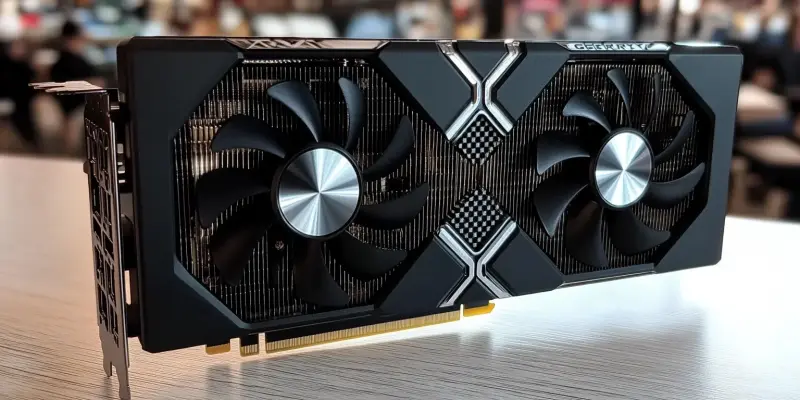
The NVIDIA GeForce RTX 5070 Ti is expected to mark a significant milestone for the gaming industry, bringing with it a host of advancements designed to elevate the gaming experience to new heights. Slated for release within the first half of 2025, this high-end graphics card caters to the needs of gamers who seek unparalleled performance and the latest in graphics technology. As part of NVIDIA’s RTX 50 series, the RTX 5070 Ti distinguishes itself through notable improvements in memory, power consumption, and overall capability, setting a new standard for gaming GPUs.
Enhanced Memory and Performance
One of the most compelling aspects of the RTX 5070 Ti is its robust memory configuration, which promises to deliver a marked improvement in performance over its predecessors. The graphics card is equipped with 16 GB of GDDR7 memory, a leap forward from the GDDR6 memory found in earlier models. Coupled with a 256-bit memory bus, this configuration results in an impressive total memory bandwidth of 896 GB/s. This is a 33% increase in bandwidth compared to the RTX 4070 Ti SUPER, thereby allowing for faster data transfer rates and a smoother gaming experience.
The anticipated specifications of the RTX 5070 Ti also include 8960 cores, which are expected to significantly enhance its processing power. Initial reports suggested a Total Board Power (TBP) of 300W, but the latest information reveals a TBP of 350W. This 23% increase from the RTX 4070 Ti’s 285W TBP indicates that NVIDIA is prioritizing performance gains, even if it means higher power consumption. This shift underscores NVIDIA’s commitment to delivering top-tier gaming experiences that satisfy the demands of both gamers and developers.
Memory Advances and GPU Structure
In addition to the enhanced memory bandwidth, the RTX 5070 Ti’s introduction of GDDR7 memory marks a substantial technological advancement for the entire RTX 50 series. The new memory standard is clocked at 28 Gbps, contributing to the card’s ability to handle more data at faster speeds. This change is part of a broader trend in the GPU industry, as manufacturers seek to push the boundaries of what is possible in terms of graphics performance and efficiency.
The RTX 5070 Ti will be built around the GB203-300 GPU, a cut-down version of the GB203-400 chip used in the higher-end RTX 5080. This strategic approach allows NVIDIA to offer similar core performance at a more accessible price point, without compromising on quality. The use of cut-down versions for “Ti” variants is not new for NVIDIA; it ensures better performance alignment within their product tiers while providing gamers with a range of options tailored to different needs and budgets.
Strategic Positioning in the Market
NVIDIA’s strategy with the RTX 5070 Ti extends beyond just the technical specifications, as the company aims to position this graphics card as a competitive option in the high-end GPU market. This involves balancing the need for improved performance with considerations around power consumption, cost, and overall value. By increasing the TBP, NVIDIA is making a calculated trade-off, betting that the gains in performance will outweigh the rise in power requirements. This approach is particularly relevant for high-end gaming and intensive applications where every bit of extra power can translate into a better user experience.
The RTX 5070 Ti is part of a broader lineup of six RTX 50 “Blackwell” products, all of which are expected to launch in the first half of 2025. This includes flagship models like the RTX 5090 and RTX 5080, as well as more accessible options like the RTX 5070 and RTX 5060. The key differentiators among these products will be the number of GPU SMs (streaming multiprocessors), cores, memory capacity, memory bus width, and TBP. This range ensures that NVIDIA has a suitable product for every segment of the market, from casual gamers to professional developers.
Conclusion and Future Implications
The anticipated release of the NVIDIA GeForce RTX 5070 Ti is set to represent a significant leap forward in the gaming sector, promising an array of groundbreaking enhancements aimed at delivering an extraordinary gaming experience. Scheduled for launch in the first half of 2025, this top-tier graphics card is specifically designed for gamers seeking unmatched performance and state-of-the-art graphics technology. As a key member of NVIDIA’s RTX 50 series, the RTX 5070 Ti stands out through substantial advancements in memory, energy efficiency, and overall performance capabilities, establishing a new benchmark for gaming GPUs.
NVIDIA’s commitment to innovation is evident in the RTX 5070 Ti, which is expected to set new standards in rendering, ray tracing, and AI-driven graphics enhancements. Gamers can look forward to smoother frame rates, more realistic visuals, and faster loading times, all contributing to a significantly improved gaming experience. The RTX 5070 Ti not only promises higher efficiency in power consumption but also a robust construction designed to meet the rigorous demands of modern gaming. This release is poised to redefine what gamers can expect from graphics technology in the coming years.