
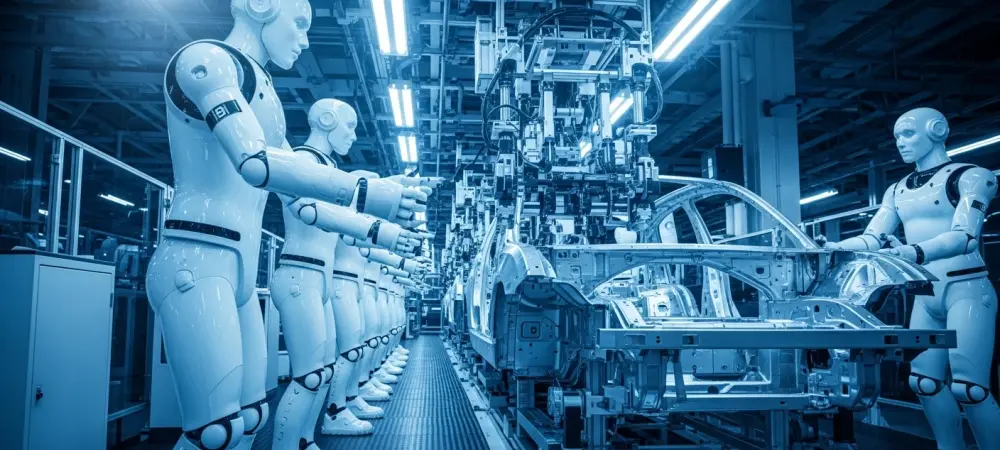
What’s Driving the $9.9B Humanoid Actuator Boom?

Article Highlights
Off On

A monumental financial surge is quietly underway within the robotics industry, with projections indicating the global market for humanoid robot actuators will skyrocket from a modest base to nearly $9.9 billion by 2031. This explosive expansion is not merely a forecast but a reflection of a fundamental shift, as humanoid robots move decisively from experimental pilot programs into widespread commercial and industrial applications. At the heart of this transformation are actuators, the intricate components that function as the muscles and joints of these advanced machines. These systems are responsible for converting software intelligence into physical motion, defining a robot’s dexterity, balance, and strength. The escalating demand for more capable robots in sectors such as manufacturing, logistics, and healthcare is directly fueling the need for higher-performance actuators, marking a critical turning point where the underlying hardware becomes as important as the controlling AI.

The Technical and Geographic Forces at Play

The increasing deployment of humanoids in demanding industrial environments is a primary catalyst for this market acceleration, as factories and warehouses require robots with actuators capable of enduring higher loads, longer duty cycles, and sustained mechanical stress without failure. Consequently, manufacturers are intensely focused on developing and sourcing actuators that deliver exceptional precision control, a compact design for seamless integration, high energy efficiency to extend operational time, and uncompromising durability for a reliable return on investment. Geographically, this growth is not uniform. The Asia Pacific region has emerged as a major hub, driven by a widespread push for manufacturing automation and the establishment of sophisticated supply chains. Concurrently, North America is a significant growth area, with its strong emphasis on advanced robotics research and the burgeoning demand for service robots in commercial and public spaces. Ultimately, the future success of suppliers in this burgeoning field will depend heavily on their ability to provide customized, scalable, and easily integrated actuator solutions tailored to the specific needs of a diverse and rapidly expanding client base.

Explore more

The Fastest Way to Land a New Job in 2026

Ling-yi Tsai is a distinguished HRTech strategist with over two decades of experience helping organizations and individuals navigate the intersection of human talent and advanced technology. As an expert in HR analytics and recruitment systems, she has a unique vantage point on how the “resume tsunami” of the mid-2020s has fundamentally altered the hiring landscape. Her approach moves beyond simply

Trend Analysis: Autonomous Driving Marketing Regulations

The sleek aesthetic of modern dashboards belies a growing tension between the hyperbolic language of Silicon Valley and the rigid safety mandates of government regulators who are currently redefining the boundaries of commercial speech. The central conflict lies in whether a product name is merely a marketing tool or a critical safety instruction that dictates how a human interacts with

Ecommpay Unveils New Guide to Combat Rising E-commerce Fraud

The sheer scale of digital financial theft has reached a tipping point where traditional defense mechanisms often fail to protect the modern merchant. With the UK payment sector facing a staggering loss of £1.17 billion in 2026, Ecommpay has released a specialized resource titled E-commerce fraud defence: A quick guide for merchants. This initiative aims to equip businesses with the

How Do Unified Platforms Simplify European Payment Scaling?

NavigatingthelabyrinthineregulatoryenvironmentandtechnicalfragmentationoftheEuropeanpaymentlandscaperequiresalevelopfoperationalagilitythatmanytraditionalfinancialinstitutionsstruggletomaintaineffectively. As cross-border commerce continues to accelerate throughout 2026, the demand for seamless account-to-account transactions has forced fintech leaders to rethink their underlying infrastructure. The recent expansion of the strategic partnership between Form3 and the global fintech giant SumUp serves as a landmark example of this shift. By moving beyond their initial collaboration on United Kingdom payment rails, such as

Should You Retrofit or Rebuild Data Centers for AI?

The global landscape of digital infrastructure is currently grappling with a monumental shift as generative models and high-density computing clusters rapidly outpace the thermal and electrical capacities of facilities designed and built just a few years ago. This evolution has forced a critical evaluation of existing assets, pushing operators to decide whether to adapt their current inventory or start from