

The Ghost in the Machine: Why Massive Facilities Run on Skeleton Crews
Standing before a million-square-foot data center often feels like witnessing a monolith of the future, yet the quiet parking lot suggests a facility that has been entirely abandoned. While these structures might consume enough electricity to power a mid-sized metropolitan area, the human presence required to maintain them is remarkably small. This discrepancy between the physical footprint and the workforce is not an accident of architecture but a deliberate result of extreme operational efficiency. Modern digital infrastructure relies on a design philosophy that prioritizes hardware density and automated systems over a dense population of workers.
Understanding this “ghost in the machine” phenomenon requires looking beyond the sheer volume of concrete and steel. The reality is that the digital economy depends on a highly optimized ratio of personnel to processing power. Unlike traditional manufacturing where more production capacity usually necessitates more employees, data centers scale their capacity by increasing the complexity of their cooling and power systems, which allows a single technician to oversee vast swaths of computing power. Consequently, these facilities represent some of the most labor-efficient structures on earth, where the ratio of square footage to staff remains uniquely low.
Moving Beyond the Blueprint: Defining Modern Operational Headcount
To accurately evaluate how a facility functions, analysts must draw a sharp line between the temporary chaos of construction and the rhythmic cycle of steady-state operations. A data center site might host thousands of electricians and specialized contractors during its final build phase, but once the “go-live” signal is given, the population drops precipitously. What remains is a core group of professionals dedicated to maintaining uncompromising service level agreements that demand near-perfect uptime. This workforce represents the permanent heartbeat of the facility, providing a level of physical oversight that even the most advanced software cannot replicate.
The headcount at these facilities is dictated by the relentless nature of 24/7 digital services, which never experience a true closing time. Because servers do not stop for holidays or weekends, the total employee roster is generally five times larger than the number of individuals actually present on the floor during any single shift. This rotation ensures that redundant skills are always available to handle a midnight hardware failure or a sudden fluctuation in the regional power grid. This operational reality is shaped by the need for a persistent human presence that can respond to emergencies in seconds, even if the majority of their shift is spent in quiet observation.
The Four Pillars of Technical On-Site Functions
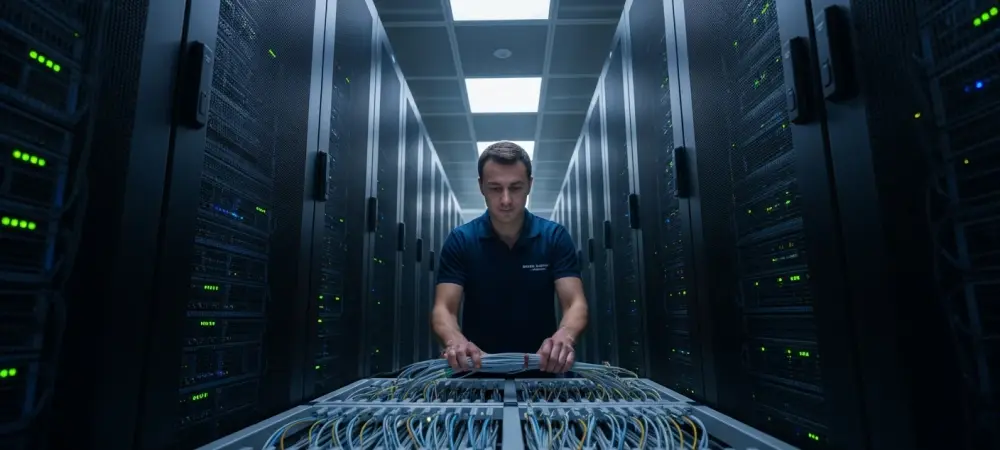
Maintaining the “five nines” of reliability—meaning the facility is operational 99.999% of the time—requires a workforce divided into specific technical quadrants. Information technology technicians form the first pillar, managing the physical “racking and stacking” of servers and the intricate cable management that remote software engineers simply cannot touch. Their work is the physical bridge between the cloud and the earth, ensuring that every piece of silicon is properly connected and cooled. This hands-on labor remains essential as the density of hardware makes physical maintenance more delicate and labor-intensive.
The remaining three pillars focus on the mechanical and structural health of the environment. HVAC and cooling specialists manage increasingly complex thermal zones, while electrical engineers monitor the power chain from the utility substation down to the individual uninterruptible power supply units. Surrounding these technical roles is a layer of logistics and security personnel who enforce rigorous physical access protocols. This multidisciplinary team creates a safety net that protects the hardware from environmental threats and human error alike, ensuring that the facility remains compliant with global safety and security standards.
The Impact of High-Density AI Workloads and Regional Talent Gaps
The rise of artificial intelligence has introduced a new variable into the staffing equation, as high-density workloads demand more frequent physical interventions than traditional enterprise computing. Liquid-cooled systems and accelerated computing clusters are far more temperamental than their predecessors, often requiring specialized maintenance that automated tools cannot yet perform. Industry experts have observed that as power densities increase, the need for specialized on-site technicians grows in tandem, reversing some previous trends toward total automation. This shift suggests that the era of AI actually requires a more robust human touch to manage the volatile thermal output of high-performance chips.
Geography further complicates the staffing landscape, creating a counterintuitive relationship between location and headcount. In major tech hubs, operators can maintain leaner on-site teams because they have immediate access to a deep pool of specialized contractors who can be summoned at a moment’s notice. However, remote “edge” data centers often require a larger permanent staff of “generalist” technicians who must be capable of fixing anything from a leaky pipe to a fried motherboard. This need for self-sufficiency in rural areas often drives up operational headcount, as waiting for a specialist to travel from a major city could result in unacceptable periods of downtime.
Strategies for Balancing Automation with Human Oversight
Operators who successfully optimized their headcount did so by shifting their focus from routine manual monitoring toward high-level technical troubleshooting. This transition leaned heavily on the implementation of sophisticated Data Center Infrastructure Management software, which took over the mundane tasks of checking temperatures and power loads. By the time these facilities reached peak operational maturity, the human staff had evolved into a core team of senior engineers who specialized in the unique idiosyncrasies of local architecture. This shift allowed the workforce to focus on preventative maintenance and strategic upgrades rather than reactive repairs.
This strategic evolution allowed facilities to remain lean while simultaneously improving their ability to manage the complexities of liquid-cooled, high-density infrastructure. Moving forward, the industry prioritized deep technical agility over sheer volume, ensuring that every on-site worker possessed the diverse skills necessary to navigate a rapidly changing hardware landscape. Those who invested in specialized training and remote-hands integration discovered that they could maintain the highest standards of reliability with a workforce that was as precise and efficient as the machines they served. This model proved that the future of digital infrastructure lay not in larger teams, but in smarter, more specialized ones.