

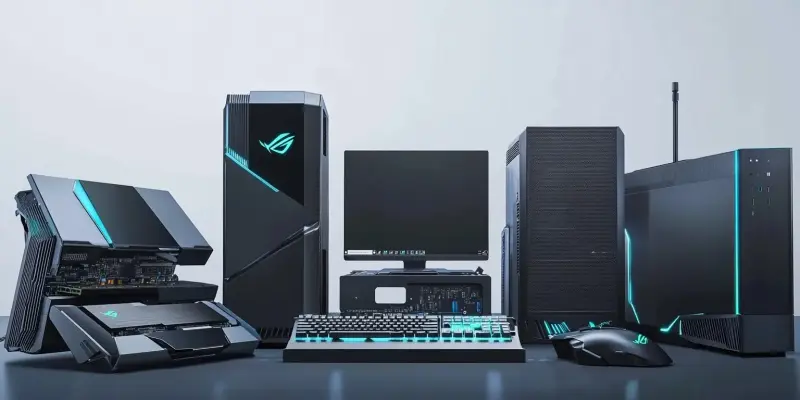
The year 2025 is set to be an exciting time for PC hardware enthusiasts, with major releases from industry leaders Nvidia, AMD, and Intel. These forthcoming hardware launches are anticipated to significantly elevate performance standards, introduce new features, and alter market dynamics. Enthusiasts and professionals alike are eager to witness how these advancements will reshape the landscape, impacting everything from gaming to computational tasks.
Nvidia GeForce RTX 5000 Series
Nvidia is expected to take the lead in January 2025 with the launch of its GeForce RTX 5000 series graphics cards, generating substantial anticipation within the tech community. The series includes the high-end RTX 5090, RTX 5080, and the mid-range RTX 5070, aiming to build upon the success of the previously acclaimed RTX 40 Super series. These new models promise impressive advancements in performance, integrating technologies such as PCIe 5.0 and continuing the use of 16-pin 12VHPWR connectors.
The RTX 5090 is perhaps the most talked-about model in the lineup, due to its rumored price tag of $2,500. This significant price increase marks the card’s premium nature and anticipated unparalleled performance for both gaming and professional applications. The RTX 5080 and RTX 5070 are also expected to see price hikes of around 50% compared to their predecessors, positioning them as high-end options for enthusiasts who prioritize cutting-edge performance. These pricing trends suggest a market shift where top-tier products are becoming more distinguished from mid and low-end offerings, reflecting Nvidia’s strategy to maintain its leadership in the high-performance segment despite higher consumer costs.
AMD Radeon 9000 GPUs
In contrast, AMD is taking a strategic approach with its Radeon RX 9000 series, targeting the mid-range graphics card market and aiming to capture a broader audience. The RX 9070 XT and RX 9700 are expected to be the flagship models of this series, each featuring robust 16GB of memory. By focusing on the mid-range, AMD aims to strengthen its market presence without directly competing with Nvidia’s flagship models, thereby carving out a niche in the volume-oriented segments.
The RX 9000 series is designed to offer strong performance at more attractive price points, making it an appealing option for gamers and professionals looking for a balance between cost and capability. This strategy allows AMD to provide compelling alternatives to Nvidia’s high-end models, highlighting its commitment to addressing the needs of price-sensitive consumers. AMD’s focus on the mid-range market with the RX 9000 series is expected to deliver significant improvements in performance and efficiency, ensuring that it remains a robust contender in the competitive graphics card market.
AMD Ryzen 9 9950X3D and 9900X3D
Beyond its new GPUs, AMD is also set to revolutionize the processor market with the launch of its Ryzen 9 9950X3D and 9900X3D processors. These high-core-count processors are poised to bring substantial improvements in both gaming and general performance, thanks to the innovative 3D V-Cache technology. This technology enhances performance by increasing the amount of cache available to the processor, addressing some of the concerns previously raised about Ryzen models.
The Ryzen 9 9950X3D and 9900X3D have been eagerly anticipated following the mixed reviews of their predecessors in the Ryzen 9000 series. These new models are expected to deliver better performance in gaming and computational tasks, making them attractive options for both enthusiasts and professionals. AMD’s dedication to improving performance through cutting-edge technologies like 3D V-Cache underscores its commitment to maintaining competitiveness in the processor market, setting new standards for what consumers can expect from high-end CPUs.
Cheaper Motherboards
To complement the new processors, both AMD and Intel are expected to introduce more affordable motherboards to the market. These motherboards, including AMD’s B850 and Intel’s B860 chipsets, are aimed at providing budget-friendly options without sacrificing cutting-edge features. With support for Wi-Fi 7, USB 4, and PCIe 5, these new motherboards promise to make the latest platforms more accessible to a broader audience.
The release of these affordable motherboards reflects a broader trend towards democratizing access to advanced computing power. By offering budget-friendly options with high-end features, AMD and Intel aim to attract a wider range of consumers, from cost-conscious gamers to professionals looking for efficient and economical solutions. These motherboards are expected to play a crucial role in the adoption of the newest GPUs and processors, providing a solid foundation for building high-performance systems without overwhelming costs.
Intel ARC B570 Graphics Card
Intel continues to assert its presence in the graphics card market with the highly anticipated ARC B570. Expected to release on January 16th, the ARC B570 is priced competitively around $220 and aims to offer strong performance for its price point. This model follows the positive reception of the ARC B580 and is designed to provide a compelling alternative to offerings from Nvidia and AMD, reinforcing Intel’s commitment to competitive pricing and performance.
The ARC B570 is poised to be a game-changer in the lower price segments, catering to consumers looking for reliable performance without exorbitant prices. By pricing their graphics cards competitively, Intel is positioning itself as a strong contender in the market, potentially disrupting the status quo dominated by Nvidia and AMD. Intel’s strategic move to bolster its presence in the more affordable segment indicates a focused attempt to offer excellent performance-per-dollar value, challenging its competitors in the budget-conscious space.
Conclusion and Final Observations
The year 2025 promises to be an exhilarating period for PC hardware enthusiasts, as the industry braces for major releases from tech giants Nvidia, AMD, and Intel. These upcoming launches are expected to set new benchmarks for performance, bring innovative features to the forefront, and shake up the market dynamics considerably. PC aficionados and professionals are buzzing with anticipation, eager to see how these technological advancements will transform the landscape of computing.
Gaming enthusiasts are particularly looking forward to more immersive experiences, driven by heightened graphical capabilities and faster processing speeds. Meanwhile, those involved in computational tasks—such as data analysis, 3D rendering, and machine learning—are hoping for more efficient and powerful hardware that can handle increasingly complex workloads.
Speculation is rife about what Nvidia’s next-gen GPUs, AMD’s new processors, and Intel’s advancements will bring to the table. The potential for radical changes in everything from personal computing to enterprise solutions is immense. As 2025 approaches, the tech community remains on tenterhooks, awaiting a new era of innovation in PC hardware that could redefine expectations for years to come.