

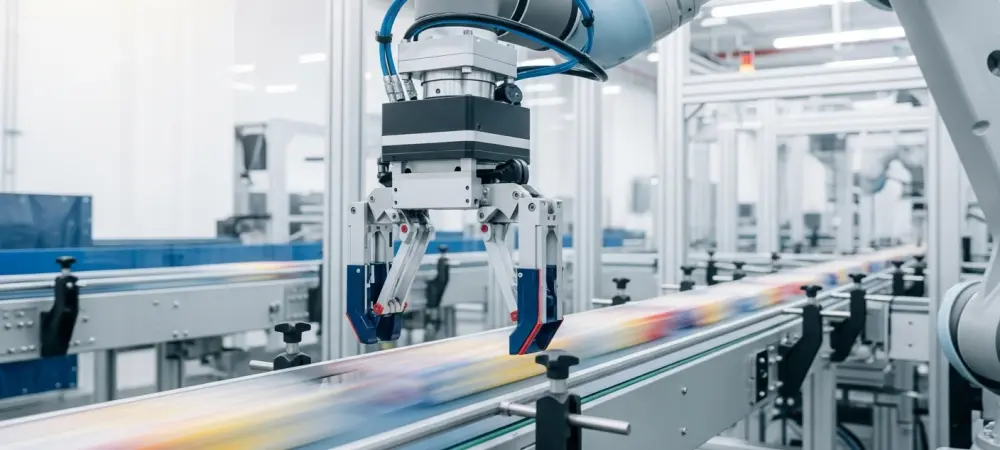
The convergence of advanced imaging and high-speed motion control has transformed static manufacturing lines into dynamic, self-correcting ecosystems capable of handling unprecedented complexity. Vision-guided robotic picking represents a significant advancement in the packaging and automation industry. The review will explore the evolution of the technology, its key features, performance metrics, and the impact it has had on various applications. The purpose of this review is to provide a thorough understanding of the technology, its current capabilities, and its potential future development. By integrating sophisticated software with high-precision hardware, manufacturers are now addressing the persistent challenges of the modern factory floor.
Foundations of Modern Vision-Guided Robotics
Vision-guided systems function as the primary sensory interface for industrial automation, effectively providing mechanical arms with “eyes” to navigate their environment. This technology serves as a vital solution to the industry’s “double shortage,” which involves both a lack of general manual labor and a critical scarcity of specialized robotics programmers. By automating the visual identification of objects, facilities can operate with fewer human interventions while maintaining high standards of quality.
The emergence of simplified software, such as PickMaster Lite, has significantly lowered the barrier for entry into high-end automation. This transition toward accessible programming allows original equipment manufacturers to streamline their workflows without needing to hire a dedicated team of software engineers. The core principle lies in democratizing access to complex motion control, ensuring that even facilities with limited technical resources can implement advanced picking cells.
Core Technical Pillars of Picking Software
Integrated Vision and High-Speed Conveyor Tracking
Modern picking software relies on the seamless fusion of 2D and 3D vision systems to identify item features, location, and orientation on the fly. This capability is essential for handling irregular objects that arrive in random configurations. High-speed conveyor tracking allows robots to pick items while the belt moves at speeds of up to 100 meters per minute. This continuous motion eliminates the inefficiencies associated with start-stop production lines, directly translating into higher throughput.
No-Code Programming and Process Blueprints
The shift from traditional line-by-line coding to intuitive, blueprint-based environments has redefined the relationship between the operator and the machine. Predefined process templates enable floor staff to configure complex workflows through visual interfaces rather than abstract syntax. This approach reduces training time and empowers staff to make rapid adjustments to the production line, ensuring that the facility remains responsive to changing market demands without requiring external engineering support.
Motion Planning and Collision Avoidance
Sophisticated software translates user instructions into fluid, curved 3D trajectories that maximize mechanical efficiency. Built-in collision avoidance rules act as a critical safeguard, protecting both the expensive robotic hardware and the personnel working in proximity. By optimizing robot paths, the system minimizes mechanical wear and tear, which extends the operational lifespan of the equipment while simultaneously shaving milliseconds off cycle times.
Scalable Connectivity and System Architecture
Modern installations prioritize scalable connectivity by integrating with universal controllers and fieldbus protocols such as Modbus TCP, EtherNet/IP, and PROFINET. This “plug-and-play” architecture allows for the easy connection of Programmable Logic Controllers and Human-Machine Interfaces. The ability to support multiple robots and cameras within a single framework ensures that as a business grows, its automation infrastructure can expand without requiring a complete system overhaul.
Innovations in Simplified Robot Commissioning
The use of digital twin technology has revolutionized how picking cells are brought online. By utilizing simulation tools like RobotStudio, engineers can test and refine setups in a virtual space before any physical hardware is installed. This process identifies potential bottlenecks and mechanical conflicts early, significantly reducing the risks associated with deployment.
Recent trends have moved toward decentralized camera result sharing and process load balancing across multiple robot cells. This intelligence ensures that no single robot is overwhelmed while others remain idle, maximizing the overall efficiency of the installation. Pre-configured software modules have cut commissioning time by nearly a quarter, allowing facilities to achieve a faster return on investment.
Practical Implementations in Manufacturing and Logistics
Real-world deployment in the packaging sector has demonstrated the effectiveness of these systems in high-speed sorting and kitting operations. In the food and beverage industry, where hygiene and speed are paramount, vision-guided robots provide a sterile and consistent alternative to manual handling. These systems manage delicate items with precision, reducing waste caused by mechanical damage.
Notable implementations by original equipment manufacturers have led to the creation of standardized picking cells. These pre-assembled units are being distributed globally, providing a “turnkey” solution for companies that need to modernize their logistics quickly. The ability to handle diverse product types with minimal reconfiguration has made these cells a staple in modern distribution centers.
Barriers to Adoption and Technical Hurdles
Despite the benefits, integrating new software with legacy factory equipment remains a significant challenge. Older hardware often lacks the processing power or connectivity required to interface with modern vision algorithms. Furthermore, the high initial cost of precision 3D sensors can be a deterrent for small and medium enterprises. Technical limitations also persist when handling highly reflective or transparent objects, such as glass or certain plastics, which can confuse standard vision sensors. While progress is being made, standardizing protocols across different robotics manufacturers remains an ongoing effort. These hurdles require careful planning and a balanced approach to investment during the modernization process.
The Trajectory of Autonomous Picking Solutions
The potential for Artificial Intelligence and Machine Learning to further automate pick-and-place optimization is the next frontier. Future breakthroughs will likely involve “edge-to-cloud” connectivity, where real-time performance data from multiple sites is aggregated to optimize global supply chains. This level of insight will allow for predictive maintenance and even more refined motion planning based on vast datasets.
As high-performance automation becomes more accessible, even small enterprises will be able to compete on a global scale. The long-term impact on the supply chain will be a shift toward localized, highly flexible manufacturing hubs. These facilities will use autonomous systems to adapt to consumer trends with unprecedented speed and efficiency.
Final Assessment of Modern Robotic Picking Systems
The evolution of vision-guided robotic systems demonstrated a clear shift from rigid, high-cost engineering toward flexible, user-centric automation. Measurable gains in throughput and the reduction of commissioning effort validated the move toward simplified software solutions like PickMaster Lite. These tools effectively bridged the gap between complex robotic capabilities and the immediate, practical needs of the manufacturing floor.
The industry moved toward a future where the “double shortage” of labor and expertise no longer served as a total barrier to progress. This technological shift laid the groundwork for more resilient supply chains that thrived on adaptability. Moving forward, the focus must remain on refining sensor accuracy for difficult materials and ensuring that smaller facilities can continue to adopt these advancements through scalable, cost-effective models.