

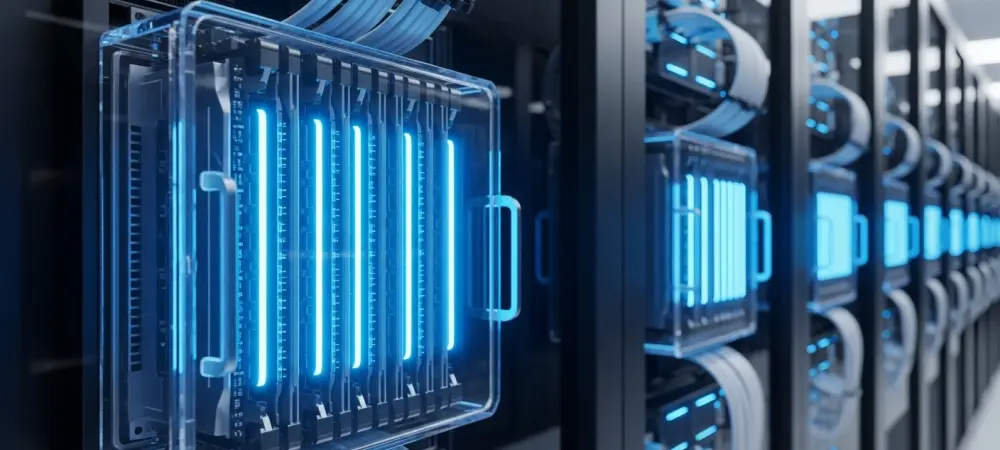
The massive architectural shift toward high-capacity memory solutions is currently redefining how hardware engineers approach the widening performance gap in modern data centers. While High Bandwidth Memory remains the gold standard for peak performance, its extreme cost and complex manufacturing have created a vacuum for a more accessible yet powerful alternative. Micron’s move to vertically stack Graphics Double Data Rate (GDDR) modules represents a strategic pivot, aiming to deliver the density required for the next generation of artificial intelligence without the prohibitive price tag of premium HBM tiers.
The Evolution: Graphics Memory Architecture
Traditional planar GDDR has served the gaming industry for decades, relying on a two-dimensional layout where chips are placed side-by-side on a printed circuit board. However, this 2D approach has hit a physical wall, as the surface area required for higher capacities often exceeds the space available on modern GPU substrates. By moving into the third dimension, vertical stacking allows manufacturers to pile memory dies on top of each other, drastically increasing total capacity while maintaining a compact footprint.
This transition was born from necessity rather than mere curiosity. As AI models move from the training phase into widespread inference deployment, the demand for memory capacity has skyrocketed. Standard consumer-grade GDDR simply lacked the density for large-scale enterprise tasks, while HBM remained too scarce and expensive for mid-tier deployments. Vertical stacking bridges this divide, providing a high-density “middle-ground” that repurposes proven gaming technology for more rigorous industrial applications.
Structural Components: Technical Foundations
Multi-Layer Die Stacking
At the heart of this innovation is the stacking of four or more GDDR layers into a single package. This arrangement fundamentally alters the memory subsystem’s density by allowing more storage bits to occupy the same horizontal space. By concentrating more data into a tighter volume, the technology enables hardware to handle larger datasets locally, which is vital for maintaining the throughput required for real-time AI processing.
Specialized Interconnect: Bonding Techniques
To make these stacks functional, engineers utilize advanced wire-bonding and through-silicon via (TSV) techniques that link the various layers to the base controller. These interconnects must be incredibly precise to ensure that data signals do not degrade as they travel through the vertical stack. Maintaining high-speed data transfer across these layers is a primary structural hurdle, as any latency or signal interference would negate the benefits of the increased density.
Emerging Trends: Memory Density and Scaling
We are currently seeing a strategic shift where major players like Micron are prioritizing high-capacity enterprise solutions over traditional consumer refreshes. The industry is gravitating toward these hybrid tiers to balance performance with affordability. This trend suggests that the rigid wall between “gaming” and “enterprise” hardware is crumbling, as the same silicon architecture is now expected to perform across vastly different market segments.
Real-World Applications: AI and Computing
The deployment of stacked GDDR is particularly impactful in data centers focused on AI inference. Unlike training, which requires the massive bandwidth of HBM to process raw data, inference relies more heavily on having enough capacity to store large, pre-trained models. Stacked GDDR allows for the creation of more cost-effective AI nodes, enabling companies to scale their infrastructure more rapidly than they could if they were solely reliant on the HBM supply chain.
Engineering Challenges: Technical Hurdles
The move to vertical stacking is not without its risks, primarily regarding thermal management. GDDR is notoriously power-hungry and generates significant heat during operation; when these modules are layered, the heat from the middle dies becomes trapped, potentially leading to thermal throttling. Designers must innovate new cooling methods or reduce clock speeds to maintain stability, which could lead to a performance trade-off in certain high-load environments.
The Future: Hybrid Memory Ecosystems
Looking toward the horizon, the coexistence of stacked GDDR and HBM4 will likely define the memory landscape. We can expect even higher stack counts as manufacturing processes mature, potentially leading to a paradigm where memory capacity is no longer a bottleneck for local AI execution. This evolution will likely force a reorganization of the global supply chain, as the demand for high-layer-count modules begins to outweigh the needs of the traditional gaming market.
Summary and Final Assessment
The development of vertical GDDR stacking successfully addressed the urgent need for a scalable memory tier between consumer hardware and elite enterprise solutions. By repurposing graphics technology into a 3D structure, manufacturers provided a viable path for the democratization of high-capacity AI hardware. While thermal constraints remained a persistent engineering obstacle, the strategic value of this architecture proved undeniable for the growth of inference infrastructures. Ultimately, the industry moved toward a more flexible ecosystem that prioritized density and cost-efficiency to meet the rising demands of global computing.