

The Next Frontier of Global Connectivity and Event Management
The massive convergence of international sports and hyper-connected digital ecosystems has reached a boiling point where traditional wireless networks simply cannot sustain the sheer density of contemporary data consumption. As the tournament currently unfolds across the United States, Canada, and Mexico, Verizon is spearheading a massive technological undertaking to build a connectivity infrastructure capable of withstanding unprecedented pressure. This project serves as a premier case study in large-scale service management, where passive viewing has been replaced by data-intensive participation. By integrating private 5G, network slicing, and high-capacity fiber, the telecommunications giant aims to deliver a seamless environment where technology and sport converge without the threat of service interruption.
Lessons from the Evolution of Large-Scale Network Deployment
Understanding the current requirements necessitates a look at the rapid evolution of mobile data consumption observed leading up to this year. In previous global tournaments, connectivity functioned as a secondary utility—a convenience for social media updates or basic communication. However, industry shifts have transformed the stadium experience into a high-definition, interactive ecosystem involving augmented reality, real-time betting, and 4K streaming. Past developments in 4G and early 5G densification taught providers that standard public networks often buckle under extreme density. These foundational lessons have shaped the current landscape, moving the industry toward a governed service model where performance targets are non-negotiable and infrastructure must remain proactive.
Engineering Resilience through Multi-Layered Architecture
Strategic Segmentation: Private 5G and Network Slicing
A critical aspect of the current strategy involves the implementation of network slicing and private 5G to enforce strict operational segmentation. In a high-pressure environment where data consumption is projected to exceed 50TB per match, a single congested network is a liability. By creating “slices” of the network, Verizon can prioritize mission-critical traffic—such as referee body cameras, security communications, and stadium management systems—independent of public spectator traffic. This ensures that even if 80,000 fans are simultaneously uploading video, the operational workflows that keep the event safe and fair remain unaffected. This level of governance represents a major benefit for enterprise reliability.
Densification and the Integration of Fixed Wireless Access
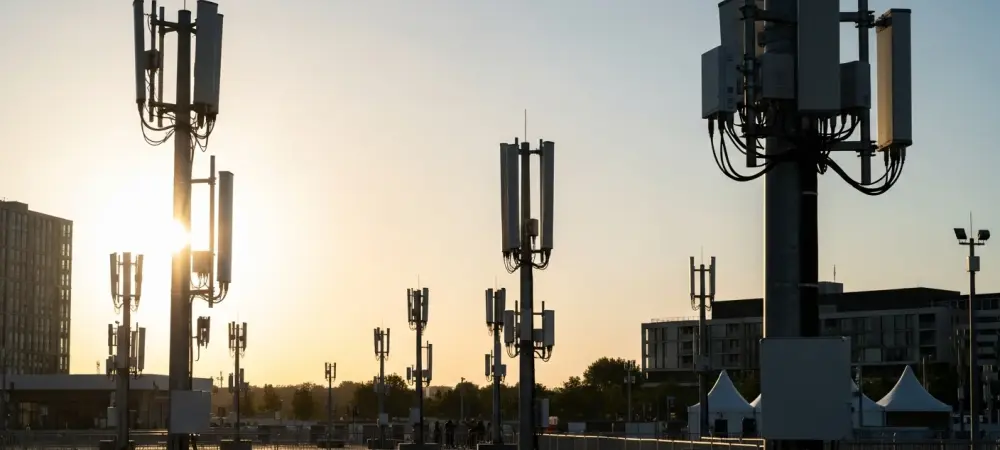
Building upon the need for dedicated bandwidth, Verizon is employing preventive planning through extreme physical densification across all venues. This includes the installation of thousands of under-seat antennas and the deployment of temporary cell sites at fan zones and transit hubs. A key technical highlight is the use of Fixed Wireless Access, which provides the speed and flexibility needed for rapid deployment at temporary locations without the long lead times of traditional wired setups. This hybrid approach allows for a layered connectivity model where the speed of FWA complements a robust, high-capacity fiber backbone. The primary challenge lies in maintaining a consistent user experience across varied regulatory environments.
Overcoming the Complexities of Regional and Data Demands
Current operations present unique complexities, particularly regarding the coordination of regional infrastructure differences across three different nations. Beyond the physical hardware, there is the overlooked aspect of data gravity—the sheer volume of information generated in a localized area that must be processed with minimal latency. Success in this deployment hinges on network visibility, or the ability to monitor user experience in real-time. A common misunderstanding is that simply adding more towers solves congestion; in reality, intelligent software-defined networking is required to steer traffic dynamically. By addressing these nuances, the provider moves beyond a best-effort service to a guaranteed performance environment.
The Future of Enterprise Connectivity and Governance
The innovations tested during this tournament are already reshaping the broader telecommunications landscape, influencing how smart cities and industrial hubs are designed. There is a visible shift toward Network-as-a-Service, where connectivity is tailored to specific use cases through software-defined parameters. Future technological and regulatory changes will likely focus on more efficient spectrum sharing and increased automation in network management. Experts predict that current deployments will serve as a permanent blueprint for enterprise risk management, proving that massive, high-density environments can be managed predictably through a combination of physical densification and virtualized network control.
Strategic Takeaways for Large-Scale Service Management
Analysis of these preparations offers several actionable strategies for business leaders and network architects. First, the transition from reactive to proactive maintenance is essential; organizations should invest in network visibility tools to identify potential service degradation before it impacts the end user. Second, the use of private 5G for mission-critical tasks is a best practice that ensures operational continuity regardless of external traffic. Finally, a balanced approach—combining the rapid deployment capabilities of FWA with the long-term resilience of fiber—is the most effective way to manage dynamic environments. Professionals should apply these lessons by treating connectivity as a governed asset rather than an infinite resource.
Setting the Standard for Global Connectivity
The scaling of 5G infrastructure for the world’s premier sporting event represented a fundamental shift in service delivery for the modern era. By integrating sophisticated architecture with rigorous governance, the project ensured that the tournament remained a showcase for human achievement rather than a cautionary tale of technical failure. This topic remained significant as it underscored the growing reliance of global commerce on invisible, high-capacity infrastructure. Stakeholders recognized that the strength of a network resided not just in its raw speed, but in its ability to be intelligently managed under extreme pressure. Moving forward, the industry adopted these managed service principles to define the next generation of urban connectivity.