

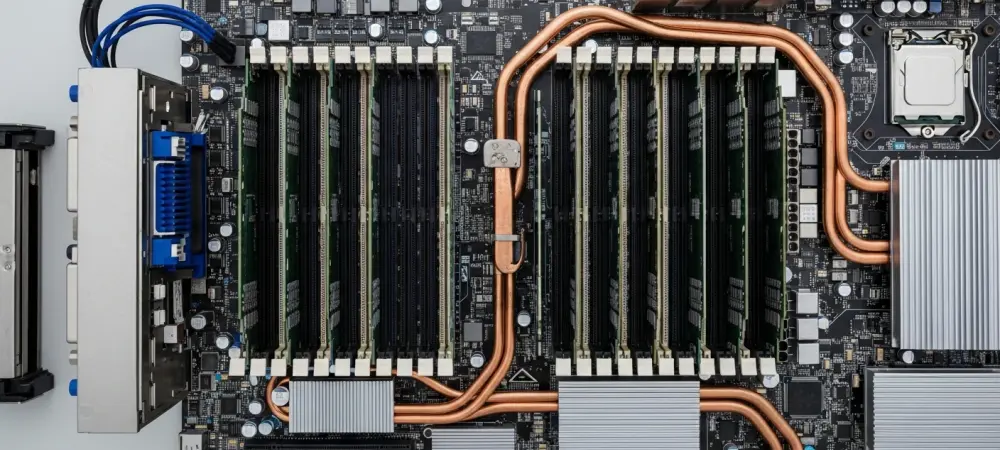
Modern computational demands in the fields of artificial intelligence and high-fidelity rendering have reached a point where standard memory bandwidth often becomes the primary bottleneck for entire server architectures. The introduction of V-Color’s newest OC RDIMM memory line addresses this specific challenge by providing a high-speed solution tailored for the Intel W890 workstation platform. By achieving a remarkable 9600 MT/s on the ASUS PRO WS W890E-SAGE SE motherboard, these modules demonstrate a significant leap in data transfer capabilities. This advancement is not merely about raw speed; it represents a fundamental shift in how professionals can leverage the Intel Xeon 6 ecosystem to handle massive datasets with reduced latency. The integration of specialized SK Hynix DDR5 chips ensures that even at these extreme frequencies, the hardware remains stable and efficient under sustained heavy loads.
Advanced Engineering and Technical Specifications
High-Performance Silicon: The Role of SK Hynix Chips
The foundation of these new memory modules lies in the selection of premium SK Hynix DDR5 chips, which are renowned for their overclocking headroom and electrical stability. These specific integrated circuits allow the OC RDIMM series to maintain a baseline operation of 8000 MT/s while drawing a mere 1.1V of power. Such low voltage requirements at high frequencies are crucial for maintaining a manageable thermal profile within densely packed workstation chassis. By minimizing heat output at the component level, V-Color enables professional users to push their systems further without risking thermal throttling or long-term hardware degradation. This balance between power efficiency and extreme performance is a key differentiator for the W890 platform, as it allows for a more sustainable operation during multi-day computational tasks.
Building upon this physical foundation, the modules utilize a server-grade ECC Registered DIMM architecture to ensure that every bit of data remains accurate during transit. Error Correction Code (ECC) technology is indispensable for workstations where a single bit flip could result in the failure of a complex simulation or the corruption of a critical AI model. The RDIMM design further enhances stability by using a register to buffer the address and command signals, which reduces the electrical load on the memory controller. This architectural choice is particularly important when populating all available memory slots on the ASUS PRO WS W890E-SAGE SE, as it maintains signal integrity even at the staggering 9600 MT/s threshold. Consequently, the combination of high-quality silicon and robust buffering mechanisms creates a reliable environment for the most demanding technical workloads imaginable.
Capacity and Scalability: Meeting Diverse Professional Needs
Workstation environments vary greatly in their resource requirements, and the new OC RDIMM line offers a wide spectrum of capacities to accommodate these differences. Modules are available in configurations ranging from standard 16 GB sticks to high-density 256 GB units, providing a path for massive total system memory. For researchers working with large language models or complex fluid dynamics, the ability to install several hundred gigabytes of high-speed RAM is a transformative capability. This scalability ensures that the Intel Xeon 6 platform can be tailored to specific budget and performance targets, whether the goal is maximizing bandwidth for real-time rendering or expanding capacity for virtualized environments. The versatility of this lineup allows organizations to invest in exactly the amount of memory needed while retaining the option for future expansion.
The implementation of these high-capacity modules does not come at the expense of speed, which has historically been a trade-off in the memory industry. Traditionally, as capacity increased, the maximum achievable clock speed would often decrease due to the increased electrical complexity. However, V-Color has engineered these RDIMMs to maintain high-frequency performance even at the upper limits of module density. This achievement is vital for professionals who require both the space to store large datasets in active memory and the speed to process them rapidly. By eliminating the choice between “large” and “fast,” the W890 platform becomes a more cohesive tool for modern data science. This advancement reflects a broader trend toward high-density, high-bandwidth solutions that can keep pace with the rapidly evolving processing power of modern multi-core server CPUs.
Ecosystem Integration and Market Impact
Validation and Compatibility: The ASUS Partnership
A critical aspect of launching high-performance memory is ensuring that the hardware can actually operate at its rated speeds in a real-world environment. V-Color has addressed this by securing QVL validation for the premium ASUS PRO WS W890E-SAGE SE motherboard, which serves as the primary testing ground for the 9600 MT/s milestone. This validation process involves rigorous testing to confirm that the memory timings, voltages, and thermal characteristics align perfectly with the motherboard’s BIOS and power delivery systems. For system integrators and IT departments, this certification provides the necessary assurance that the components will work together seamlessly right out of the box. This reduces the time required for system tuning and troubleshooting, allowing professionals to focus on their creative or analytical work rather than hardware debugging.
Beyond simple compatibility, this partnership highlights the closing gap between enthusiast-level performance and enterprise-grade reliability. The ASUS W890 series is designed to withstand the rigors of 24/7 operation, and the inclusion of V-Color’s OC RDIMMs enhances this mission by providing the highest possible throughput. The collaboration between memory manufacturer and motherboard vendor ensures that the Intel Xeon 6 processor can reach its full potential, particularly in AVX-512 and AI-accelerated tasks. As software continues to evolve to take advantage of wider memory buses and higher clock speeds, having a validated ecosystem becomes a competitive advantage for firms involved in high-end content creation and engineering. This synergy between hardware components is what ultimately drives the industry forward toward more capable and efficient workstation designs.
Professional Applications: Driving Efficiency in Complex Workloads
The real-world implications of 9600 MT/s memory speeds are most evident in data-intensive fields like AI development and scientific visualization. In these scenarios, the CPU is often left waiting for data to be fetched from memory, leading to underutilization of expensive processing cores. By significantly increasing the memory bandwidth, the V-Color OC RDIMMs reduce these wait times, directly translating to faster render passes and quicker training cycles for machine learning models. This performance boost is not just a luxury; it is a necessity for organizations looking to reduce their time-to-market for new products or research findings. When a workstation can process 15% to 20% more data in the same timeframe, the cumulative productivity gains over a fiscal year are substantial for any professional enterprise.
Furthermore, the adoption of these high-speed modules sets a new standard for what is expected from professional workstations. As workflows become increasingly integrated and complex, the demand for ironclad reliability coupled with extreme performance will only grow. The V-Color release serves as a benchmark for the industry, proving that the technical hurdles of high-speed registered memory have been overcome. For the broader market, this means that the Intel Xeon 6 ecosystem is now more viable than ever for high-end tasks that were previously reserved for full-scale server clusters. By bringing this level of performance to the desktop workstation, V-Color and Intel are democratizing high-performance computing and enabling smaller teams to tackle projects of immense scale. The transition toward 9600 MT/s memory architectures suggested that the industry should prioritize the adoption of validated hardware combinations to ensure maximum uptime and performance consistency. Professionals looked to implement these high-speed RDIMMs in environments where memory latency directly impacted the bottom line, such as financial modeling or real-time simulation. Organizations found success by pairing these modules with the latest Intel Xeon 6 processors, effectively eliminating traditional data bottlenecks. Future considerations included the expansion of high-speed memory support across more mid-range workstation boards to broaden the accessibility of these performance gains. This shift demonstrated that the integration of high-bandwidth memory was a critical step in maintaining the competitive edge required for modern computational challenges.