

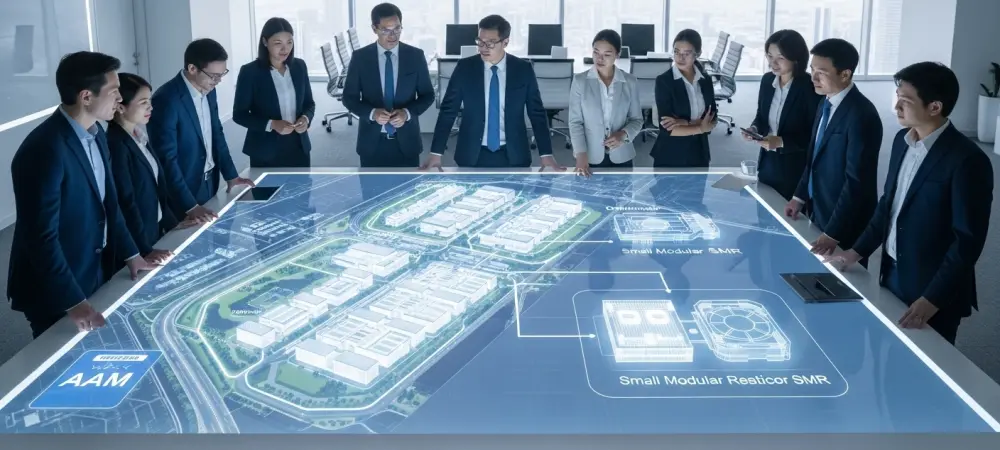
The escalating computational demands of the artificial intelligence revolution have created a voracious and often unseen appetite for energy, threatening to strain national power grids to their breaking points. In a groundbreaking move to address this impending crisis, the U.S. government is championing a landmark initiative to directly pair the power needs of AI with the clean, consistent output of next-generation nuclear energy. At a recent “industry day” event hosted by the Department of Energy at the historic Savannah River Site in South Carolina, officials unveiled an ambitious plan to solicit private sector proposals for building massive AI data centers on federal land, intrinsically linked to new, dedicated power generation. This initiative signals a pivotal convergence of national security, technological supremacy, and a pragmatic energy strategy, aiming to forge a sustainable path for America’s digital future.
A Strategic Imperative for a New Era
The federal government is framing this initiative as far more than a simple real estate transaction, casting it as a modern-day Manhattan Project essential for securing America’s technological future. A top official from the National Nuclear Security Administration (NNSA) articulated the gravity of the situation, emphasizing that the United States is locked in a “global race for AI compute power and the energy that’s needed to drive that.” This high-level framing positions the development of AI infrastructure not merely as a commercial opportunity but as a “strategic national imperative” critical to maintaining a competitive edge over global adversaries. The plan to build a self-sufficient ecosystem for AI development is a direct response to the geopolitical challenges of the modern era, where technological dominance is increasingly synonymous with national security and global influence.
Central to this strategic vision is the innovative requirement of co-locating data centers and their power sources. Any proposal for developing facilities at the Savannah River Site comes with a mandatory condition: it “must include new energy generation” built on-site. This approach directly confronts the primary bottleneck currently hindering the explosive growth of hyperscale data centers, which is the limited availability of massive, reliable power from existing electrical grids. By fostering a symbiotic relationship where power generation and computational facilities are developed in tandem, the Department of Energy aims to create a highly streamlined, efficient, and resilient model. This template for self-contained technological hubs could fundamentally reshape how critical digital infrastructure is designed and deployed across the nation, ensuring operational stability independent of grid constraints.
The Nuclear Option and Public-Private Synergy
While the government remains open to a portfolio of energy solutions, there is a clear and powerful preference for nuclear power to serve as the long-term backbone for this ambitious project. An NNSA official stated unequivocally, “I really want to drive nuclear power there. That’s the most important thing.” This emphasis reflects a strategic decision to leverage the unique advantages of nuclear energy, which provides the clean, dense, and constant 24/7 power that AI data centers require for optimal performance. The Savannah River Site’s long history as a key component of the nation’s nuclear program makes it an ideal location for deploying advanced technologies, including potentially Small Modular Reactors (SMRs). While non-nuclear options like solar are considered a viable “bridge” to expedite initial development, the ultimate vision is one of nuclear-powered computation on a massive scale.
The initiative is structured to foster a compelling public-private partnership, offering a dual pathway for potential developers. On one hand, the project presents a significant commercial opportunity for companies to build and operate data centers to serve the needs of the tech giants, many of whom were in attendance. On the other hand, there is a distinct possibility for the winning bidder to support the NNSA’s own extensive and growing computational needs. This creates a powerful scenario where the U.S. government itself could become an anchor tenant, providing a stable revenue stream and a mission-critical purpose that de-risks the massive private investment required. The agency’s critical mission of designing, maintaining, and simulating the nation’s nuclear stockpile requires “a ton of computing,” according to its Program Director of Advanced Computing.
An Unprecedented Gathering of Industry Titans
The significance of the proposal was underscored by the high-profile attendance at the industry day, which drew a veritable who’s who from the technology and energy sectors. The presence of hyperscalers like Microsoft, Google, and Meta, alongside specialized data center operators such as QTS and Digital Realty, and AI-focused firms like CoreWeave and Crusoe, signaled intense and widespread industry interest. On the energy side, the audience was just as diverse, with established giants like GE Vernova joined by innovative advanced nuclear startups including Oklo and Terrestrial Energy. This convergence of industry leaders demonstrated a broad appetite from both the supply and demand sides of the equation, confirming that the private sector is highly receptive to this government-facilitated effort to solve the intertwined challenges of energy scarcity and burgeoning AI demand.
The Savannah River Site itself presents a uniquely advantageous foundation for such a monumental undertaking. The government has designated ten distinct tracts of land, totaling 3,103 acres, for potential development. Crucially, the site boasts an exceptionally robust and resilient electrical infrastructure with “triple redundancy,” fed by three separate 115kV lines that ensure a highly reliable power backbone. While the site’s current peak usage is approximately 50MW, this is projected to increase significantly due to new NNSA missions. Further enhancing its appeal, the location is already slated for a major power upgrade, with two 75MW solar farms, each equipped with Battery Energy Storage Systems (BESS), already in development and scheduled to become operational in 2029. This will add a substantial 150MW of renewable capacity, providing a strong initial power base for incoming projects.
A Vision Cemented by Federal Backing
The U.S. government demonstrated that it is not merely offering land but is prepared to provide significant financial muscle to ensure the initiative’s success. An official from the renamed DOE Loan Office, now the Energy Office of Energy Dominance Financing (EDF), explicitly stated that federal loans are available for nuclear and other power generation projects tied to the data center development. Characterizing his office as being filled with “creative bankers,” he emphasized that supporting this kind of infrastructure is a “priority of the President,” signaling powerful and unambiguous backing from the highest levels of the executive branch. This commitment to providing financial incentives and removing bureaucratic hurdles sends a clear message to the private sector that the government is a fully invested partner in this national endeavor.
Ultimately, the meeting at the Savannah River Site marked a strategic and proactive effort by the United States to lay a foundational component of its national strategy for the decades to come. By offering secure federal land, promoting the co-location of data centers with new power generation, and championing nuclear energy, the government created a template for sustainable hyperscale development. The enthusiastic reception from leading technology and energy firms confirmed the viability of this unique public-private partnership model. The initiative transcended a simple real estate transaction; it established a comprehensive vision for securing American leadership in the critical, intertwined fields of artificial intelligence and advanced energy technology, setting a course for a new era of innovation.