

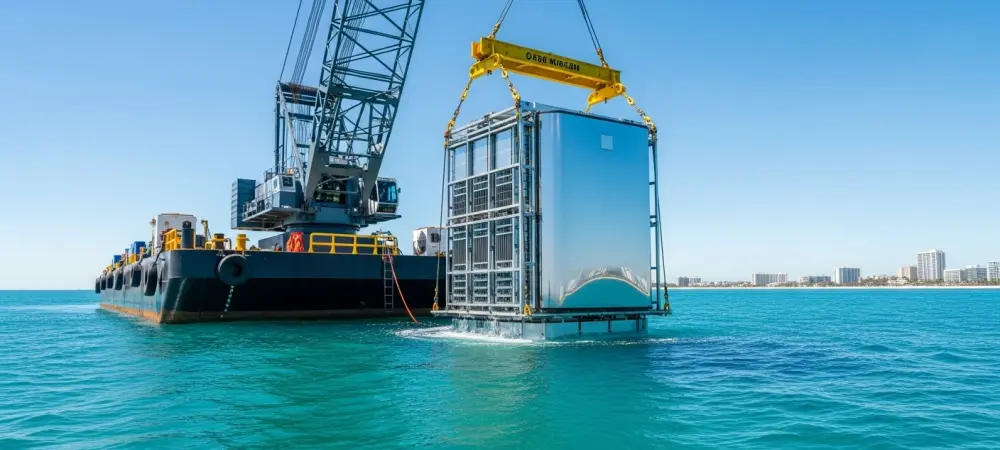
The insatiable appetite of global cloud computing infrastructure has pushed engineers to seek thermal sanctuary within the cold, pressurized depths of the world’s oceans. As traditional land-based facilities struggle with rising real estate costs and the massive electricity demands of artificial intelligence, subsea computing has moved from a speculative experiment toward a critical pillar of sustainable infrastructure. This technology utilizes the stable, low temperatures of the seabed to solve the most persistent problem in the industry: the massive heat generated by high-density server racks.
Evolution and Core Principles of Subsea Computing
Modern underwater data centers (UDCs) operate on the principle of passive maritime cooling, where hermetically sealed pressure vessels are submerged to depths where the water remains consistently cold. This approach represents a departure from the early experimental phases seen in previous years, transitioning into a sophisticated engineering discipline. By placing compute power in the ocean, providers can utilize the surrounding water as a massive heat sink, effectively bypassing the need for energy-intensive air conditioning.
This evolution is particularly relevant given the global mandate for carbon neutrality. While terrestrial data centers must compete for land and water resources, UDCs occupy otherwise unused space on the continental shelf. The core components include corrosion-resistant hulls, specialized internal heat exchangers, and high-tension subsea cabling that handles both power delivery and high-speed data transmission back to coastal hubs.
Architectural Components and Technical Performance
Passive Maritime Cooling and Thermal Management
The primary advantage of the UDC lies in its radical thermal efficiency. By circulating specialized coolants within a sealed module that transfers heat directly to the surrounding seawater, the facility eliminates the mechanical complexity and energy drain of traditional HVAC systems. This thermal exchange is remarkably consistent because the deep-water temperature remains stable regardless of seasonal changes on the surface. Technical analysis reveals that this method allows for a Power Usage Effectiveness (PUE) rating as low as 1.15. In comparison, even the most efficient land-based facilities often struggle to stay below 1.30 when accounting for cooling overhead. This difference represents millions of dollars in saved operational costs and a significant reduction in the environmental burden of data processing.
Integration with Offshore Renewable Energy
One of the most compelling aspects of the HiCloud facility is its direct synergy with offshore wind energy. By co-locating data modules near wind farms, the infrastructure minimizes energy loss during transmission. This setup creates a closed-loop system where green energy powers the servers, and the ocean provides the cooling, resulting in a nearly carbon-neutral operational cycle.
Power stability is maintained through advanced underwater power distribution units that regulate the variable output of renewable sources. The ability to process data at the source of power generation significantly reduces the strain on aging land-based electrical grids. This integration is not merely about sustainability; it is a strategic move to secure energy independence for critical digital infrastructure.
Recent Innovations and Industry Milestones
The field has recently shifted from small-scale pilots toward massive commercial deployments, exemplified by the HiCloud project in the Lingang Special Area. This facility, which recently reached a 24MW capacity, demonstrates that subsea modules can handle high-density computing loads previously reserved for terrestrial “hyperscalers.” This shift proves that the technology is no longer a niche solution for research but a viable commercial alternative.
Furthermore, the industry is now looking toward scaling operations to a staggering 500MW capacity. These massive undersea clusters are designed to function as decentralized nodes in a global network, providing low-latency services to coastal populations. The transition toward high-density modules allows for more processing power per square meter of seafloor compared to the sprawling footprints of traditional warehouses.
Real-World Applications and Deployment Scenarios
Coastal smart cities are the primary beneficiaries of this maritime infrastructure. In regions like Shanghai, where land is at an extreme premium and the population density is high, submerging data centers near the shore provides high-speed connectivity without occupying valuable urban real estate. This proximity reduces latency, which is essential for the next generation of autonomous systems and real-time data analytics.
Telecommunications providers are also utilizing these modules to bolster their edge computing capabilities. By placing the data center at the terminus of subsea fiber cables, providers can process international data traffic before it even reaches the mainland. This application is particularly effective in special economic zones where high electricity costs on land would otherwise make high-performance computing prohibitively expensive.
Engineering Hurdles and Environmental Constraints
Despite the clear benefits, the corrosive nature of saltwater remains a formidable adversary. The long-term integrity of pressure-resistant seals and the prevention of biofouling on heat exchangers require advanced material science and expensive coatings. If a seal fails, the entire module is lost, making the initial engineering requirements far more stringent than those of any land-based equivalent.
Furthermore, the logistical complexity of hardware maintenance presents a significant barrier. Unlike a traditional facility where a technician can simply swap a failed drive, a subsea module must be hoisted to the surface or serviced by specialized remotely operated vehicles. This reality creates a high initial capital expenditure that can deter investors who are used to the accessible nature of terrestrial facilities.
Future Trajectory and Scalability
The path forward for subsea infrastructure appears robust, even as early pioneers like Microsoft pivoted away from the concept. The success of modular designs suggests that the industry will move toward standardized, mass-produced pods that can be deployed rapidly across different maritime regions. This modularity will be the key to global expansion, allowing for a “plug-and-play” approach to undersea capacity.
Future breakthroughs are expected in autonomous maintenance systems and even more resilient alloys. As the “Green Data” movement gains momentum, the pressure on corporations to lower their carbon footprints will likely drive more investment into the subsea sector. The long-term impact could be a complete restructuring of how the internet is physically housed, moving it from the shadows of our cities to the depths of our oceans.
Final Assessment of Subsea Data Infrastructure
The review of current underwater data center technology demonstrated that passive maritime cooling was no longer a theoretical benefit but a proven method for achieving extreme efficiency. By integrating directly with renewable energy sources, these facilities offered a blueprint for a future where digital growth did not come at the expense of the environment. The Shanghai deployment showed that commercial viability was attainable through strategic partnerships and advanced engineering. The transition to subsea computing addressed the critical bottlenecks of land scarcity and energy consumption that had begun to plague the technology sector. Although the challenges of maintenance and corrosion remained significant, the operational gains in thermal management outweighed the initial costs for high-density applications. Ultimately, the successful deployment of these maritime modules suggested that the future of high-performance computing would be defined by its ability to harmonize with the natural environment.