

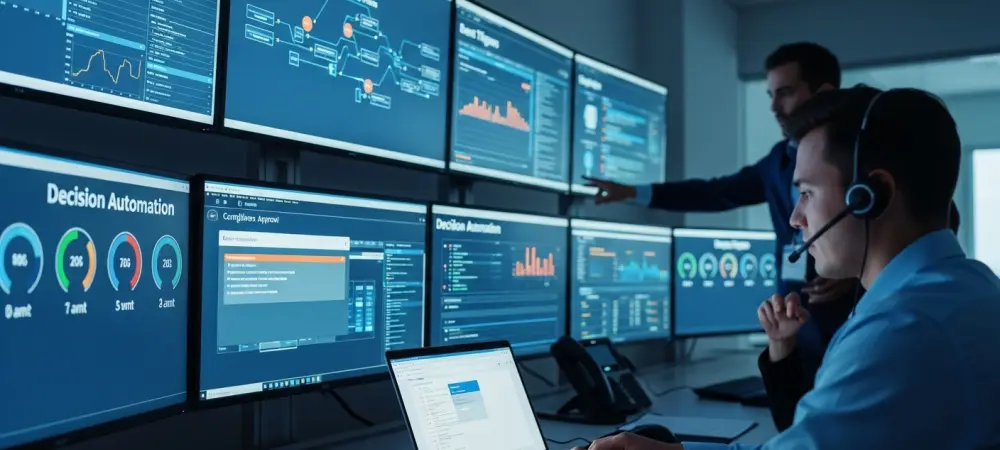
From boardroom mandates to frontline outcomes, the competitive edge increasingly hinged on chaining data, intelligence, and automation into a single motion that turns model output into governed execution without swivel‑chair gaps or audit blind spots. That shift reframed AI from a lab asset to an operations discipline, where orchestration decided whether insights lived as dashboards or moved markets as actions.
Enterprises had analytics aplenty, yet value stalled at handoffs across fragmented systems; orchestration knit those parts together so decisions traveled with lineage, policy, and proof. This analysis explored why that motion gathered momentum, how it showed up in production, what UiPath and Databricks operationalized together, how impact was measured, which risks mattered, and where the curve bent next.
1. Market Landscape and Momentum
1.1 Adoption, Growth Trends, and Investment Signals
Budgets clustered around platforms that consolidate AI, RPA, and MLOps, with forecasts pointing to steady spend growth from this year through the next several. Pilots gave way to embedded agents and copilots, and dashboards ceded ground to decision automation bound by shared metadata and policy. Convergence defined the stack: lakehouse adoption rose, vector search normalized unstructured pipelines, and policy‑driven, agentic workflows became table stakes. Analysts across Gartner, IDC, Everest Group, and Forrester echoed one theme: scale demanded a control plane.
1.2 Real-World Orchestration in Action
A repeatable pattern emerged when Databricks intelligence was embedded directly into UiPath‑run processes, compressing the distance from scoring to settlement. Financial firms triggered collections and reviews from real‑time risk, healthcare routed enriched notes into prior‑authorization flows, manufacturers dispatched parts and schedules from predictive signals, and retailers fused propensity with supply moves in one governed loop. Outcomes arrived as faster decisions, higher straight‑through rates, fewer manual pivots, and audit‑ready trails that survived scrutiny.
2. Expert and Executive Perspectives on Orchestration at Scale
Analysts framed orchestration as the control plane for value realization: governance, lineage, and policy were non‑negotiable. CDOs and CIOs sought unified observability and cost controls to end tool sprawl and handoffs. CISOs emphasized centralized guardrails for data access, model use, and automated actions, while operations leaders prized context‑aware automations over static rules. Vendor leaders aligned: Maestro coordinated agents, robots, and people; Databricks ensured trusted data and intelligence.
3. How the UiPath–Databricks Integration Operationalizes AI
3.1 Secure, Real-Time Access to Trusted Enterprise Data in Databricks
Connectivity spanned tables, files, features, vectors, and documents under role‑based access. Streaming and batch kept automations current, with lineage persisting from source to action as enrichment, feature serving, and RAG fed downstream work.
3.2 Orchestrating AI Agents, Robots, Systems, and People via UiPath Maestro
A single control plane scheduled and monitored robots, agents, APIs, and approvals. Events from Databricks jobs and Delta pipelines triggered UiPath processes, while exceptions flowed to humans with dynamic routing and SLAs.
3.3 Governance, Transparency, and Compliance by Design
Policies traveled with data, models, and automations, covering access, PII, approvals, and retention. Audits traced inputs to outcomes; risk controls watched versions, drift, and changes with clear separation of duties.
3.4 Reference Architectures and Workflow Patterns
Decisioning closed the loop: feature outputs informed UiPath decisions, ERP or CRM executed, and feedback returned to the lakehouse. Document intelligence mixed vector stores with RAG and approvals, and multi‑agent case resolution ran under Maestro with Databricks supplying context.
4. Measuring Impact: From Insights to Action
4.1 KPI Framework and Baselines
Time‑to‑decision, time‑to‑action, and cycle‑time showed compression, while straight‑through rates rose and rework fell. Quality metrics tracked accuracy, leakage, and customer effort alongside cost‑to‑serve and infrastructure spend per decision.
4.2 Business Cases and Expected ROI Ranges
Collections saw higher recoveries and shorter DSO; claims lifted auto‑adjudication with fewer appeals; maintenance cut downtime and smoothed inventory; outreach increased conversion and CLV with lower churn. Value proved out through phased rollouts, control groups, and live dashboards.
5. Risks, Trade-offs, and Mitigation Strategies
5.1 Technical Risks
Freshness gaps, schema drift, and model decay yielded to monitoring, SLAs, and validation gates. Tool sprawl and brittle links eased with standardized connectors, while latency and cost balanced via tiered serving and caching.
5.2 Organizational and Compliance Risks
Change fatigue softened through service design and role‑based training. Judgment tasks avoided over‑automation with escalation and thresholds, and regulated data stayed protected through templates, redaction, and explainability.
5.3 Governance and Reliability Toolkit
Runbooks, RACI, and incident response stabilized automated actions. Catalogs captured lineage and approvals, and FinOps guardrails enforced budgets, chargeback, and efficiency reviews.
6. What’s Next: The Future of Enterprise AI Orchestration
Systems moved toward multi‑agent, policy‑aware coordination across functions. Lakehouse, vector stores, and real‑time features fused to ground automation, while compliance shifted to proactive controls and continuous evidence. Platforms that unified data, intelligence, and execution consolidated share, with agility gains offset by the need for deeper observability.
7. Conclusion and Call to Action
The convergence of Databricks’ data intelligence with UiPath’s orchestration had transformed insight into governed action at scale, and the path forward rested on selecting value‑backed workflows, codifying guardrails early, and instrumenting KPIs from day one. Teams that piloted closed‑loop patterns, standardized connectors, and embedded human‑in‑the‑loop checkpoints were positioned to scale responsibly, extend reusable blueprints, and sustain measurable impact across lines of business.