

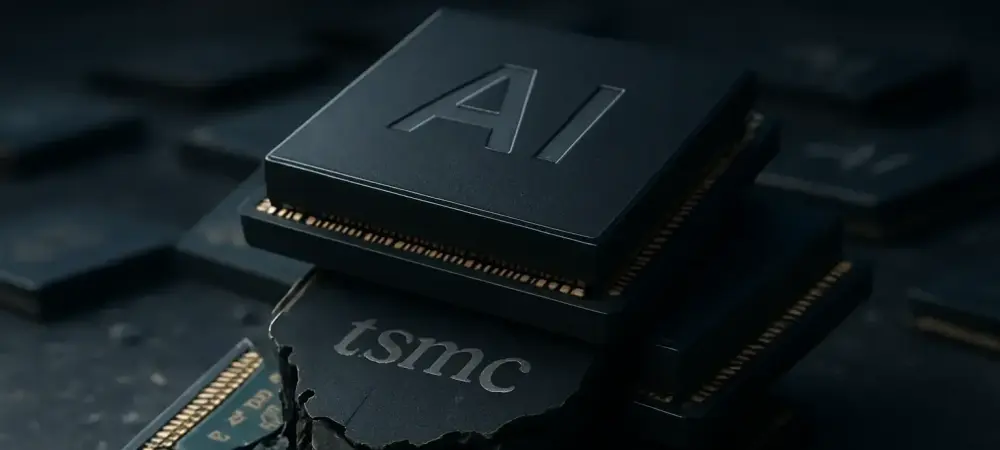
The very technology poised to redefine human progress is now straining the foundational company responsible for its existence, creating a paradox where overwhelming success is beginning to resemble a crisis. Taiwan Semiconductor Manufacturing Company (TSMC), the world’s most indispensable chipmaker, finds itself at the epicenter of the artificial intelligence explosion. As the sole foundry capable of producing the cutting-edge silicon that powers this revolution, its unparalleled dominance has become its greatest vulnerability, pushing its manufacturing capabilities to the absolute limit.
When Winning Looks a Lot Like Losing
The central irony for TSMC is that its victory in the foundry wars has created an untenable situation. As the manufacturer for nearly every major AI chip designer, the company is suffering from its own success. The demand is not just high; it is a relentless tidal wave of orders that has swamped production lines and extended lead times to unprecedented lengths. This predicament poses a critical question for the entire technology sector: what happens when the lynchpin of the global supply chain can no longer keep pace with the world’s insatiable appetite for innovation?
This is not a failure of strategy but a consequence of unmatched excellence. By mastering the most complex manufacturing processes, TSMC became the default choice for industry leaders. However, this has created a single point of failure. The company’s inability to satisfy every order in a timely fashion is no longer just a business challenge for TSMC; it is a bottleneck threatening the forward momentum of the entire AI industry, forcing a reckoning with the risks of such profound market concentration.
The Unseen Engine of the AI Revolution
Behind every AI breakthrough and generative model lies the intricate work of TSMC. The company serves as the silent manufacturing partner for fabless giants like NVIDIA and AMD, translating their sophisticated chip designs into physical reality. Without TSMC’s advanced process nodes, the powerful GPUs and accelerators that train and run complex AI algorithms would simply not exist in their current form, making the foundry the effective bedrock upon which the modern tech ecosystem is built.
The connection between the global AI boom and TSMC’s fabrication plants is direct and absolute. Progress in artificial intelligence is intrinsically linked to the availability of its 5-nanometer, 4-nanometer, and now 3-nanometer chips. Each generational leap in AI performance has been enabled by the company’s ability to shrink transistors and pack more computational power onto a single piece of silicon. Consequently, the progress of countless industries now hinges on the output of this one company.
Fractures Emerge Under Unprecedented Pressure
The most immediate crisis is a deluge of demand that has completely exhausted TSMC’s current capacity. Orders for its most advanced nodes have created a backlog so severe that customers face significant delays, disrupting product roadmaps across the tech landscape. This overwhelming demand is not a temporary spike but the new baseline, driven by the permanent shift toward accelerated computing.
Compounding this issue is a critical bottleneck in advanced packaging. High-performance computing clients, who are fueling the AI surge, require complex packaging solutions like Chip-on-Wafer-on-Substrate (CoWoS) to integrate multiple chiplets into a single, powerful processor. TSMC’s capacity for these services is falling far short of demand, creating a chokepoint that is even more acute than the wafer shortage itself and forcing some clients to delay or scale back their ambitions.
This internal pressure is reverberating throughout the supply chain. TSMC’s own suppliers are struggling to keep up, while acute labor shortages for skilled technicians and engineers are hampering expansion efforts. The immense financial and operational strain is forcing the company to navigate a treacherous path of rapid growth, where the cost of falling behind is just as severe as the risk of overextending.
The High Cost of Maintaining Dominance
To address these shortfalls, TSMC has embarked on an aggressive and financially strenuous expansion. The company’s capital expenditure is projected to surge toward $50 billion by 2026, a staggering figure dedicated primarily to building out next-generation 2-nanometer capacity. This is not a choice but a necessity to meet the projected demand curve and maintain its technological lead.
However, industry analysts note that this massive investment carries significant financial risks. Such aggressive expansion creates enormous new operational strains, from securing the necessary tooling and raw materials to training a workforce capable of running these hyper-advanced facilities. It is a high-stakes bet that assumes demand will continue its exponential trajectory, leaving little room for error or market fluctuations.
An Opening for Competitors in a Strained Market
TSMC’s capacity constraints have forced its major customers to confront the risks of single-sourcing. In response, a strategic shift is underway as companies like NVIDIA and AMD begin to actively diversify their supply chains. This is not a matter of choice but a strategic imperative to mitigate risk and ensure a stable supply of their most critical components, fundamentally altering the foundry landscape.
This environment has created a crucial opportunity for competitors that were previously sidelined. TSMC’s struggles, particularly in advanced packaging, have allowed companies like Intel Foundry Services to gain traction. With alternative solutions like its Embedded Multi-die Interconnect Bridge (EMIB) technology, Intel is positioning itself as a viable secondary source, attracting clients who can no longer afford to wait in TSMC’s queue.
The situation revealed that while TSMC’s technological supremacy remained unchallenged, its operational limits had been reached. The immense weight of the AI industry’s growth forced not only difficult trade-offs and historic investments from the chip titan but also a broader industry movement toward a more diversified and resilient supply chain. This period of intense strain ultimately catalyzed an evolution, proving that even a near-monopoly must adapt when faced with demand of a truly revolutionary scale.