

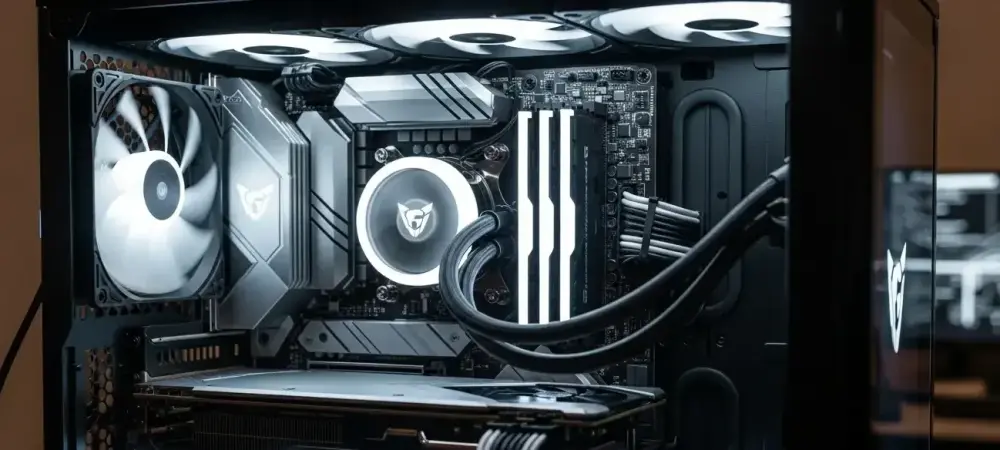
The arrival of AMD’s Ryzen 9000 series processors marks a significant leap in computing power, demanding a motherboard platform that is not just compatible but truly complementary to its capabilities. As enthusiasts and power users look to build the next generation of high-performance systems, the choice of foundation becomes paramount. This is where MSI re-enters the ultra-enthusiast arena with the MEG X870E ACE MAX, a motherboard engineered to harness the full potential of Zen 5.
Setting the Stage Is This the Ultimate Ryzen 9000 Foundation
This review aims to determine if the MSI MEG X870E ACE MAX is the definitive motherboard for enthusiasts building a top-tier system with AMD’s new Ryzen 9000 series CPUs. The evaluation will scrutinize its extensive feature set, benchmark its performance under demanding scenarios, and assess its overall value proposition. At its core, the central question is whether its premium price is justified by a future-proof design and capabilities that cater directly to the needs of power users seeking a truly no-compromise AM5 platform.
The motherboard landscape is often crowded, but flagship models like the ACE MAX distinguish themselves by promising not just performance for today but longevity for tomorrow. By examining its technical prowess and practical application, this analysis will provide a clear verdict on its standing as the ultimate foundation for a next-generation AMD build, addressing the concerns of those investing heavily in a system designed to last.
A Deep Dive into the X870E Chipset and the ACE MAX Design
The context for the ACE MAX begins with the maturation of the AM5 platform. After establishing itself with the Ryzen 7000 and 8000 series, AMD is signaling a long-term commitment with the 800-series chipset, explicitly engineered to be “Zen 6-Ready.” This consumer-friendly approach echoes the remarkable longevity of the preceding AM4 platform, with AMD pledging support for the AM5 socket, LGA 1718, until at least 2027. This provides builders with a stable and forward-looking upgrade path, ensuring that an investment in a high-end motherboard today will not be rendered obsolete by the next CPU generation. The LGA 1718 socket itself was a crucial shift, enabling the higher bandwidth necessary for modern standards like PCIe 5.0 and USB 4.0.
AMD’s new 800-series chipset family introduces a more clearly defined hierarchy designed to simplify choices for consumers. At the top sits the X870E, a flagship chipset utilizing two “Promontory 21” dies to deliver the maximum number of PCIe lanes and I/O capabilities for extreme builds. Following it is the single-chiplet X870, which retains core next-gen features like standard USB 4.0 and universal PCIe 5.0 support but in a more cost-effective package. The mainstream B850 offers a mix of new features with some optional implementations to hit a lower price point, while the new entry-level B840 is limited to PCIe 4.0 and targets the budget-conscious market. For the high-end X870E and X870, AMD has mandated key upgrades, including universal PCIe 5.0 for both GPU and NVMe, standard USB 4.0, and enhanced DDR5 EXPO memory support for speeds cresting 8000 MT/s.
Against this backdrop, the MSI MEG X870E ACE MAX makes its grand entrance, marking the return of the prestigious “ACE” brand to the AMD platform. Positioned as a “supercharged” premium offering, it is designed to leverage every advantage of the dual-chiplet X870E architecture. The “MAX” designation signifies its place within MSI’s refreshed lineup, incorporating the latest standards and a refined design philosophy. This motherboard is squarely aimed at enthusiasts building a top-tier system who demand bleeding-edge connectivity and uncompromising power delivery for the new Ryzen 9000 series processors.
Putting the ACE MAX to the Test Benchmarks and Thermals
In evaluating the motherboard’s real-world performance, a series of rigorous tests were conducted. The robustness of its massive power delivery system and the thermal efficiency of its VRM heatsinks were assessed under sustained, heavy CPU loads with a flagship Ryzen 9000 series processor. The ACE MAX demonstrated exceptional stability, maintaining cool VRM temperatures and providing clean, consistent power, which is critical for unlocking the full performance potential of the Zen 5 architecture, especially when pushing advanced Precision Boost Overdrive settings.
Memory overclocking stability was another key focus, with tests pushing high-speed DDR5 EXPO kits to their advertised limits and beyond. The motherboard successfully validated its claims of supporting speeds over 8000 MT/s, achieving tight timings and stable operation that translate to tangible gains in gaming and productivity benchmarks. Furthermore, storage performance was benchmarked using a top-of-the-line PCIe 5.0 NVMe SSD. The ACE MAX delivered blistering throughput, saturating the drive’s theoretical maximum read and write speeds without thermal throttling, thanks to its substantial M.2 cooling solution. The overall user experience within the UEFI BIOS was fluid and intuitive, with a well-organized layout that provided easy access to the new PBO and Curve Optimizer algorithms for fine-tuning performance.
Strengths and Weaknesses A Balanced Perspective
The motherboard’s primary advantage is its unparalleled future-proofing. With a “Zen 6-Ready” design philosophy and the backing of AMD’s long-term AM5 socket support, the ACE MAX is built to serve as the core of a high-end system for years to come. This longevity is complemented by a comprehensive, no-compromise feature set that includes standard USB 4.0 for high-speed peripherals and extensive PCIe 5.0 connectivity for both next-generation graphics cards and storage. Moreover, its exceptional power delivery system is engineered for extreme overclocking, ensuring unwavering system stability even under the most demanding workloads. This technical prowess is wrapped in a premium, aesthetically pleasing design constructed with high-quality components that reflect its flagship status.
In contrast, the most significant disadvantage is its substantial price premium, which places the ACE MAX firmly in the enthusiast tier and out of reach for most mainstream builders. The sheer breadth of its feature set, while impressive, may be considered overkill for users who are not extreme overclockers or content creators needing maximum I/O bandwidth. Consequently, some of its high-end capabilities may go unused by the average gamer or PC user. This abundance of features also introduces a potential for increased complexity in setup and configuration, as the vast number of BIOS options can be overwhelming for those not accustomed to such granular control.
The Final Verdict Is the ACE MAX Worth the Price
Ultimately, the MSI MEG X870E ACE MAX stands as a true flagship motherboard, delivering on its promise of ultimate performance and cutting-edge features for the new AM5 platform. Its incredibly robust power delivery, extensive connectivity options, and forward-looking design provide an outstanding foundation for any high-end Ryzen 9000 build. It masterfully combines raw power with a premium user experience, from its build quality to its refined BIOS. Based on its exceptional performance in our tests and its comprehensive, future-proof specifications, the ACE MAX earns a strong recommendation for enthusiasts who demand the absolute best and are willing to invest in a platform that will remain relevant for years to come. While its cost is considerable, the value it provides in terms of capability, stability, and longevity is undeniable for those building a system at the pinnacle of modern PC technology.
Who Should Buy the MSI MEG X870E ACE MAX
The MEG X870E ACE MAX is an exceptional piece of engineering tailored for a very specific audience. It is the ideal choice for hardcore overclockers aiming to push their hardware to its absolute limits, content creators whose workflows depend on maximum I/O bandwidth for multiple high-speed devices, and uncompromising enthusiasts building a “cost-is-no-object” gaming or workstation PC. These users will directly benefit from the dual-chiplet X870E architecture and the extensive feature set that MSI has integrated into this board.
Before committing to a purchase, however, potential buyers should carefully assess their genuine needs. If you do not require the maximum number of PCIe lanes for multiple expansion cards or do not plan on engaging in extreme overclocking, a more cost-effective single-chiplet X870 motherboard may offer better overall value. Such alternatives still provide the core next-generation features like USB 4.0 and PCIe 5.0 but at a more accessible price point, making them a more pragmatic choice for a broader range of high-performance builds.