

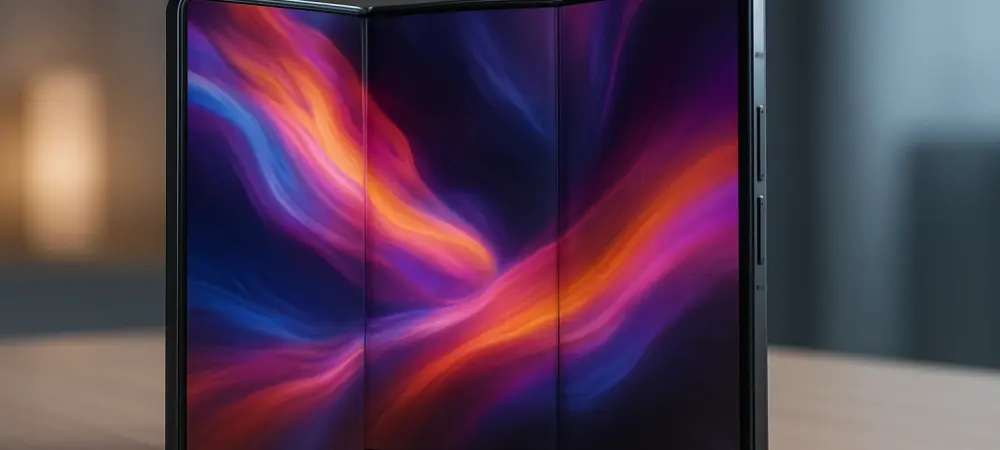
In an era where technological advancements are reshaping everyday devices, foldable phones have emerged as a front-runner in mobile innovation. This trend is further exemplified by Tecno’s tri-foldable phone concept, the Phantom Ultimate G Fold, which underscores the relentless pursuit of increased durability and usability in flexible display technology. Here, we delve into the core principles behind this technology, including the dual-hinge innovation and its implications for the mobile landscape.
Advancements in Tri-Foldable Design
The tri-foldable phone design is remarkable for its clever engineering, embracing a dual-hinge mechanism designed to optimize display protection and functionality. The design features a minor hinge creating a teardrop shape for the initial fold, paired with a larger self-locking hinge to secure the device, thus delivering enhanced compactness when folded. This dual-hinge execution allows for a reduced folded thickness of 11.49 mm and a fully unfolded thinness of 3.49 mm. This innovation not only promotes device protection but also upgrades usability, allowing smooth transitions between the folded and unfolded states, ensuring a more reliable performance across various contexts.
Another pivotal trait within the tri-foldable phone design is the inward-fold approach coupled with an integrated cover display. Unlike its predecessor model, the Phantom Ultimate 2, which left a portion of its display unshielded, the G Fold’s inward-fold and cover display provides enhanced durability by concealing the main 9.94-inch screen when not in use. This aspect ensures superior protection and usability by reducing potential damage risks and offering a pragmatic cover display for quick tasks. As a result, this design iteration marks a substantial step toward combining lightweight form factors with robust display safeguarding.
Innovations and Sector Implications
Recent years have seen a surge in foldable phone technology, driven by consumer demand for stylish yet functional devices. Innovations such as Tecno’s focus on durable and usable designs illustrate the industry’s commitment to transforming foldable phones from niche gadgets into mainstream devices. The tri-foldable concept not only appeals to tech enthusiasts but also signifies a shift in how consumers and industries perceive portable technology. The inclusion of high-strength materials like ultra-high-strength steel and Titan Fiber suggests a trend toward crafting long-lasting devices without sacrificing design aesthetics.
Furthermore, the potential applications of tri-foldable phones extend to numerous sectors, including business, entertainment, and beyond. Imagine professional environments where presentations and data visualization can be effortlessly managed on foldable displays. Additionally, creative industries can leverage the unique formatting capabilities of these phones for content creation and consumption. As the technology permeates various spheres, its impact on productivity, efficiency, and versatility becomes increasingly pronounced.
Navigating Challenges and Future Prospects
Despite these advances, the path to widespread adoption of tri-foldable phones encounters distinct challenges. Technical hurdles, such as optimizing durability without compromising weight, remain key obstacles. Additionally, market acceptance hinges on practical considerations related to pricing and consumer perceptions. The intricacies of regulations also add another layer of complexity, prompting ongoing development efforts to balance innovation with compliance. Looking toward the future, the tri-foldable phone stands poised for potential breakthroughs. Continued research and development could lead to refined hinge mechanics and materials, enhancing both longevity and performance. This evolution may redefine mobile technology standards, potentially establishing tri-foldable devices as industry benchmarks. As manufacturers explore these opportunities, the longer-term impact on consumer technology is likely to unfold, promising novel experiences for users worldwide.
Final Assessment
The review of the tri-foldable phone technology reveals a significant leap forward in foldable phone design elements. Tecno’s Phantom Ultimate G Fold embodies an evolving journey of integrating cutting-edge features with practical usability. While marked by notable innovations, the concept also illuminates areas requiring further exploration, including complete specifications and potential market strategies. This momentum represents a broader narrative of the mobile technology industry’s ongoing efforts to craft novel yet practical solutions. As these endeavors progress, they herald a transformative era in which tri-foldable phones could influence diverse facets of technology and society.