

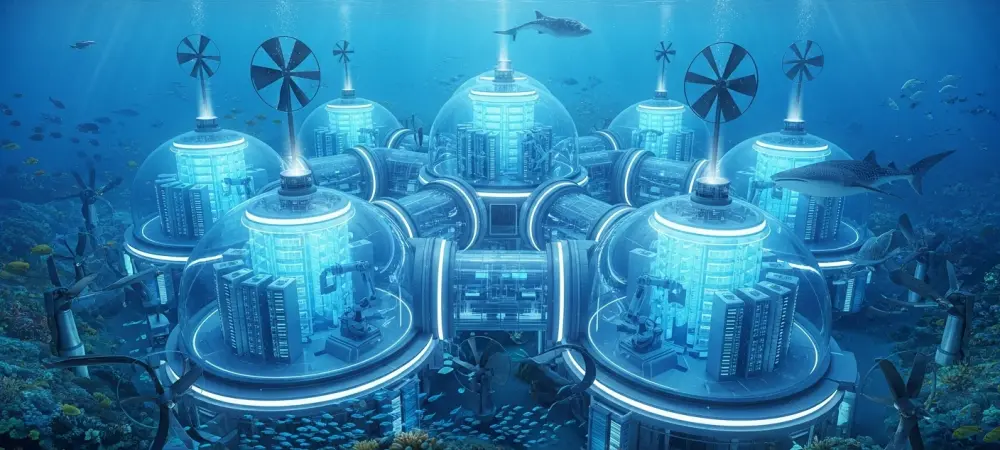
The relentless expansion of artificial intelligence has pushed the limits of terrestrial engineering, forcing a radical migration from congested urban landscapes to the silent, pressurized depths of the world’s oceans. As the global digital economy accelerates, the traditional model of housing servers in land-based warehouses is meeting insurmountable resistance from local power grids and environmental regulations. Terrestrial facilities currently struggle with a triple threat: dwindling land availability, strained electricity networks, and the brutal cooling requirements of modern high-density GPU clusters. To circumvent these bottlenecks, a new wave of marine infrastructure is emerging, effectively redefining the physical layer of the internet by utilizing the deep sea as a massive, natural heat sink. This transition represents more than a technical curiosity; it is a fundamental shift toward a more sustainable and scalable foundation for the global AI ecosystem.
Market Momentum and the Shift Toward Marine Infrastructure
Adoption Statistics and the Global Power Bottleneck
The exponential growth of Large Language Models and high-frequency data processing has led the International Energy Agency to project that global data center electricity consumption will more than double by the turn of the decade. Traditional land-based facilities are increasingly viewed as resource liabilities, often allocating as much as 40 percent of their energy budgets solely to mechanical cooling systems and water-intensive chillers. In contrast, subsea data centers operate with a Power Usage Effectiveness of less than 1.15, marking a significant leap over the current industry average of 1.5. This efficiency gain stems directly from the passive cooling properties of deep seawater, which allows for denser server configurations without the need for traditional energy-hungry climate control.
Beyond the immediate energy savings, the reliance on marine locations alleviates the mounting pressure on freshwater supplies and urban real estate. These submerged modules require nearly 90 percent less land than their terrestrial counterparts and utilize almost zero freshwater for heat dissipation, making them an attractive alternative for coastal regions facing resource scarcity. As the demand for AI processing continues to climb, the ability to deploy infrastructure in the ocean provides a release valve for cities that can no longer support the massive footprints of modern hyperscale data centers. This strategic relocation ensures that digital growth does not come at the expense of local utility stability or community resources.
Commercial Milestones: From Proof-of-Concept to Operational Reality
While early initiatives demonstrated the theoretical physics of underwater computing, the industry has recently crossed the threshold into a fully operational commercial phase. A landmark project in the Lingang Special Area off the coast of Shanghai serves as the premier case study, featuring a 1,433-ton sealed data cabin submerged at depths of up to 35 meters. This massive structure houses approximately 2,000 high-performance servers and specialized GPU clusters provided by major telecommunications firms like China Telecom. Unlike the experimental modules of the previous decade, this project functions as a live utility, proving that submerged vaults can reliably handle the rigors of real-world enterprise workloads.
The facility is directly tethered to a 200-megawatt offshore wind farm, establishing a symbiotic ecosystem where energy is consumed at the point of generation. This direct connection via photoelectric composite cables minimizes the transmission losses typically associated with long-distance electrical transport. By bypasssing the terrestrial grid, the project achieves an annual savings of approximately 61 million kilowatt-hours. The successful deployment of this 24-megawatt installation, completed through a rapid development cycle ending in mid-May, signals that the engineering hurdles of high-pressure housing and modular retrieval are now manageable at a commercial scale.
Expert Perspectives on Technical and Environmental Viability
Industry leaders and marine engineers suggest that the “blue” digital infrastructure model is the most logical answer to the physical limitations of the AI era. By placing data centers in the cold environment between offshore wind turbines, developers provide a stable, low-temperature setting that has been shown to reduce server failure rates compared to land-based facilities. Experts highlight that the absence of oxygen and the consistent thermal profile within the sealed capsules contribute to a longer hardware lifespan. However, professionals also point to the high bar for entry, noting that success requires sophisticated retrieval systems and specialized materials to withstand the relentless pressure of the seabed.
The collaboration between state-affiliated entities and private tech firms is seen as the necessary blueprint for managing the significant upfront investments required for these submerged vaults. Current large-scale installations require capital expenditures estimated at over $225 million, a cost that covers the development of heavy-duty sealed cabins and complex undersea cabling. While these costs are substantial, proponents argue that the reduction in long-term operational expenses—specifically in cooling and land leases—creates a more favorable total cost of ownership. The consensus among technical observers is that the subsea model is no longer a niche experiment but a viable standard for high-intensity computing.
Future Trajectory: Scaling Challenges and Strategic Evolution
The future of subsea AI data centers lies in the ability to scale from localized modules to massive, gigawatt-scale hubs that can support the next generation of digital infrastructure. Developers are already signaling plans for 500-megawatt expansions, which would fundamentally reshape the digital landscape for coastal nations seeking to increase their processing power without expanding their terrestrial footprint. As these projects move toward massive scale, the industry must innovate in the field of material science to combat the persistent threat of saltwater corrosion. Ensuring the integrity of submerged cabins and composite cables over a 20-year lifespan remains a primary focus for long-term technical viability.
Logistical complexity also presents a hurdle that the industry must evolve to meet through automation and specialized maritime robotics. Performing maintenance on the seabed is inherently more difficult than in a traditional facility, requiring modular designs that can be easily retrieved or serviced by remotely operated vehicles. Additionally, as the number of submerged cabins increases, the industry will need to coordinate closely with marine conservationists to ensure that heat dissipation and electromagnetic fields do not disrupt local ecosystems. If these engineering and ecological challenges are managed through transparent regulation and innovation, the subsea model will likely evolve into the global standard for carbon-neutral, high-intensity computing.
Conclusion: Navigating the New Frontier of High-Performance Computing
The commercialization of subsea AI data centers established a new paradigm for industrial infrastructure, proving that the ocean floor served as a viable remedy for the global power and cooling crises. By merging offshore renewable energy with passive marine cooling, these initiatives provided a sustainable path forward for the energy-intensive AI industry. The projects demonstrated that the physical constraints of land and grid stability were not insurmountable obstacles, but rather catalysts for marine engineering innovation. As land-based resources became increasingly scarce, the transition to submerged vaults secured the growth of the digital economy without compromising environmental standards. This architectural shift ultimately redefined the relationship between technology and nature, ensuring that the world’s most critical data was processed in the most efficient environment possible.