

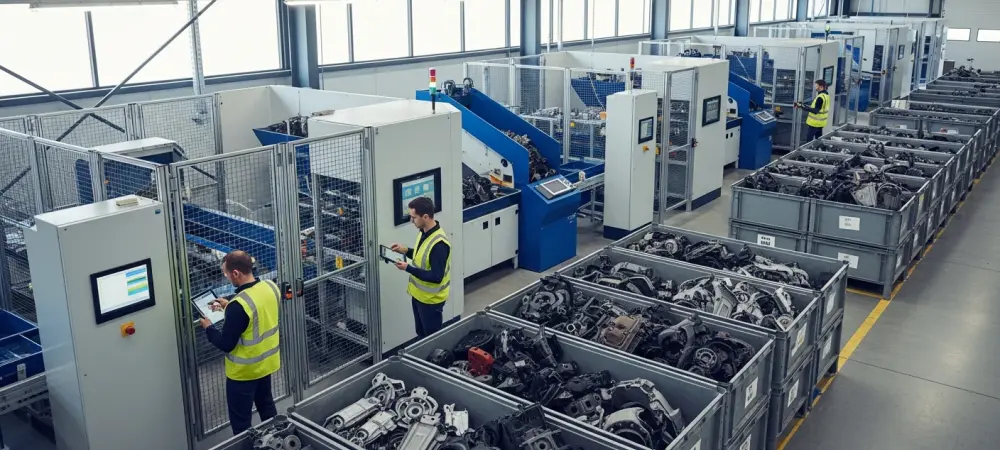
The initial fascination with generative artificial intelligence as a conversational partner has rapidly dissolved, replaced by a much grittier focus on the gears and grease of the real economy. This transition marks the end of an era defined by speculative digital novelties and the beginning of a period where AI functions as a silent, essential utility. In the current landscape, the most profound transformations are occurring far from the sleek glass offices of Silicon Valley, taking root instead in the bustling warehouses, salvage yards, and logistics hubs that form the backbone of global commerce. The focus has pivoted toward resolving systemic friction—the tiny, aggregate inefficiencies that historically hampered physical industries.
By moving beyond the abstract, AI is now being harnessed to address the “messy work” that defines the physical world. This includes the intricate management of supply chains, the optimization of resource recovery, and the precision required for high-volume industrial recycling. The significance of this shift lies in the realization that AI is not a separate entity but a vital component of the industrial nervous system. It acts as a corrective measure for human error and a catalyst for operational consistency, ensuring that the movement of goods and the processing of raw materials occur with a level of accuracy that was previously unattainable.
This analysis explores the nuances of industrial coordination, drawing on expert perspectives to highlight how the elimination of hidden operational costs is the true benchmark of technological maturity. By examining the move toward grounded, utilitarian applications, it becomes clear that the value of AI is measured by its ability to streamline complex workflows. The focus remains on how these systems unify isolated tools into a cohesive infrastructure, allowing traditional sectors to thrive in an increasingly data-driven global market where speed and reliability are the primary currencies.
Current Market Dynamics and the Shift Toward Practical Adoption
Statistical Evolution and the Rise of Utilitarian AI
The industry has moved decisively away from “AI theater,” a term once used to describe the superficial adoption of technology for branding purposes, toward a grounded reliance on utilitarian systems. Data from 2026 shows a significant surge in AI adoption within traditional sectors like waste management and automotive recycling. These industries are no longer looking for flashy features; instead, they prioritize operational consistency and the reduction of financial impact stemming from repetitive decision-making errors. Recent studies indicate that companies implementing AI-supported workflow design have seen a notable decrease in overhead by automating the classification and routing of materials that were previously handled through manual guesswork.
The statistical evolution highlights a trend where the financial viability of a project is tied directly to its ability to minimize small-scale errors. In sectors like logistics, where margins are notoriously thin, the integration of AI has transitioned from an experimental luxury to a survival necessity. Organizations are focusing on the “boring” but high-impact areas of the business, such as predictive maintenance of sorting equipment and the real-time valuation of scrap materials. This shift is reflected in the increased investment toward software that functions as an invisible layer of intelligence, guiding laborers through complex tasks without requiring them to become data scientists themselves.
Real-World Applications in High-Volume Industrial Environments
Physical salvage operations have become a primary testing ground for the integration of AI with global eCommerce platforms. For instance, the coordination required to manage tens of thousands of active listings on sites like eBay necessitates a level of precision that human oversight alone cannot provide. In the automotive recycling sector, systems architects are designing frameworks that manage lifecycle variables with incredible granularity. This involves tracking metal recovery rates, electronics salvage potential, and real-time market demand simultaneously to ensure that every vehicle processed yields the maximum possible value.
Notable companies and systems architects are currently working to unify what were once isolated software tools into a single, cohesive “connective tissue.” Rather than having separate programs for inventory, shipping, and sales, new AI-driven platforms provide a unified environment where a single data entry point informs the entire lifecycle of a product. Such systems reduce the distance between raw industrial resources and the end consumer, creating a more responsive and resilient market structure.
Expert Perspectives on Systemic Friction and Knowledge Capture
Industry leaders like Vladimir Sainciuc have long cautioned against the “Knowledge Trap,” a phenomenon where vital operational wisdom remains locked inside the minds of a few veteran employees. This reliance on human memory creates a fragile business environment; when an experienced worker leaves or the workload increases, the lack of a codified system leads to immediate value loss. By capturing the decision-making logic of the best workers and embedding it into an operating framework, a business can achieve a level of scalability that was once impossible.
The consensus among technological strategists is that growth is frequently hampered by unexamined, small-scale decision bottlenecks. These “hidden costs” accumulate over thousands of daily interactions, such as mispricing a rare component or inefficiently routing a delivery truck. Sainciuc and his peers emphasize that adding more labor to a broken or under-systemized structure is an exercise in diminishing returns. Instead of hiring more people to manage the chaos, the more effective strategy involves implementing AI-supported decision frameworks that provide clarity and direction at every stage of the industrial process.
By focusing on coordination rather than mere labor replacement, these experts are redefining the relationship between humans and machines in the warehouse. The goal is not to eliminate the worker but to eliminate the friction that makes the worker’s job difficult. When the system handles the cognitive load of inventory classification and market analysis, the human operator is free to focus on the physical execution of the task. This synergy creates a more resilient operating system where the business is no longer vulnerable to the inconsistencies of individual human performance or the volatility of the labor market.
The Future of Industrial AI: Coordination and Horizontal Integration
Looking ahead, the movement toward total horizontal integration across the industrial supply chain appears inevitable. The development of “single environment” platforms is expected to collapse the traditional barriers between different stages of production and distribution. By creating a seamless flow of information from the moment a resource is identified to the moment it reaches the end user, industries can eliminate the redundancies that currently plague global logistics. This integration will likely result in a more sustainable model of material recovery, where predictive analytics ensure that no part of a salvaged asset goes to waste. The broader implications for global sustainability are profound, as the ability to precisely track and recover materials reduces the need for virgin resource extraction. However, the transition for legacy industries is not without its risks. The challenge of turning decades-old, data-poor operations into data-driven entities requires a fundamental shift in corporate culture. Companies that remain under-systemized risk being left behind by competitors who can move faster and with greater accuracy. The future landscape will likely be dominated by those who view their physical assets through the lens of a unified, digital operating system.
As the industrial sector continues to evolve, the focus will remain on the resilience of these systems. The goal is to create a supply chain that can automatically adjust to disruptions, whether they are caused by shifting market demands or logistical bottlenecks. By turning individual efforts into a unified and scalable framework, the real economy can move past the limitations of manual friction. The integration of AI into the physical world is ultimately about building a more efficient and predictable future for global trade, where the complexity of the “messy work” is managed by the precision of intelligent systems.
Redefining AI Success Through Operational Utility
The transition of artificial intelligence from a digital buzzword to a fundamental utility for the warehouse and the recycling yard marked a significant turning point in industrial history. Organizations realized that the true power of the technology was found in its ability to streamline the physical complexities of the real economy rather than in its capacity for abstract conversation. By focusing on the removal of systemic friction and the capture of trapped knowledge, businesses transformed their operations from fragile, human-dependent structures into resilient, scalable systems. This shift allowed for a more precise management of resources and a drastic reduction in the hidden costs that had previously hindered growth.
The successful implementation of these frameworks provided a blueprint for future industrial development, emphasizing the necessity of turning individual labor into unified operating systems. Companies that embraced this utilitarian approach found themselves better equipped to handle the volatility of the global market. The maturity of AI was ultimately measured by its quiet presence in the background of successful operations, where it ensured that every decision was informed by data and every resource was utilized to its full potential. This progress underscored the importance of moving beyond technological novelty to address the practical, physical needs of a modern economy.