

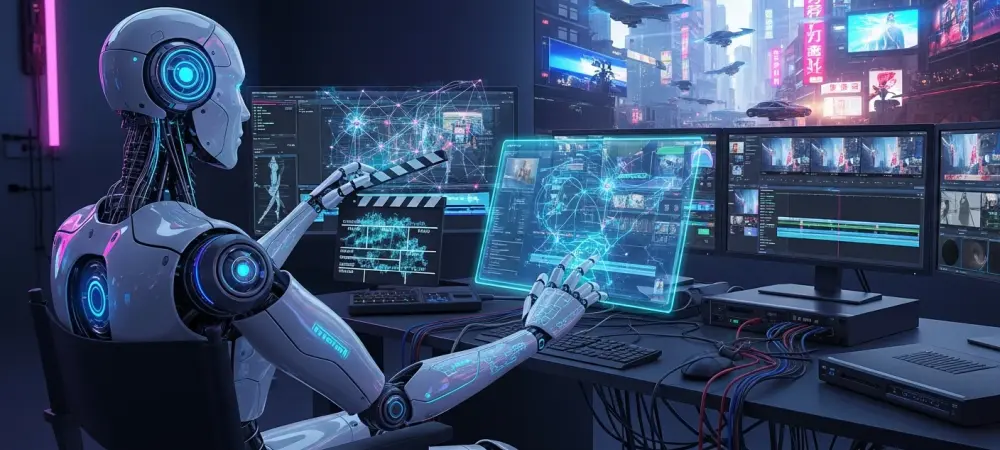
The cinematic landscape has witnessed a monumental shift where the once-blurred lines between synthetic generation and captured reality have completely vanished into a seamless stream of digital artistry. The journey from the flickering, surreal, and often nightmarish clips seen in the earliest stages of generative video to the high-fidelity cinematic outputs currently dominating the market is nothing short of extraordinary. Generative video has rapidly matured from a mere technical curiosity or social media novelty into a professional powerhouse capable of anchoring high-budget commercial campaigns. This analysis explores how the transition of AI-driven motion from a niche experiment to a legitimate asset in professional workflows is fundamentally dismantling traditional production barriers.
By examining the current growth benchmarks, the rise of sophisticated multimodal models like Seedance 2.5, and the broader shifts in the creative economy, it becomes clear that we have entered an age where visual storytelling is limited only by imagination rather than budget or hardware. As cloud-based enterprise platforms integrate these generative tools into professional marketing stacks, the industry is seeing a total reimagining of what it means to “shoot” a scene. Corporate adoption is accelerating, not just as a cost-cutting measure, but as a strategic tool for rapid iteration and creative exploration.
The Rapid Evolution and Adoption of Generative Motion
Market Expansion and Technical Benchmarks
The industry is currently shifting from low-resolution proxies to native 4K rendering and 10-bit color depth, meeting the rigorous standards of global broadcast and high-end cinema. This technical leap is significant because it allows professional colorists to manipulate footage without the degradation or “banding” typically associated with compressed generative files. Furthermore, the support for 10-bit color provides a broader gamut for creative expression, ensuring that digital shadows and highlights retain the nuance required for theatrical releases. These benchmarks are no longer theoretical; they represent the new baseline for any platform seeking to compete in the enterprise space.
Data reveals a significant increase in prompt adherence and temporal consistency, which has solved the “jitter” problem that plagued earlier generative attempts. The ability to generate 30-second continuous clips that match standard commercial lengths is perhaps the most vital development for the advertising sector. Rather than stitching together dozens of five-second snippets, creators can now maintain a cohesive narrative flow and consistent character features across an entire advertisement. This stability has encouraged major brands to shift a portion of their production budgets toward synthetic media, finding that the efficiency gains allow for more diverse and localized content strategies.
Real-World Application: Seedance 2.5 and Professional Workflows
ByteDance’s latest iteration, Seedance 2.5, demonstrates how multimodal inputs—using images, audio, and 3D models—provide creators with granular control over digital scenes. The system is no longer reliant solely on vague text descriptions; instead, it allows for up to 50 reference inputs to define the specific look and feel of a production. For example, a filmmaker can upload a 3D “white-box” model to dictate the exact blocking and camera path, ensuring that the AI generates motion that aligns with a pre-planned cinematic vision. This move toward structural control marks the end of the “lottery” era of generative art.
Moreover, native audio synchronization is being utilized to eliminate manual post-production tasks by aligning sound and visual physics automatically within the latent space. When a digital character speaks or an object hits the ground, the model understands the physical relationship between the visual action and the resulting sound wave. This eliminates the need for frame-by-frame foley editing, drastically reducing the time required to move from a concept to a final, exportable asset. This synchronization is particularly impactful for social media creators who require high-volume output without sacrificing the professional polish of synchronized sound.
Expert Perspectives on the Industrial Shift
Industry veterans highlight the move away from “prompt engineering” toward structured creative control, where AI functions as a sophisticated digital puppet master rather than a random generator. The emphasis is no longer on finding the “magic words” to trick an AI into producing a decent image, but on using these tools to execute complex artistic visions. Experts suggest that the most successful creators are those who treat the AI as a junior director or a highly skilled VFX house that requires precise guidance. This shift has elevated the role of the creative director, who must now curate and refine AI outputs with a sharp eye for narrative logic.
Thought leaders emphasize that the reduction in “re-rolls” and failed attempts is directly translating to lower overhead costs for boutique agencies and independent studios. In the past, a significant portion of the budget was lost to the trial-and-error nature of generative tools, but the current reliability of models like Seedance 2.5 has stabilized these costs. Professionals note that while AI handles the technical execution of light, shadow, and motion, the premium on human creative direction and narrative strategy has never been higher. The value is no longer in the ability to operate a camera, but in the ability to conceive a story that resonates emotionally with an audience.
The Future Landscape of AI-Enhanced Storytelling
The trajectory suggests a future where “one-person production houses” can compete with large-scale studios by utilizing AI for complex visual effects and previsualization. This democratization of high-end media means that a single storyteller with a laptop can produce visuals that previously required a crew of fifty and a multi-million-dollar budget. However, this shift also brings a set of challenges, primarily the potential saturation of digital content. As the cost of production plummets, the volume of media will likely skyrocket, making it harder for individual projects to stand out in an increasingly crowded marketplace.
Furthermore, the ethical necessity of distinguishing between synthetic and captured footage remains a primary concern for the industry. As the “uncanny valley” closes and digital humans become indistinguishable from real actors, the industry must adopt transparent labeling and digital watermarking to maintain trust with the audience. The broader implication is a complete transformation of the creative economy. High-end advertising and storytelling are becoming accessible to everyone, forcing traditional studios to innovate beyond purely visual spectacles and focus on the depth of their writing and the uniqueness of their intellectual property.
Conclusion: Navigating the New Era of Digital Media
Professional AI video production matured into a reliable commercial tool, defined by high-definition output, native audio, and sophisticated control mechanisms. The transition from a technical curiosity to a strategic asset was finalized as brands realized the immense potential for personalized and rapid content creation. Producers shifted their focus from the novelty of the technology to the strategic implementation of these tools within larger marketing and film ecosystems. This evolution effectively removed the traditional barriers to entry, allowing a new generation of creators to flourish in a landscape that valued vision over capital.
As the industry moved forward, the most successful organizations were those that treated generative video as a collaborative partner rather than a replacement for human talent. They adopted hybrid workflows that combined the speed of AI with the emotional intelligence of human directors, resulting in a new form of digital storytelling. The closure of the uncanny valley provided the final proof that synthetic media was no longer a separate category of content but a fundamental pillar of modern filmmaking. Moving toward an automated visual future, the emphasis remained firmly on the power of the narrative and the clarity of the creative message.