

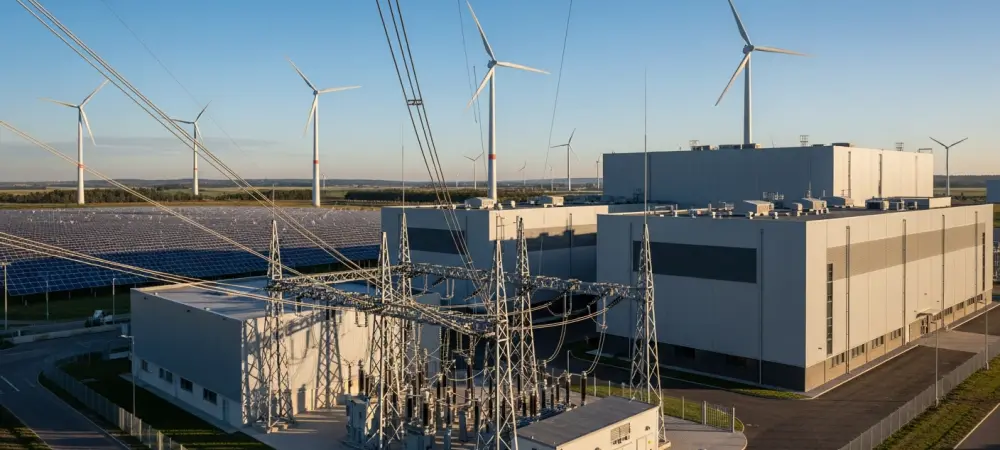
The global collision of artificial intelligence ambitions and aging physical infrastructure has created a high-stakes environment where data center viability is no longer defined by raw computing power but by direct electrical access. Across the United Kingdom and much of the developed world, the surge in hyperscale demand has significantly outpaced national grid capacities, transforming energy procurement from a utility concern into the primary strategic hurdle for the digital economy. As technology firms race to deploy the latest generative models, they find themselves constrained by a physical reality that cannot keep pace with virtual expansion. This analysis examines the industry-wide move toward private energy infrastructure, the statistical reality of current grid bottlenecks, and how “behind-the-meter” solutions are fundamentally redefining the approach to power.
Statistical Growth and the Emergence of Private Energy Models
Quantifying the Infrastructure Bottleneck and Demand Surge
The United Kingdom currently manages more than 500 active data centers, yet the momentum of the sector is increasingly stifled by a massive backlog in utility connection. Approximately 125GW of new projects are currently stalled in connection queues due to severe grid saturation, representing a significant portion of the nation’s planned digital infrastructure. Projections from energy analysts indicate that power consumption for the data center sector will increase six-fold by 2035, while the “Great Grid Upgrade” timeline continues to lag behind the immediate, high-velocity needs of the technology industry.
This scarcity of accessible power has forced a radical shift in how the government and grid operators manage applicants. The move from a legacy “first come, first connected” model to a more rigorous “first ready” framework highlights the growing realization that energy is a finite resource. Developers must now provide concrete proof of financial and planning readiness to even secure a spot in the queue. This change effectively penalizes speculative projects while prioritizing those with the immediate capability to build, yet even the most ready developers face wait times that can span a decade or more.
Real-World Application of Behind-the-Meter Solutions
To bypass these decade-long wait times, major operators are increasingly adopting “behind-the-meter” (BTM) deals as a standard operating procedure. These arrangements connect data center facilities directly to local solar farms, wind parks, or gas turbine sites rather than waiting for a connection to the national transmission network. This allows projects to proceed on their own timelines, entirely independent of the broader utility infrastructure’s constraints. What was once considered an experimental or secondary power source has now become the preferred method for ensuring that a billion-dollar facility does not sit idle upon completion.
Furthermore, companies are moving away from treating power as a utility to be “plugged in” at the end of a construction cycle. Instead, they are forming deep energy partnerships during the very initial phases of land acquisition. By securing a private power source before even breaking ground, developers mitigate the risk of becoming another statistic in the national connection queue. These off-grid arrangements are becoming the baseline expectation for new hyperscale developments, creating a new class of digital infrastructure that functions as a self-contained island of power and data.
Industry Perspectives on Navigating Grid Stagnation
Industry leaders emphasize that the legacy regulatory framework, where data centers are treated merely as “demand-only” consumers, has created a period of artificial stagnation. This environment is likely to persist until at least 2027 as regulators struggle to update policies to match modern technology needs. The mismatch between the speed of digital innovation and the slow pace of utility regulation has left a gap that only private infrastructure can fill. Experts suggest that until the grid is treated as a dynamic, two-way marketplace for both consumption and storage, private generation will remain the only viable path for growth.
Beyond the benefit of speed, there is a significant financial incentive driving the push for private infrastructure. Approximately 40% of standard electricity costs in many regions are tied to grid-balancing levies and transmission fees. By establishing direct, private-wire connections, operators can avoid these substantial surcharges, leading to a much lower total cost of ownership over the life of the facility. This cost-avoidance strategy not only speeds up the deployment of AI infrastructure but also makes the operational budget of these massive centers more predictable in an era of volatile energy prices.
However, thought leaders also stress the absolute importance of “legal due diligence” when entering these private energy agreements. Operators must carefully account for government-backed contracts that might force private generators to prioritize the national grid during peak shortages. This means that a data center’s private power source might be legally mandated to stop supplying the center to prevent a citywide blackout. Navigating these contractual complexities requires a sophisticated legal approach to ensure that “private” truly remains private during times of systemic stress.
The Future of Decoupled Power and Infrastructure Resilience
The industry is rapidly transitioning toward a “hybrid power architecture” that fundamentally changes the role of the public utility. In this model, private generation serves as the primary baseload for the data center, while the national grid is relegated to a secondary or emergency backup role. This reversal of traditional power roles ensures that the facility maintains maximum uptime while minimizing its impact on local residential and commercial energy users. It also allows the operator to have greater control over their carbon footprint by selecting specific, green energy partners for their primary supply.
Future developments will likely integrate large-scale on-site battery storage and secondary generation systems to manage the natural intermittency of renewable sources. To ensure 100% uptime, operators are building massive energy storage complexes that can bridge the gap during periods of low wind or sun. While the shift to private energy offers clear advantages in terms of speed and cost, it also places the massive burden of energy management directly on the operator. This creates a growing divide between elite firms capable of managing complex energy portfolios and smaller players who remain tethered to the traditional, and increasingly congested, public grid.
The long-term implications suggest a decoupled digital economy where tech hubs are no longer built in traditional urban centers or near legacy industrial parks. Instead, we are seeing a shift where digital infrastructure is built around private energy clusters, such as remote solar arrays or nuclear small modular reactors. This fundamentally alters regional development patterns, as the search for power dictates the geography of the internet. The result is a landscape of technology islands that are resilient, self-sufficient, and largely immune to the failings of national infrastructure.
Conclusion: Securing Autonomy in an Energy-Constrained Era
The shift toward private data center energy represented a fundamental pivot from public utility reliance to a model of integrated, self-sufficient infrastructure. Operators recognized that the only way to sustain the momentum of the AI revolution was to decouple their progress from the slow-moving gears of national grid upgrades. By aggressively pursuing “behind-the-meter” strategies, these developers successfully circumvented the regulatory delays that threatened to stall the global digital economy. This transition transformed the industry’s role, as data center managers evolved into sophisticated energy portfolio administrators who balanced production, storage, and consumption in real-time.
Securing this energy independence became the most critical competitive advantage for data center developers. It allowed them to offer guaranteed uptime and price stability in a market characterized by scarcity and volatility. As the digital landscape continued to evolve, the ability to command private power emerged as the primary differentiator between those who could scale and those who remained trapped in connection queues. Ultimately, the lessons learned during this period of grid stagnation paved the way for a more resilient and autonomous technological future, where power was no longer a external constraint but a core component of the architectural design.