

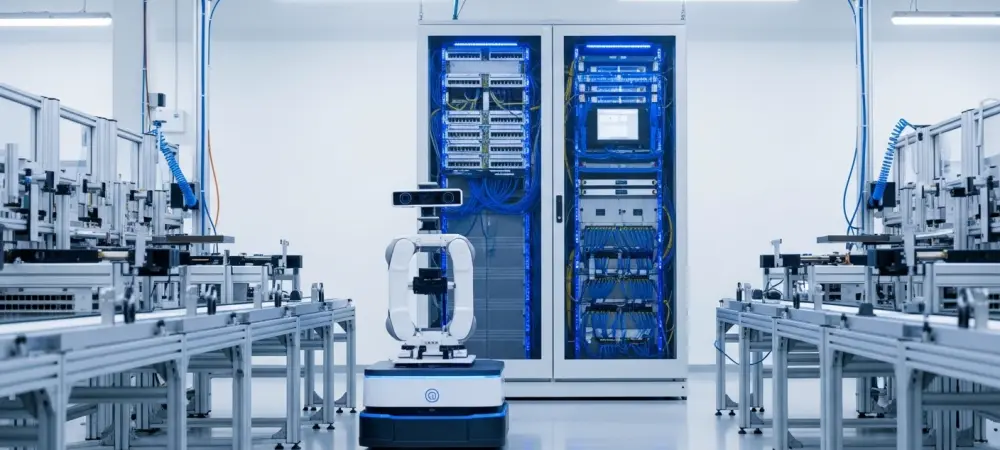
The quiet hum of a fully autonomous factory floor relies less on the visible machinery and more on the invisible streams of data moving at lightning speed between sensors and controllers. While early wireless technologies often struggled with the harsh interference of heavy metal environments, Private 5G has finally moved beyond the initial cycle of inflated expectations to become the essential nervous system for Industry 4.0. In this sophisticated landscape, reliable, low-latency communication is no longer just a technical luxury; it serves as a non-negotiable prerequisite for high-stakes autonomous operations and real-time edge processing.
This shift marks a fundamental change in how industrial leaders perceive connectivity. Instead of chasing technical speculation, the market is now characterized by a pragmatic focus on integrating 5G with existing Operational Technology (OT) infrastructures. Companies like Siemens have pioneered this transition by prioritizing specific use-case results over raw technical specs, ensuring that the technology serves the factory’s needs rather than the other way around.
Shifting from Technological Hype to Pragmatic Adoption
Market Growth: The Move Toward Utility
The industrial 5G landscape has transitioned from a period of experimental pilot programs into a stabilized, growth-oriented phase defined by concrete industrial demand. Enterprises are increasingly moving away from the “one-size-fits-all” model traditionally offered by major telecommunications carriers, which often lacked the nuance required for factory settings. Instead, the focus has shifted toward specialized industrial networking that prioritizes consistent reliability over theoretical peak speeds. Current data suggests that decision-makers are primarily interested in how 5G facilitates seamless OT integration rather than its identity as a standalone innovation. This maturation reflects a broader trend where 5G is viewed as a utility, similar to electricity or compressed air, provided it can guarantee the uptime required for mission-critical manufacturing. Consequently, the market is rewarding providers who can speak the language of the factory floor.
Real-World Applications: Industrial Use Cases
Practical implementation is best observed in environments like the Salzgitter steel production facility, where 5G has successfully replaced restrictive physical cabling in high-risk zones. By automating heavy-duty cranes and autonomous guided vehicles through a wireless medium, the facility has achieved a level of flexibility that was previously impossible. This transition allows for dynamic floor layouts that can be reconfigured in hours rather than weeks of rewiring.
Moreover, the millisecond-level accuracy provided by deterministic wireless communication is essential for maintaining safety in these heavy-duty environments. Strategic partnerships between industrial giants and tech leaders like Qualcomm or Palo Alto Networks have further enhanced these deployments by merging 5G connectivity with on-premises generative AI and robust cybersecurity. These collaborations create a fortified environment where data remains local and secure while powering advanced automation.
Expert Perspectives on the Industrial Connectivity Landscape
Industry leaders, including Siemens’ Daniel Mai, emphasize that pragmatism now dominates every conversation regarding 5G deployment. There is a growing expert consensus that 5G must be marketed as a direct solution for pressing labor shortages and operational inefficiencies. For many manufacturers, the goal is not to have the most advanced network, but to ensure that their shrinking workforce can be augmented by reliable robotic assistants that never lose their connection.
This paradigm shift also dictates a change in how these systems are sold and maintained. Rather than relying on traditional mobile carrier business models, the industry is leaning toward established industrial sales channels and Original Equipment Manufacturer (OEM) partners who understand the unique lifecycle of factory equipment. These entities understand the unique lifecycle of factory equipment, which often spans decades, and can provide the specialized technical support that general telecommunications providers frequently overlook.
The Future Outlook for Private 5G and Automation
Technological Orchestration: The Next Frontier
The coming years will likely see a deeper convergence of 5G with edge computing and large language models (LLMs) to create a truly unified digital ecosystem. This orchestration will allow machines to not only communicate their status but to actively participate in complex problem-solving through decentralized AI nodes. Such a transition would turn the factory floor into a self-healing environment where the network automatically reroutes traffic to prioritize the most critical safety or production tasks.
However, significant challenges remain, particularly concerning spectrum allocation and the initial hardware costs associated with specialized industrial routers. The need for technical expertise that bridges the gap between traditional IT and heavy-duty OT remains a bottleneck for many smaller enterprises. Overcoming these barriers will require more standardized hardware and simplified management interfaces that do not require a team of specialized network engineers to operate.
Long-Term Impact: Resilient Supply Chains
As 5G matures, it will act as the primary enabler for “lights-out” manufacturing, where facilities operate with minimal human intervention. This evolution is expected to result in more resilient supply chains that can withstand global disruptions through decentralized, highly automated production hubs. By reducing the reliance on fixed infrastructure, manufacturers can remain agile, shifting production lines in response to real-time market fluctuations or logistical constraints.
The successful integration of Private 5G required a pivot from engineering-led marketing to problem-centric solutions. Industrial players recognized that the value of the technology was found in its role as a supporting component within a broader technological orchestra. Leaders began focusing on incremental, reliable improvements that integrated seamlessly with existing legacy systems, ensuring that digital transformation remained a sustainable and realistic goal for heavy industry moving forward.